
Walk into almost any classroom today and you’ll find teachers caught between two pressures: AI tools that could genuinely help their students learn, and the fear that those same tools will do the learning for them. It’s a real tension. But the teachers getting the best results aren’t banning AI or surrendering to it — they’ve figured out how do teachers use AI in the classroom without cheating concerns, and their approach is smarter than either extreme. It starts with redesigning the work, not policing the tools.
Here’s the reframe that changes everything: cheating happens when the assignment rewards the product over the process. If an essay’s grade depends entirely on the final text, AI is a shortcut. But if the grade reflects drafting, revision, in-class discussion, and reflection on the writing process, AI becomes much harder to misuse — and much more useful as a legitimate learning aid. The teachers winning at this redesigned the assignments, not just the rules.
How Do Teachers Use AI in the Classroom Without Cheating Concerns? Redesign the Assignment
Make the process visible and gradable
The single most effective anti-cheating strategy is also the best teaching strategy: grade the process, not just the product.
- Require drafts with revision history. Google Docs version history shows exactly how a piece of writing evolved. A paper that appears fully formed in one paste is obvious; a paper built over three drafts with teacher comments is real work.
- In-class writing components. Have students write introductions, outlines, or key paragraphs during class — handwritten or on locked-down devices. Then let them expand at home. You now have a verified baseline of their actual ability.
- Oral defenses and discussions. A five-minute conversation — “explain your thesis and your strongest piece of evidence” — instantly reveals whether a student understands their own paper. This is the oldest anti-cheating method in academia, and it still works.
- Reflection components. Ask students to write about how they used AI (if at all), what they changed, and what they learned. This turns AI use into a metacognitive exercise instead of a secret.
Design AI-resistant (and AI-inclusive) assignments
- Connect to personal experience: “Describe a tradition in your family and analyze what it reveals about your community’s values.” AI can’t fake lived experience convincingly.
- Use class-specific sources: Assignments based on in-class discussions, guest speakers, or local events require knowledge AI doesn’t have.
- Require multi-modal work: Presentations, debates, labs, and performances are inherently AI-resistant.
- Flip it — assign AI use explicitly: “Generate an essay with AI, then critique it: find three factual errors, two weak arguments, and rewrite the conclusion.” Students learn critical evaluation, and cheating becomes the assignment.
Legitimate Classroom Uses of AI
When teachers model good AI use openly, students learn it’s a tool, not a trick:
- Differentiated materials: Generate reading passages at multiple levels on the same topic, create extra practice problems, or simplify complex texts for struggling readers — in seconds instead of hours.
- Instant feedback on drafts: Students paste a paragraph and ask for feedback on clarity or argument structure (not rewriting). They revise themselves — the learning stays with them.
- Brainstorming and outlining: AI as a thinking partner for generating ideas before writing begins. The student’s job is selecting, developing, and expressing — the parts that build skill.
- Language support: For English learners, AI can explain idioms, suggest clearer phrasing, or translate instructions — genuine accessibility, not cheating.
- Teacher productivity: Lesson planning, quiz generation, rubric drafting, parent email templates. Our guide to free AI tools includes several teachers swear by.
Setting Clear Policies That Actually Work
Vague “don’t cheat” policies fail because students genuinely don’t know where the line is. Be explicit:
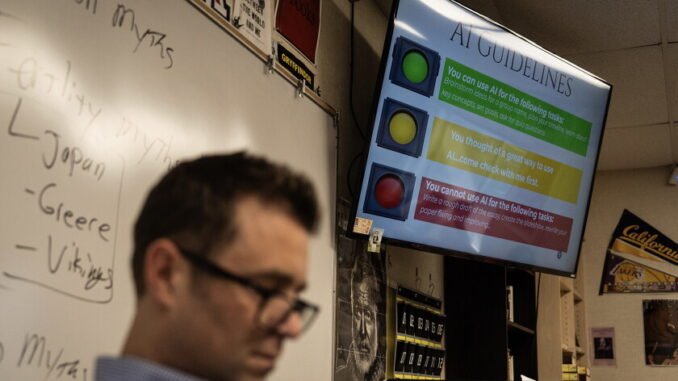
- Publish a clear AI policy per assignment. Use a simple traffic-light system: green = AI encouraged (brainstorming assignments), yellow = AI allowed with disclosure (drafting help), red = No AI (in-class assessments). Students follow clear rules far better than vague ones.
- Require disclosure. A simple statement — “I used [tool] for [purpose]” — normalizes honest use and makes hidden use feel like what it is.
- Teach AI literacy directly. Show students AI making mistakes: factual errors, fake citations, biased responses. Once they’ve seen it confidently wrong, the mystique fades and critical use begins. Our guide on writing better AI prompts works as a classroom lesson too.
- Address it head-on, early. Have the conversation in week one, not after the first cheating incident. Frame it around learning: “I want to see your thinking because that’s what I’m grading.”
The U.S. Department of Education has published guidance on AI in education that many districts now reference when building their own policies — worth knowing as you draft yours.
What About AI Detectors?
Be cautious. AI detection tools have significant false-positive rates — they’ve flagged the US Constitution and student writing alike. Accusing a student based on a detector score alone is unfair and legally risky for schools. Use detectors, if at all, as a starting point for a conversation, never as proof. The process-based methods above are far more reliable.
Building a Classroom Culture Around Honest AI Use
Policies and assignment design handle the mechanics, but culture does the heavy lifting. Talk openly about why honest work matters — not just “it’s cheating” but “you’re here to build a brain that works without AI, because the interesting jobs of your future go to people who can think.” Celebrate process: showcase strong revisions, not just strong final products. When students see drafting and struggle valued publicly, the incentive to shortcut fades. And model it yourself — when you use AI for lesson planning, say so. Transparency from the front of the room teaches more than any policy document.
For parents navigating this at home, our guide on talking to kids about using AI responsibly complements the classroom approach, and the risks of relying too much on AI for homework covers the student side of the equation.
The bottom line: the teachers succeeding with AI didn’t find a better way to catch cheating — they made cheating pointless by grading process over product, designing assignments AI can’t fake, and teaching students to use AI as a thinking tool rather than an answer machine. Ban nothing, redesign everything, and be explicit about the rules. It works.
Leave a Reply