
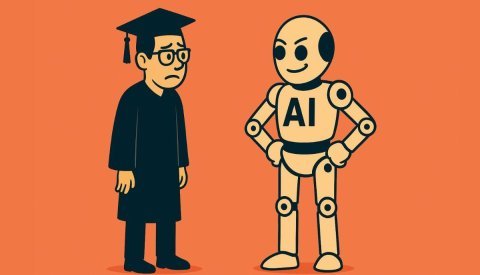
College costs have tripled since the 1980s. Student debt tops $1.7 trillion. And now AI can write essays, solve problem sets, and even pass professional exams. It’s a fair question, and millions of families are asking it: will AI make college degrees less valuable in the future? The honest answer is more nuanced than either the “college is dead” crowd or the “degree forever” defenders admit. AI is changing what makes a degree valuable — not eliminating the value entirely.
Let me frame this correctly. A college degree was never just about the knowledge — if it were, libraries would have killed universities centuries ago. A degree bundles several things: knowledge, a credential signal to employers, a network, social development, and a structured environment for maturing. AI disrupts some of these bundles more than others. Let’s take them apart.
Will AI Make College Degrees Less Valuable in the Future? What’s Under Pressure
The knowledge monopoly is gone
This one’s already happened. When any motivated person can learn calculus, coding, or marketing from AI tutors and free resources, the degree’s value as exclusive knowledge access has collapsed. Employers increasingly know this — which is why skills-based hiring (practical assessments over credential screening) keeps growing, especially in tech. If your degree’s main selling point was “I learned things,” that pitch is weakening.
Routine white-collar work is being automated
Here’s the uncomfortable part: many entry-level jobs that justified degrees — basic analysis, report writing, routine coding, standard legal research — are exactly what AI does well. Our analysis of jobs least likely to be replaced by AI shows the pattern: roles requiring judgment, creativity, and human relationship skills hold value; routine knowledge work doesn’t. Degrees that prepared students for routine knowledge work are losing their ROI logic.
The signaling value is diluting
When AI can help anyone produce A-level coursework (see our piece on the risks of AI homework overuse), employers reasonably wonder what a GPA signals anymore. Grade inflation plus AI assistance means the credential carries less information than it used to. Employers are responding with more skills testing, portfolios, and trial projects.
What Keeps Degrees Valuable
But before you cancel the college fund, the other side is strong:
- The network effect is irreplaceable. Your college network — classmates who become co-founders, professors who open doors, alumni who hire — has nothing to do with AI and everything to do with being physically present with ambitious people for four years. This alone justifies elite schools’ price tags for many families.
- Credential gating persists. Medicine, law, engineering, academia, and many corporate roles still legally or culturally require degrees. AI doesn’t change licensing boards.
- The wage premium endures (for now). College graduates still earn roughly $1 million more over a lifetime than high school graduates on average. That premium may shrink, but it hasn’t vanished.
- Structured maturation matters. Four years of deadlines, collaboration, independence, and intellectual challenge develops capabilities AI can’t shortcut. The 18-year-old who navigates college emerges different from one who didn’t — and employers notice.
- Research universities produce knowledge. The degree is a byproduct; the institution’s real output is research, which AI assists but doesn’t replace.
How the Value Proposition Is Shifting
The degree isn’t dying — it’s being repriced around different attributes:
- From “what you know” to “what you can do”: Programs emphasizing portfolios, internships, co-ops, and real projects are gaining value; lecture-and-exam programs are losing it.
- From prestige to outcomes: Families are increasingly asking about employment rates and starting salaries by major, not just rankings. The ROI calculation is getting ruthless.
- Field matters more than ever: Nursing, engineering, computer science (the applied kind), skilled trades programs — fields with clear skill-to-job pipelines hold value. Generic degrees with no career linkage are where the “is it worth it?” question bites hardest.
- Hybrid paths are normalizing: Certifications + portfolio, community college + transfer, apprenticeships + online credentials — the “degree or nothing” binary is dissolving into a menu of options.
What Students Can Do Right Now (Whatever They Choose)
Whether you’re college-bound, skipping college, or already enrolled, the AI era rewards the same moves: build a portfolio of real work (employers increasingly hire on proof, not promises), develop AI fluency in your field (the premium goes to those who wield the tools, not those who compete with them), cultivate human skills that appreciate as automation spreads (communication, judgment, leadership), and get real experience early through internships, freelancing, or projects. The credential gets you the interview; the proof gets you the job. That was always somewhat true — AI just made it completely true.
Practical Advice for Families Deciding Now
- Run the ROI math. Total cost (including debt interest) vs. realistic starting salary in the intended field. If the debt exceeds one year’s expected starting salary, think very carefully. The Federal Student Aid site has calculators.
- Major matters more than school for most careers. An engineering degree from a state school beats a generic degree from a private college costing 4x more, in purely financial terms.
- Prioritize programs with experiential learning. Co-ops, internships, undergraduate research, portfolio-building — these are the degree components AI can’t commoditize.
- Consider the alternatives seriously. For some paths — skilled trades, certain tech roles, entrepreneurship — apprenticeships, certifications, or direct work experience may beat a degree on ROI. This isn’t anti-college; it’s pro-math.
- Don’t skip college from fear; don’t attend from inertia. Both are bad decision processes. Decide based on the specific program’s outcomes for the specific career path.
For students already in school, our guides on how teachers are handling AI and the ethics of AI in college essays cover the academic integrity landscape you’ll navigate.
The bottom line: AI is eroding the degree’s value as exclusive knowledge and as a reliable signal of routine competence — but the network, the credential gating, the structured development, and the wage premium persist. The degree isn’t becoming worthless; it’s becoming conditional. Its value now depends heavily on the field, the program’s practical components, and the cost. Run the numbers, choose programs that build demonstrable skills, and treat college as an investment to be evaluated — not a default to be assumed.
Leave a Reply