
You ask Siri to set a timer. You ask ChatGPT to write a poem. Both feel like “talking to AI” — but under the hood, they’re fundamentally different technologies built for different jobs. If you’ve ever wondered what is the difference between AI chatbots and virtual assistants, you’re not alone: the industry itself blurs the terms constantly. Understanding the distinction helps you pick the right tool for each task — and explains why Siri sometimes feels dumb next to ChatGPT, and why ChatGPT can’t set your alarm.
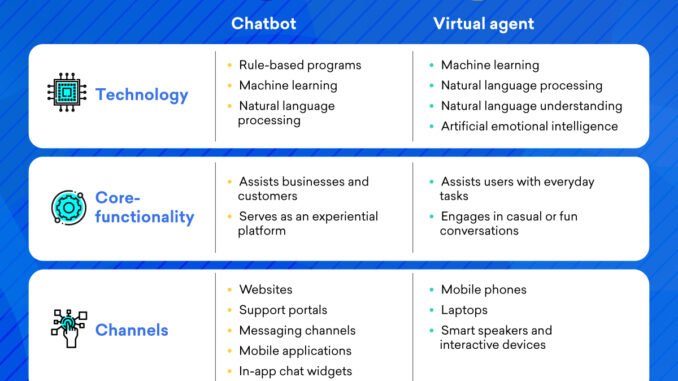
Here’s the one-sentence version: chatbots are built for conversation; virtual assistants are built for action. Chatbots (like ChatGPT) excel at understanding and generating language — explaining, writing, reasoning. Virtual assistants (like Siri, Alexa, Google Assistant) excel at doing things — controlling devices, accessing your apps, completing tasks. Everything else follows from that core difference.
What Is the Difference Between AI Chatbots and Virtual Assistants? The Core Distinction
AI chatbots: masters of conversation
Modern AI chatbots (ChatGPT, Claude, Gemini, Copilot) are built on large language models — systems trained on vast amounts of text to understand and generate human-like language. Their strengths:
- Deep language understanding: They grasp nuance, context, and complex multi-part questions. You can have a genuine back-and-forth.
- Content creation: Writing, summarizing, translating, coding, brainstorming — generating new text is their native ability.
- Reasoning: They can work through problems step by step, explain concepts, and adapt explanations to your level.
- Memory of conversation: They track context across long exchanges, referring back to earlier points.
Their limitations: chatbots generally can’t do things in the real world. ChatGPT can’t set your alarm, order groceries, or turn off your lights (though this is changing as they gain tool integrations). They produce words, not actions. For a deeper look at getting the most from them, see our guide on writing better AI prompts.
Virtual assistants: masters of action
Virtual assistants (Siri, Alexa, Google Assistant, and increasingly their AI-upgraded versions) are built around task completion. Their strengths:
- Device and app control: Setting timers, playing music, controlling smart home devices, sending texts, making calls.
- System integration: They live inside your phone, speaker, or car — with access to your calendar, contacts, apps, and settings.
- Quick commands: Optimized for short, specific requests: “set a timer,” “what’s the weather,” “navigate home.”
- Always available: Wake-word activated, hands-free — designed for moments when you can’t type.
Their limitations: traditional virtual assistants are surprisingly bad at conversation. Ask a follow-up question, phrase something unusually, or request anything creative, and they stumble — because they’re essentially sophisticated command parsers, not language understanders. (This is exactly why Apple, Google, and Amazon are all rebuilding their assistants on chatbot-style language models right now.)
Side-by-Side Comparison
| Feature | AI Chatbots | Virtual Assistants |
|---|---|---|
| Core strength | Conversation & content | Tasks & device control |
| Examples | ChatGPT, Claude, Gemini | Siri, Alexa, Google Assistant |
| Understands complex questions | Excellent | Limited (improving) |
| Controls your devices | Minimal | Excellent |
| Writes & creates content | Excellent | Poor |
| Hands-free use | Growing (voice modes) | Native (wake words) |
| Access to your apps/data | Limited | Deep |
| Typical interaction | Long, thoughtful exchanges | Quick commands |
The Convergence: Why the Line Is Blurring
Here’s where it gets interesting: the two categories are merging. Chatbots are gaining agency — the ability to take actions. ChatGPT can now browse the web, run code, generate images, and connect to apps. Claude can use computers. Meanwhile, virtual assistants are gaining intelligence — Apple Intelligence, Google’s Gemini-powered Assistant, and Alexa’s LLM upgrade are rebuilding the “dumb command parser” on chatbot-style language models.
The likely endpoint: a single AI that both converses brilliantly and acts on your behalf — the helpful entity science fiction promised. We’re maybe 2–3 years from that being genuinely good rather than demo-good. The National Institute of Standards and Technology (NIST) tracks AI capabilities and standards as these systems evolve, if you want an authoritative window into where the technology stands.
Which Should You Use When?
Practical guidance for right now:
- Use a chatbot when: you need writing, explanation, brainstorming, analysis, coding help, learning, or complex questions. If the answer is words, start here.
- Use a virtual assistant when: you need something done — timers, reminders, smart home control, calls, navigation, quick facts while your hands are busy. If the answer is an action, start here.
- Use both together: Ask ChatGPT to plan your trip itinerary, then ask Siri to set reminders for the bookings. Draft the email with Claude, then tell your assistant to send it. They complement each other.
For specific use cases, our guides cover both sides: scheduling apps that work with AI assistants for the action side, and AI email writing for the conversation side.
Privacy Differences Worth Knowing
The two types have different privacy profiles. Virtual assistants are always listening for wake words and deeply integrated with your personal data (location, contacts, routines) — convenient but exposure-rich. Chatbots process what you type, and our AI privacy guide covers what not to share. Neither is inherently “safe” or “dangerous” — but understanding what each one hears helps you make informed choices. Check out protecting privacy with voice assistants for the assistant-specific precautions.
Quick Answers: Chatbots vs. Assistants
Which should I use for a given task?
Simple rule: if the answer is words (writing, explaining, brainstorming), use a chatbot like ChatGPT or Claude. If the answer is an action (set a timer, turn off the lights, send a text), use your virtual assistant. They’re converging, but today each is bad at the other’s job.
Are they merging into one thing?
Yes — chatbots are gaining the ability to take actions, and assistants are being rebuilt on chatbot-style language models. Within a few years the distinction will likely vanish into a single AI that both converses and acts. Until then, use the right tool for the task.
The bottom line: chatbots are for conversation and creation (words in, words out, brilliantly); virtual assistants are for action and control (commands in, things done). The distinction matters today because each is bad at the other’s job — but they’re converging fast, and within a few years the question may be obsolete. Until then, use the right tool for the task: talk to chatbots, command your assistants.
Leave a Reply