
You finish a series at midnight, and Netflix immediately surfaces three more shows that are eerily perfect for you. Spotify’s Discover Weekly feels like it reads your mind. YouTube keeps you watching “just one more video” for an hour. None of this is accidental — it’s some of the most sophisticated AI in consumer tech, working on one problem: predicting what you’ll watch next. If you’ve ever wondered how does AI help streaming services recommend shows to watch, here’s the inside story of the algorithms shaping your evenings — how they work, why they’re so good, and the hidden trade-offs.
The stakes are enormous: Netflix has said publicly that the majority of what people watch comes from recommendations, not search. For streaming services, better recommendations directly equal subscriber retention — and retention is the entire business. So they pour staggering resources into this: Netflix reportedly spends over $100 million a year on its recommendation systems. Here’s what that money builds.
How Does AI Help Streaming Services Recommend Shows to Watch? The Three Core Techniques
1. Collaborative filtering: “people like you watched…”
The foundational technique. The AI finds users whose taste overlaps with yours, then recommends what those similar users loved but you haven’t seen. If 10,000 people who rated the same quirky sci-fi shows as you all binged a new series, the system bets you’ll like it too — without understanding anything about the show’s content. Netflix pioneered this at scale (their famous 2006–2009 Netflix Prize offered $1 million to whoever improved their algorithm by 10%).
The strength: it surfaces gems you’d never find by genre browsing — the obscure documentary your taste-twins loved. The weakness: the cold-start problem — new users and brand-new shows have no data, so the system flounders until viewing history accumulates.
2. Content-based filtering: “more like this”
Here the AI analyzes the content itself: genre, cast, director, mood, pacing, themes, even visual style and dialogue patterns. Netflix famously tags content with thousands of micro-genres (“visually-striking nostalgic dramas”) — partly human curation, increasingly AI-assisted. When you finish a heist comedy, the system finds other titles sharing those attributes.
The strength: works immediately, even for new users — one watched title is enough to generate suggestions. The weakness: it can trap you in a narrow lane. Love one true-crime doc? Here’s forty more, forever.
3. Deep learning hybrids: the modern engine
Today’s systems combine both approaches with deep neural networks that factor in hundreds of signals: what you watched, when (late-night viewing differs from Sunday afternoon), on what device, how long you watched before quitting, what you rewatch, what you rate, even which thumbnail you clicked. Netflix personalizes thumbnails per user — the same show gets different artwork depending on whether you respond to faces, action scenes, or landscapes. Spotify analyzes actual audio (tempo, key, energy) alongside listening patterns. YouTube optimizes for watch time with reinforcement learning — the algorithm experiments constantly, learning which suggestions keep you specifically watching.
Why the Recommendations Feel So Personal (And Sometimes Creepy)
- Micro-segmentation: Netflix doesn’t put you in one bucket (“comedy fan”) — it models you across thousands of taste dimensions simultaneously. You’re not a demographic; you’re a unique vector in taste-space.
- Context awareness: Time of day, device, location, and even weather feed in. The system learns you watch documentaries on Sunday afternoons and reality TV at midnight — and serves accordingly.
- Constant experimentation: These systems A/B test relentlessly. That row layout, that thumbnail, that ordering — all tested against engagement metrics on millions of users. What you see is the winner of ten thousand experiments.
- The feedback loop: Every click trains the model further. The more you use the service, the better it knows you — which is both the value proposition and the lock-in mechanism.
The Downsides Nobody Advertises
- Filter bubbles: Recommendation AI optimizes for engagement, not enrichment. It feeds you more of what you already like, narrowing rather than broadening taste. The documentary lover never discovers the musical; the comedy fan never tries the drama.
- The engagement trap: YouTube’s algorithm became infamous for radicalization pipelines — optimizing purely for watch time surfaced increasingly extreme content. Optimizing for “keeps watching” and “good for you” are different objectives, and the AI only knows the first.
- Popularity bias: Collaborative filtering amplifies hits — popular content gets recommended more, gets more views, gets recommended more. Great niche content starves while blockbusters feast.
- Manipulation surface: Thumbnails, autoplay, and row ordering are persuasion architecture. You’re choosing — but from a menu engineered to steer you.
- Data collection: Every pause, rewind, and abandoned episode is logged and modeled. It’s the price of personalization — worth knowing you’re paying it.
Taking Control of Your Recommendations
- Rate actively. Thumbs up/down (Netflix), likes (Spotify/YouTube) — explicit signals train the model faster than passive watching. Ten minutes of rating transforms your recommendations.
- Use profiles properly. Shared accounts poison the algorithm — your kids’ cartoons train your profile. Separate profiles per person; it’s what they’re for.
- Search deliberately. Don’t just consume the feed — search for genres, moods, and topics outside your history. Every novel search teaches the system your range.
- Prune your history. Most services let you delete viewing history items. That accidental 3am reality show binge? Remove it before it defines you.
- Try the “surprise me” features. Netflix’s “Play Something,” Spotify’s daylist variations — tools designed to break the bubble. Use them.
- Follow humans too. Critics, friends, curated lists — human recommendation remains the best discovery engine for things outside your pattern. The algorithm shows you more of you; people show you beyond you.
What’s Next: The Future of Recommendation AI
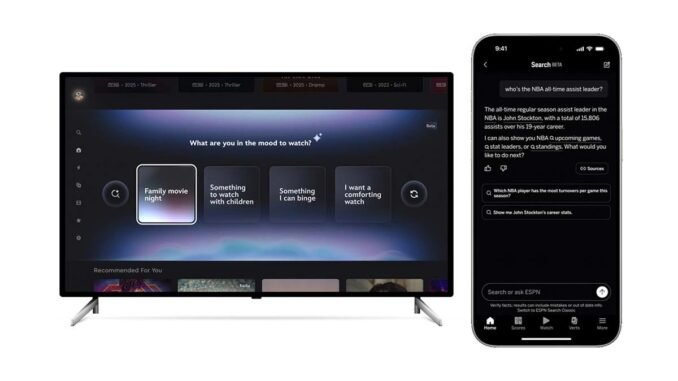
Generative AI is entering the picture: conversational recommendation (“I’m in the mood for something like X but funnier”), AI-generated trailers cut to your taste profile, and cross-service understanding. The direction is clear — from passive rows to active AI concierges that understand natural-language mood requests. The NIST AI program tracks how these personalization systems evolve alongside broader AI capabilities.
For more on getting value from everyday AI, see our guide to using AI for everyday planning — the same personalization principles apply. And if you’re curious about AI’s creative side, our AI art and galleries piece explores another domain where algorithms meet taste.
The bottom line: streaming recommendations run on collaborative filtering (people like you), content analysis (more like this), and deep learning hybrids weighing hundreds of behavioral signals — refined by relentless experimentation into systems that genuinely know your taste. They’re incredibly effective at keeping you watching, which serves the service’s retention goals first and your enrichment second. Rate actively, keep profiles separate, search outside your bubble, and supplement the algorithm with human recommendations. The AI is a powerful servant for finding your next watch — just don’t let it become your only guide to what you might love.
Leave a Reply