
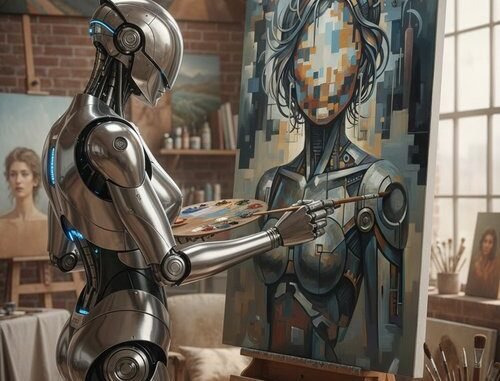
In 2018, a portrait generated by AI sold at Christie’s for $432,500 — forty times its estimate. In 2024, Christie’s held its first auction dedicated entirely to AI art. Meanwhile, traditional painters call it theft, galleries are split, and collectors are quietly buying. So is AI art considered real art by galleries and buyers? The honest answer: increasingly yes — but with asterisks, controversies, and a market still figuring out what it’s actually valuing. Here’s where the art world really stands.
Let’s define the question precisely. “Considered real art” operates on three levels: institutional recognition (museums, galleries, awards), market validation (are buyers paying real money?), and critical/philosophical acceptance (do artists and critics take it seriously?). The answers differ by level — and the gaps between them are where the interesting story lives.
Is AI Art Considered Real Art by Galleries and Buyers? The Institutional Verdict
Galleries: cautiously opening doors
The gallery world’s response has moved from rejection to selective embrace:
- Major auction houses are in. Christie’s, Sotheby’s, and Bonhams have all sold AI-assisted works — Christie’s 2024 “Augmented Intelligence” auction was a landmark, dedicated entirely to AI art. When the institutions that define art-market legitimacy dedicate auctions to it, that’s institutional recognition, full stop.
- Progressive galleries exhibit it. Galleries like bitforms (NYC, focused on new media art since 2001) and Gazelli Art House have shown AI artists for years. The pioneering AI artists — Refik Anadol (massive AI data sculptures at MoMA), Sougwen Chung, Mario Klingemann — exhibit in serious venues worldwide.
- Traditional galleries remain skeptical. Many commercial galleries still won’t touch AI work, citing collector resistance, authenticity questions, and the unresolved training-data ethics. The split roughly follows the contemporary-vs-traditional divide.
- Museums are collecting. MoMA acquired Refik Anadol’s work; the Whitney and others have shown AI art. Museum acquisition is the strongest institutional signal — museums collect for posterity, not trends.
The market: real money, real volatility
- The headline sales are real. The 2018 Christie’s sale ($432,500 for “Portrait of Edmond de Belamy”) proved buyers would pay. Subsequent AI art sales have ranged from thousands to hundreds of thousands.
- NFTs complicated the picture. The 2021–2022 NFT boom (and bust) swept much AI art into speculative mania. Prices crashed with the broader NFT market — but the serious AI art market (physical prints, installations, editions) proved more durable than the speculation.
- What’s actually selling: Works by established AI artists with genuine artistic vision and technical innovation — not random Midjourney outputs. The market, like all art markets, rewards scarcity, reputation, and critical context. An editioned print by a recognized AI artist sells; a prompt-generated image doesn’t, any more than a snapshot competes with fine-art photography.
- Collector demographics skew young and tech-adjacent — crypto wealth, tech entrepreneurs, digital natives. Traditional collectors are slower, but the generational shift favors acceptance.
The Arguments on Each Side
“Yes, it’s real art”
- Art history is full of tool panics. Photography was “not real art” (now in every museum). Digital art, video art, conceptual art — each faced the same dismissal. The pattern is consistent: new tools get rejected, then absorbed.
- Intent and curation are artistic acts. Serious AI artists don’t type one prompt and print the result — they curate thousands of outputs, composite, edit, train custom models, and make deliberate aesthetic decisions. The art is in the vision and selection, not the button-press.
- Photography analogy holds. Nobody says photographers aren’t artists because the camera does the “work.” The AI is an instrument; artistry lies in how it’s played.
- Institutions have voted. Museum acquisitions and dedicated auctions are the art world’s formal acceptance mechanisms, and they’ve been deployed.
“No — or not yet”
- The training-data ethics are unresolved. Models trained on millions of copyrighted images without consent raise genuine questions — several lawsuits are pending. Buying AI art can feel like buying the proceeds of unlicensed appropriation. The U.S. Copyright Office’s AI guidance reflects the legal uncertainty.
- Effort and skill signals are scrambled. Art markets partly value the human struggle and mastery visible in work. When output is instant, traditional signals of artistic commitment break down — collectors don’t know what they’re valuing.
- Flood risk. Infinite generation threatens the scarcity art markets depend on. Editions and blockchain verification help, but the psychological effect of infinite supply weighs on values.
- Soullessness critique. Many critics (and viewers) find AI art technically impressive but emotionally hollow — lacking the human experience that gives art resonance. Whether this is inherent or just early-stage is the open question.
What This Means for Artists and Buyers
If you’re an artist working with AI
- Develop a genuine practice, not a gimmick. The artists succeeding have distinctive visions, consistent bodies of work, and technical depth (custom models, novel techniques). One viral image isn’t a career.
- Be transparent. Disclose AI involvement. The market punishes discovered deception far more than honest AI use.
- Target the right venues. New-media galleries, digital art fairs, and forward-looking institutions — not the traditional gallery that still debates photography.
- Consider the ethics proactively. Train on licensed data (Adobe Firefly’s approach) or your own work; be ready to discuss your data sources. Collectors increasingly ask.
If you’re a buyer
- Buy the artist, not the tool. Same rule as all art: reputation, exhibition history, critical reception, and genuine vision drive long-term value.
- Verify scarcity. Editioned works with clear provenance (contracts, blockchain records) hold value; unlimited prints don’t.
- Understand the copyright limits. Purely AI-generated images likely can’t be copyrighted under current US guidance — which affects what “ownership” means. Factor it into prices.
- Buy what moves you. The philosophical debate will rage for years; the market will sort itself out. Collectors who buy work they genuinely love rarely regret it regardless.
The Likely Future
My read: AI art follows the photography trajectory — roughly 20 years from “not real art” to museum canon. We’re about 8 years in (counting from the 2018 Christie’s sale). Expect: growing institutional acceptance, a shakeout separating serious practitioners from prompt-dabblers, resolution (or at least clarity) on training-data law, and eventual boringness — AI assistance becoming as unremarkable as Photoshop, at which point the “is it real art?” question dissolves because the answer is obviously “it depends on the art.” For the creation side, our free AI image generator guide covers the tools, and detecting AI images covers the verification side.
The bottom line: major auction houses sell it, museums collect it, and buyers pay real money for it — so institutionally and commercially, AI art is increasingly “real art.” But acceptance is uneven (traditional galleries lag), the training-data ethics remain genuinely unresolved, and the market rewards serious artistic practice, not casual generation. The question is shifting from “is it art?” to “is it good art?” — which is exactly the question every new medium eventually faces, and the one that actually matters.
Leave a Reply