
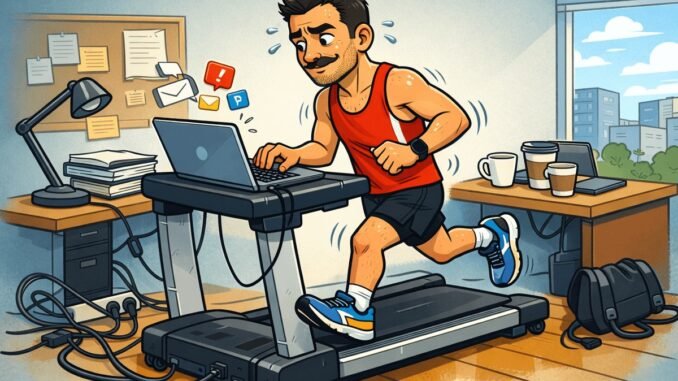
After a 12-hour day, the couch has gravitational pull. I’ve been there — gym bag packed with good intentions, gym bag unpacked at 9 PM with excuses. The standard fitness advice (“just wake up at 5 AM!”) is insulting when you’re already running on fumes. So let’s talk honestly about how can I stay motivated to exercise when I work long hours — not with hustle-culture slogans, but with systems designed for people whose schedules are genuinely brutal.
First, the liberating fact: you need less exercise than you think. Federal guidelines call for 150 minutes of moderate activity per week — that’s about 22 minutes a day. You don’t need an hour-long gym session. You need consistency at a scale your life can absorb. Motivation follows action far more often than action follows motivation, so the whole strategy is making action nearly effortless.
How Can I Stay Motivated to Exercise When I Work Long Hours? Shrink the Workout
The biggest motivation killer is the all-or-nothing workout. If “exercise” means a 60-minute gym trip, you’ll skip it on hard days — and hard days are most days. Instead, build your baseline around workouts so short they feel silly to skip:
- The 10-minute rule: Commit to just 10 minutes. Walk, bodyweight squats, push-ups, a YouTube routine. You can stop after 10 — but most days you won’t, because starting was the hard part.
- Micro-workouts through the day: 25 squats while coffee brews, a 5-minute walk after lunch, a 1-minute plank before your shower. Three micro-sessions beat zero gym trips.
- The 7-minute workout: The classic high-intensity circuit (jumping jacks, wall sits, push-ups, crunches — 30 seconds each) is genuinely effective and requires zero equipment. There are free timer apps for it.
- Walking meetings and calls: Take phone calls on foot. A 30-minute call is 30 minutes of movement you didn’t have to “find time” for.
On days with real energy, do more. On survival days, do the minimum. The streak that matters isn’t intensity — it’s showing up. The CDC’s physical activity guidelines confirm that short bouts count toward your weekly total; ten minutes three times a day is physiologically equivalent to one 30-minute session.
Habit Stacking: Attach Exercise to Things You Already Do
Willpower is a terrible scheduling tool; triggers are better. Habit stacking means bolting movement onto routines that already happen:
- After I brush my teeth in the morning → 20 push-ups (or wall push-ups to start)
- After I start the microwave → squats until it beeps
- After I park at work → a 5-minute walk around the block before going in
- After the kids’ bedtime → a 15-minute yoga video
Write your stacks down and post them on the fridge. It sounds corny; it works because the existing habit does the remembering for you. Pair this with a habit-tracking app and the visual streak becomes its own motivation — nobody wants to break a 30-day chain over a 10-minute workout.
Remove Every Excuse in Advance
Long hours mean decision fatigue, so make exercise the path of least resistance. Sleep in your workout clothes or lay them out the night before. Keep dumbbells or a resistance band where you’ll trip over them — a $25 set of bands from Amazon lives next to my TV. If you prefer the gym, pick one on your commute route, not 20 minutes in the opposite direction; every extra mile halves your attendance odds.
And reframe “long hours” honestly: track one week and find the actual gaps. Most 50-hour-week people still have 20-minute windows — lunch breaks, the gap between dinner and bed, the dead time before a show starts. You’re not finding an hour; you’re finding three 10-minute windows, which is plenty.
Motivation Maintenance for the Long Haul
Motivation isn’t a feeling you summon — it’s a system you maintain. Three things keep it alive over months:
- Track something visible. A wall calendar with X’s, an app streak, a notebook. Visible progress is rocket fuel, especially in weeks when you don’t feel different yet.
- Lower the bar on bad weeks, don’t erase it. Deadline week? The goal becomes “move 10 minutes daily,” not “train for a 10K.” Protecting the habit at minimum dose beats restarting from zero.
- Find one accountability anchor. A walking buddy, a group class with familiar faces, a friend you text your workouts to. Social commitment outperforms solo willpower consistently.
Also, stop waiting to “feel motivated.” The research is clear that action creates motivation, not the reverse — the first two weeks feel mechanical, and then the habit starts carrying you. If mornings are your only window, making them less rushed the night before is what makes a 6 AM workout possible instead of miserable.
When Motivation Fails: The Systems Approach
Motivation is a feeling; feelings are unreliable after a 10-hour day. Systems don’t need feelings. The most effective system for busy people is habit stacking: attach exercise to something you already do without fail. “After I start the coffee maker, I do 10 minutes of bodyweight exercises.” “After I change out of work clothes, I walk for 20 minutes.” The existing habit is the trigger; willpower never enters the equation.
Second: shrink the workout until it’s stupid-easy. Not “go to the gym for an hour” — “put on workout clothes and do 5 minutes.” On exhausted days, you’ll do the 5 minutes and stop, and that still counts: you kept the identity (“I’m someone who exercises”) alive. On normal days, 5 minutes becomes 20 once you start. Third: track visibly. A wall calendar with X’s, a habit app, a rubber band moved from wrist to wrist — visible streaks create a “don’t break the chain” pull that motivation can’t match. And fourth: schedule it like a meeting, with the same non-cancellation policy. You wouldn’t no-show a client; don’t no-show yourself. Systems beat motivation every time — build the system once, and it carries you through the weeks motivation doesn’t show up.
The Bottom Line
You don’t need more motivation — you need smaller workouts, stacked onto existing habits, with every excuse pre-removed. Start with 10 minutes a day, track it visibly, and let the streak do the motivating. In three months you won’t be the person who “can’t find time to exercise.” You’ll be the person who just does it, the way you brush your teeth — automatically, even on the long days.
Leave a Reply