
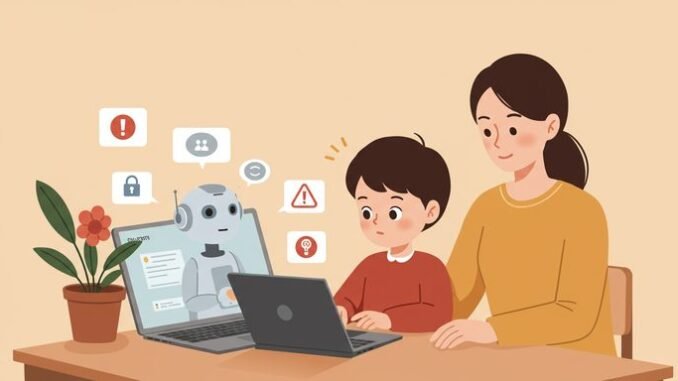
Your 12-year-old just asked ChatGPT to write her book report. Your teenager is using AI for homework you can’t tell is AI-assisted. And you’re not entirely sure what the rules should be — because the technology didn’t exist when you were learning these lessons. If you’re wondering how do parents talk to kids about using AI responsibly, take comfort in one thing: this is new for everyone, including the schools. The parents handling it well aren’t the ones with perfect rules — they’re the ones having honest, ongoing conversations. Here’s how to have them.
The biggest mistake I see parents make is treating AI like a single “talk” — one lecture about cheating, then done. It doesn’t work for the same reason one lecture about the internet didn’t work in 2005. AI is woven into homework, creativity, social life, and soon work. Your kids need an ongoing framework for thinking about it, not a list of prohibitions they’ll outgrow by next semester.
How Do Parents Talk to Kids About Using AI Responsibly? Start With Curiosity, Not Rules
Before laying down the law, understand what your kid is actually doing. Most parents are shocked — kids are often using AI in ways parents haven’t imagined, both creative and concerning. Try:
- “Show me how you use it.” Sit together and have them demonstrate. You’ll learn their actual habits, and they’ll see you’re interested rather than just policing.
- Ask what their friends do. Kids will tell you about peers’ behavior more freely than their own — and it reveals the norms they’re navigating.
- Learn the basics yourself. You can’t guide what you don’t understand. Spend 30 minutes with ChatGPT. Our guide on writing better prompts is a quick primer.
This curiosity-first approach does something critical: it keeps the conversation open. The moment kids feel surveilled rather than guided, they get secretive — and secretive AI use is where the real problems start.
The Core Conversations (By Age)
Elementary age (roughly 5–10): AI as a helper with limits
Keep it simple and concrete:
- “AI is like a really smart parrot — it repeats things but doesn’t truly understand.” Age-appropriate framing for AI’s limitations.
- “It’s okay to ask AI for help learning, but your teacher needs to see YOUR thinking.” The honesty principle, stated simply.
- “Never tell AI your name, school, address, or photos of yourself.” Privacy as a non-negotiable rule, like not talking to strangers.
- Supervise directly. At this age, AI use should happen with a parent present — it’s a shared activity, not solo screen time.
Middle school (roughly 11–14): The integrity conversation
This is when homework temptation peaks. Be direct:
- “Using AI to do your work isn’t just against school rules — it cheats YOU.” Connect to our piece on the risks of AI homework overuse: the learning gap shows up at test time.
- Define the line together: “AI can help you understand, brainstorm, and check your work. It can’t do your work for you.” Write it down. Revisit it.
- “AI makes mistakes — confidently.” Show them AI getting something wrong. Once they’ve seen it hallucinate, the blind trust breaks.
- Discuss their school’s policy explicitly. Know what the school expects so your home rules align — conflicting messages confuse kids.
High school (roughly 15–18): Ethics, future, and critical thinking
- The college and career angle: “The skills you’re building now — writing, reasoning, creating — are what will differentiate you from AI later.” Our analysis of AI-proof careers makes this concrete.
- Deeper ethics: Deepfakes, misinformation, academic integrity with real consequences. They’re old enough for nuance.
- Creative empowerment: Show them AI as a creative tool — writing songs, coding projects, designing art. Channel the energy toward making things.
- Privacy maturity: They should understand why data sharing matters, not just follow rules. Our AI privacy guide is worth reading together.
House Rules That Actually Work
- Homework first, AI second: Attempt the work yourself, then use AI to check or deepen understanding. This single rule prevents most misuse.
- Disclosure norm: “If you used AI, say so.” Normalize honesty rather than policing secrecy.
- No personal info, ever: Names, school, location, photos — the privacy rule doesn’t age out.
- Verify before trusting: “AI told me so” isn’t a source. Teach them to cross-check important claims.
- Create together: Use AI for family projects — planning a trip, writing a story together, learning something new. Modeling good use beats lecturing about bad use.
When You Suspect Misuse
Don’t lead with accusations — lead with curiosity: “This doesn’t sound like your usual writing. Help me understand how you put this together.” Often there’s a middle ground (heavy AI assistance vs. outright copying) worth discussing rather than punishing. Focus on the learning loss, not just the rule-breaking: “I’m less worried about the grade and more worried you didn’t learn this — because the test is coming.” Natural consequences (poor test performance after AI’d homework) are powerful teachers — let them land.
Staying Current as a Parent
The AI landscape shifts monthly — new apps, new capabilities, new school policies. You don’t need to track everything, but build two habits: a 5-minute monthly check-in with your kid (“anything new with AI at school?”), and following one reliable source on kids and tech. Common Sense Media offers excellent, research-backed guidance on AI, apps, and digital parenting that stays current. The parents who stay in the conversation — literally, the ongoing dinner-table conversation — raise the kids with the best judgment. Perfection isn’t the goal; presence is.
For the school side of this equation, our guide on how teachers handle AI in classrooms shows what to expect, and the ethics of AI college essays covers the high-stakes end.
The bottom line: lead with curiosity about what they’re actually doing, have age-appropriate conversations about honesty and learning (not just rules), set clear house norms around privacy and disclosure, model good AI use yourself, and treat misuse as a learning conversation rather than just a punishment. Your kids will use AI for the rest of their lives — your job isn’t to block it, but to build the judgment they’ll need when you’re not in the room.
Leave a Reply