
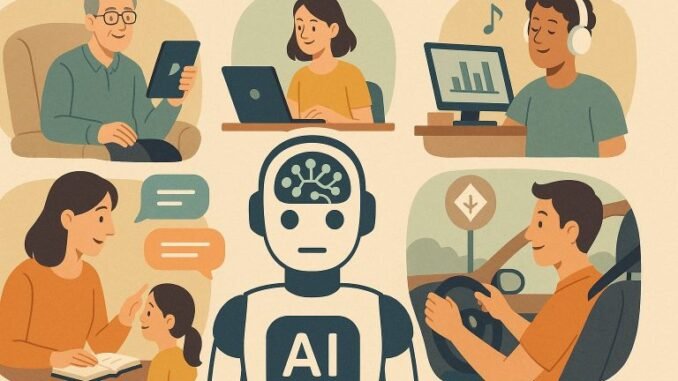
Here’s a fun exercise: count how many times you interacted with artificial intelligence today before lunch. Your phone unlocked with your face. Your email filtered spam. Google Maps rerouted you around traffic. Spotify queued a playlist that somehow knew your mood. If you’re wondering how is AI used in everyday life by regular people, the surprising answer is: constantly, invisibly, and mostly without you noticing. AI isn’t some future technology — it’s the quiet infrastructure of your Tuesday.
I think this invisibility is actually the most interesting thing about AI right now. The flashy stuff — chatbots writing essays, image generators making art — gets the headlines. But the AI that actually shapes your daily life is the boring, practical kind working behind the scenes. Pew Research Center’s technology research consistently finds that most Americans use AI-powered products daily while underestimating how much AI touches their routines. Let’s tour a regular day and spot it all.
How Is AI Used in Everyday Life by Regular People? Your Morning
Your alarm goes off — possibly a smart alarm that tracked your sleep cycles to wake you during light sleep. You check your phone: Face ID or fingerprint sign-in is AI-powered biometric recognition, trained on millions of faces to tell you apart from your sibling. Your weather app’s forecast? Modern forecasting blends traditional meteorology with machine learning models that crunch satellite data far faster than humans could.
Then there’s your inbox. Gmail’s spam filter — one of the oldest large-scale AI systems most people use — blocks over 99.9% of spam using machine learning that adapts to new scam patterns daily. Smart replies suggesting “Thanks!” or “Sounds good!” are a small language model predicting what you’d type. Your news feed, whether it’s Apple News, Google Discover, or social media, is ranked by recommendation algorithms deciding what you’re most likely to tap.
Getting Around: AI in Transit
Navigation apps are probably the AI you trust with your safety most often. Google Maps and Waze don’t just show roads — they predict traffic using real-time data from millions of phones, historical patterns, and even event schedules. When Maps says “18 minutes, 4 minutes faster than usual,” that’s machine learning estimating drive time from live conditions. Rideshare apps like Uber and Lyft use AI for surge pricing, driver-passenger matching, and ETAs.
If you fly, AI helped price your ticket — airlines use dynamic pricing algorithms that adjust fares based on demand patterns, booking pace, and even your browsing behavior. And those TSA facial comparison systems at some airports? AI matching your face to your ID photo.
At Work: The Quiet Productivity Layer
Even if your job has nothing to do with tech, AI is probably in your workflow:
- Email and writing: Grammarly’s suggestions, Outlook’s text predictions, and auto-complete in Google Docs all run on language models.
- Meetings: Zoom’s background blur and noise suppression, Teams’ live captions and transcripts — all AI. Otter.ai and similar tools transcribe entire meetings automatically.
- Scheduling: Tools like Calendly’s smart scheduling and Gmail’s “find a time” features optimize across calendars.
- Customer interactions: That chatbot on a company’s website that answered your question at 11pm? AI handling the routine stuff so humans handle the hard stuff.
- Search: Every Google search runs through AI systems that interpret what you meant, not just what you typed.
For small business owners specifically, AI tools have become genuinely useful daily drivers — our guide to the best free AI tools for small business owners covers the ones worth your time.
Evening: Entertainment, Shopping, and Home
Your streaming recommendations are the most visible everyday AI of all. Netflix has said its recommendation engine drives the majority of viewing — it’s analyzing what you watch, when you pause, what you rewatch, and what millions of similar viewers enjoyed. Spotify’s Discover Weekly, YouTube’s autoplay, TikTok’s For You page: all AI curators shaping your taste. Our deep dive on how AI helps streaming services recommend shows explains the mechanics.
Shopping online? Amazon’s “customers also bought,” dynamic pricing, fraud detection on your credit card, and the warehouse robots that picked your package — AI at every step. Your credit card company runs AI fraud detection on every single transaction, which is why your card gets frozen when you buy gas in another state.
At home, smart speakers (Alexa, Google Assistant, Siri) are voice AI; smart thermostats like Nest learn your schedule; robot vacuums map your house with computer vision. Your phone’s camera — portrait mode blur, night mode, auto-enhance — is computational photography, which is AI doing in milliseconds what used to take a Photoshop expert an hour.
Health, Money, and the Stuff That Really Matters
- Health: Your Apple Watch or Fitbit detecting an irregular heartbeat or analyzing sleep stages? AI. Some dermatology apps pre-screen skin photos. Hospitals increasingly use AI to flag concerning patterns in scans and lab results.
- Banking: Mobile check deposit (reading your handwriting), credit scoring, loan approvals, and those “unusual activity” alerts — all AI systems.
- Photos: Your phone auto-organizing photos by person, place, and “memories” slideshows — facial recognition and scene understanding running on-device.
What This Means for You
The practical takeaway isn’t to marvel at the technology — it’s to use it deliberately. Most of this AI works automatically, but the parts you control are worth learning: how to write better prompts for chatbots (see our guide on writing better AI prompts), how to manage what data you’re sharing (our piece on whether it’s safe to share personal info with AI chatbots), and how AI assistants differ from the chatbots everyone talks about (chatbots vs. virtual assistants).
Quick Answers: AI in Daily Life
Am I already using AI without realizing it?
Almost certainly. Spam filters, photo face-tagging, autocorrect, navigation rerouting, streaming recommendations, voice assistants, fraud alerts on your bank account — the average person interacts with dozens of AI systems daily. The invisible AI is the most successful AI.
The bottom line: AI isn’t coming to your everyday life — it’s been here for years, quietly verifying your face, filtering your spam, routing your commute, recommending your shows, and guarding your bank account. The people who benefit most aren’t the ones who understand the math; they’re the ones who notice the tools and learn to use them on purpose.
Leave a Reply