
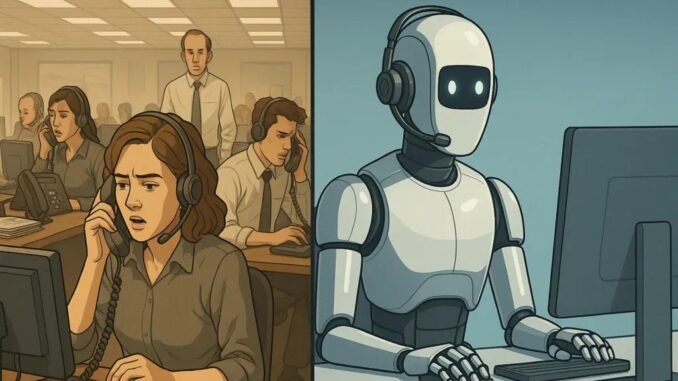
If you work in customer service, you’ve probably felt the ground shifting. The chatbot that pops up on every website is getting smarter. Your company just rolled out an “AI assistant” for the support team. The headlines scream that millions of jobs are doomed. So let’s ask the real question without the hype: will AI replace customer service jobs in the next few years? The honest answer is nuanced — AI will absolutely transform customer service work, eliminate some roles entirely, and make others more valuable. Which side you land on depends largely on what kind of service work you do.
I’ve been watching this space closely, and I want to push back on both extremes. The “AI will replace all support agents by 2027” crowd is selling something. The “AI can’t do what humans do” crowd is whistling past the graveyard. The truth is in the messy middle, and understanding it is how you protect your career.
Will AI Replace Customer Service Jobs in the Next Few Years? What’s Already Happening
Let’s ground this in what’s actually deployed today, not demos:
- AI chatbots handle the routine tier: Order tracking, password resets, return initiation, FAQ answers — the repetitive 60–70% of support volume — is increasingly resolved without humans. Companies like Klarna have publicly reported their AI assistant handling the workload of hundreds of agents.
- Agent-assist tools: Human agents now get real-time AI help: suggested replies, instant knowledge-base search, automatic call summaries, sentiment alerts when a customer is getting frustrated. One agent with AI tooling does the work that used to need two.
- Voice AI is catching up: AI phone agents that sound natural, handle interruptions, and resolve common issues are moving from pilot to production at airlines, banks, and retailers.
- Self-service keeps improving: Better help centers, AI-powered search, and proactive notifications (“your package is delayed, here’s a new date”) prevent contacts from happening at all.
The pattern is clear: anything routine, repetitive, and well-documented is being automated first. That’s not a prediction — it’s the current deployment roadmap at most large companies. The Bureau of Labor Statistics’ outlook for customer service representatives reflects these pressures in its employment projections.
Which Customer Service Jobs Are Most at Risk
Be honest with yourself about where your role sits:
Highest risk (automation likely within 2–4 years)
- Tier 1 support: password resets, order status, basic troubleshooting from scripts
- Simple data entry and ticket routing roles
- Outbound survey and appointment-reminder callers
- Basic chat support handling FAQs
If your job is mostly reading from a script and clicking through a decision tree, that work is already being automated somewhere. It’s not personal — it’s economics. An AI agent costs pennies per conversation versus dollars for a human one.
Lower risk (humans remain essential)
- Complex problem-solving: Multi-system issues, edge cases, anything requiring judgment across ambiguous information.
- Emotional situations: Angry customers, sensitive issues (healthcare, finance, bereavement), de-escalation. AI can draft a response, but humans still need to own the moment.
- High-value relationships: Enterprise account management, VIP support — where the relationship is the product.
- AI supervision: Someone has to train, monitor, and correct the AI systems. These roles are growing fast.
The Jobs That Are Being Created
This part gets less attention, but it’s real. The AI transition is creating new customer service roles:
- Conversation designers: People who write and refine what AI agents say — part writer, part psychologist, part UX designer.
- AI trainers and QA specialists: Reviewing AI conversations, flagging failures, improving responses. Often filled by experienced support agents who know what good service looks like.
- Escalation specialists: As AI handles the easy stuff, the human queue becomes concentrated expertise — harder problems, higher pay, more interesting work.
- Customer success roles: Proactive, relationship-driven work that AI can’t replicate — understanding a client’s business and helping them win.
Notice the trend: the surviving and emerging roles all require judgment, empathy, and expertise. The routine middle is hollowing out. Our broader look at the jobs least likely to be replaced by AI puts customer service in wider context.
How to Protect Your Career (Practical Steps)
If you work in customer service today, here’s what I’d actually do:
- Become the person who handles what AI can’t. Volunteer for escalations, complex cases, and emotional situations. Build expertise in the hardest 20% of issues — that’s where the job security lives.
- Learn the AI tools. Be the agent who’s great with the AI assistant, not threatened by it. Companies promote the people who make new systems work. Our guide to writing better AI prompts applies directly to agent-assist tools.
- Develop adjacent skills. Data analysis (spotting trends in support tickets), technical troubleshooting depth, or training/onboarding skills all make you harder to replace and easier to promote.
- Consider the pivot paths. Customer success, operations, QA, conversation design, and training roles all value support experience highly. Start building toward one now, not after a layoff.
- Watch your company’s roadmap. If leadership is piloting AI agents for your exact queue, believe them. Use the lead time to upskill while you’re still employed.
What About Small Businesses?
For small business owners, this shift is mostly good news: AI customer support tools let a 5-person company offer 24/7 responsive service that used to require a call center. Our guides on using AI for customer support and free AI tools for small business owners show how to deploy this without a big budget. The key insight: AI handles the routine so your human team can focus on the moments that build loyalty.
FAQs
Which customer service roles are safest from AI?
Roles that involve emotional judgment, complex problem-solving, or real accountability are the hardest to automate. Think escalations, high-value B2B accounts, regulated industries like healthcare and finance, and anything where a bad answer has serious consequences. The pattern is consistent: the more a role looks like “read the script and click the button,” the more exposed it is. The more it looks like “understand this upset person and fix something complicated,” the safer it is.
Will AI customer service actually get good, or stay frustrating?
It’s getting noticeably better each year. The jump from clunky phone trees to conversational AI that can handle multi-step requests is real, and customers increasingly can’t tell the difference for simple tasks. But the hard cases — the angry customer, the weird edge case, the situation needing a judgment call — still go sideways. The realistic outcome isn’t flawless AI; it’s AI that handles the easy 70% well and hands the rest to humans who have more time for it.
Should I avoid a career in customer service now?
Not necessarily — but be strategic about it. Entry-level, script-based support is the riskiest place to build a long career. Positions that build toward account management, customer success, technical support, or operations leadership give you skills that transfer. Use AI tools at work rather than fearing them; the service professionals thriving right now are the ones who learned to supervise and improve AI systems instead of competing with them.
Are customers actually happy with AI support?
It depends on the situation. For quick, factual questions — order status, hours, balance checks — most customers prefer instant AI answers over waiting on hold. Satisfaction drops sharply for complaints, billing disputes, and anything emotional. The companies getting this right use AI as the fast front door and make human escalation easy and obvious. The ones getting it wrong trap customers in bot loops, which breeds the resentment you see all over social media.
The bottom line: yes, AI will eliminate a meaningful number of routine customer service jobs in the next few years — that’s already underway. But it’s also making skilled human service more valuable and creating new roles around AI itself. The agents at risk are the ones doing scripted, repetitive work; the ones who are safe are building judgment, empathy, and expertise that no model can replicate. The window to move yourself into the second group is open right now.
Leave a Reply