
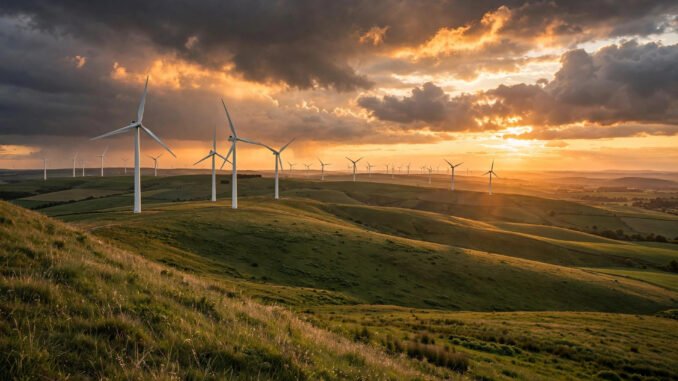
How long does it take to understand how wind turbines work — and how long before you see real results from that understanding? Like many “how long” questions, this one has two answers: you can grasp the physics in an afternoon, but the results — whether that’s lower energy bills, a career edge, or a community wind decision — unfold over months and years. This guide covers both: the elegant engineering inside those giant white towers, and the realistic timeline from curiosity to tangible payoff.
How a Wind Turbine Actually Works (The 10-Minute Version)
A wind turbine is the reverse of a fan. A fan uses electricity to move air; a turbine uses moving air to make electricity. The chain has four links:
1. Blades catch the wind — but not how you’d think
Turbine blades aren’t pushed by the wind like a sail. They’re shaped like airplane wings (airfoils), and they work by lift: wind flowing faster over the curved upper surface creates lower pressure above the blade, pulling it upward and around. This is why blades are twisted and tapered — each section is angled to keep the lift optimal as rotational speed varies along its length. Understanding this one fact puts you ahead of 95% of people: turbines harvest lift, not drag.
2. The rotor spins a shaft
Three blades (the optimal number — more blades add cost and drag without proportional gain) turn a central hub at a stately 5–20 revolutions per minute. That seems slow, but the blade tips travel at 150–200 mph — the reason for setback rules and wildlife considerations.
3. The gearbox and generator
A gearbox steps the slow rotation up to ~1,500 rpm to drive the generator (some newer direct-drive designs skip the gearbox entirely, reducing maintenance). The generator uses electromagnetic induction — magnets moving past copper coils — the same principle as every power plant since Faraday. The Department of Energy’s wind turbine explainer diagrams this drivetrain beautifully.
4. Power electronics and the grid
The raw electricity is conditioned to grid-standard AC and stepped up by a transformer at the tower base. Modern turbines also yaw (rotate to face the wind) and pitch (adjust blade angle) continuously via computer control, squeezing maximum energy from every gust while protecting themselves in storms — they brake and feather their blades above about 55 mph.
That’s the whole machine. Afternoon one: complete.
The Deeper Understanding (Weeks 2–4)
Real fluency takes a few more weeks of casual learning, and the concepts are genuinely fascinating:
The Betz limit. No turbine can capture more than 59.3% of the wind’s kinetic energy — a hard physics ceiling proven in 1919. Modern turbines reach about 45–50% in practice, remarkably close to the theoretical maximum. This is why turbine innovation focuses on bigger rotors and taller towers (reaching steadier, faster winds) rather than fundamentally new blade physics.
Capacity factor. A turbine rated at 3 megawatts doesn’t produce 3 MW constantly — the wind varies. U.S. land-based turbines now average 35–40% capacity factors, meaning they produce about a third of their theoretical maximum over a year. Offshore turbines do better (45–50%+) thanks to steadier ocean winds. Understanding capacity factor is the difference between reading energy headlines credulously and critically.
Scale economics. The average new U.S. turbine in 2026 stands nearly 500 feet tall with blades longer than a football field. Bigger is cheaper per megawatt-hour — which is why wind went from the most expensive to among the cheapest sources of new electricity in two decades. The National Renewable Energy Laboratory’s wind research pages track these cost curves with public data.
The Results Timeline: When Understanding Pays Off
Now the second question — when do you see real results from understanding wind turbines? It depends on your goal:
Goal: Lower your own energy bills (3–12 months)
Understanding wind won’t directly cut your bill unless you act on it — but it changes decisions. You’ll evaluate green-energy utility plans knowledgeably, understand community solar/wind offerings, and make smarter calls on home upgrades. Pair turbine literacy with practical steps like energy-efficient upgrades for an older home and the best thermostat setting to save money in winter, and the combined results show up in 3–12 months of utility bills.
Goal: Career or business edge (6–18 months)
Wind is the fastest-growing energy employer in America — wind turbine technician has topped “fastest growing job” lists for years, with median pay around $60,000 and two-year training programs. Understanding the technology is step one; the results (certification, employment) follow on a 6–18 month timeline. For investors and professionals, turbine literacy pays off in evaluating the energy transition with clear eyes.
Goal: Community decision-making (1–3 years)
Many Americans will vote on, live near, or host wind projects. Informed residents ask better questions: What’s the setback distance? What’s the decommissioning bond? What’s the actual capacity factor here? Understanding the technology turns you from a spectator into a participant — and community wind decisions play out over years.
Goal: Pure intellectual satisfaction (this afternoon)
Honestly underrated. The moment the lift-not-drag insight clicks, every wind farm you ever drive past becomes interesting instead of background. That’s a real result too — the world gets more legible, permanently.
Common Misconceptions Worth Clearing
“Turbines kill enormous numbers of birds.” They kill an estimated 140,000–500,000 birds annually in the U.S. — serious, and the industry works on mitigation (including AI curtailment systems) — but buildings kill ~600 million and cats kill billions. Proportion matters.
“Wind is unreliable, so it’s useless.” Grid operators manage variability with forecasting (now highly accurate day-ahead), geographic diversity, and storage. Multiple grid studies show high wind penetrations are operable; the challenge is real but solved routinely.
“They’re noisy and cause health problems.” Setback distances keep sound at levels comparable to a quiet office; large-scale health reviews find no direct link between turbine sound and health effects beyond annoyance in some residents — a genuine siting consideration, not a health crisis.
Conclusion: An Afternoon to Learn, a Lifetime of Clearer Thinking
Understanding how wind turbines work takes an afternoon: lift-driven blades, a geared generator, smart controls — elegant, comprehensible, close to physics’ efficiency ceiling. Seeing results from that understanding takes longer and depends on what you do with it: months for energy-bill decisions, a year or more for career moves, years for community impact. But the first result is immediate and free — the next wind farm on the horizon stops being scenery and starts being a machine you understand. In an electrifying world, that’s literacy worth having.
Frequently Asked Questions
How do wind turbines work in simple terms?
Wind flows over wing-shaped blades, creating lift that spins a rotor. The rotor drives a generator (often through a gearbox), producing electricity that’s conditioned and sent to the grid. Computer controls constantly adjust blade angle and direction for maximum efficiency and storm protection.
How long does it take to understand wind turbines?
The basic mechanism takes an afternoon. Deeper fluency — Betz limit, capacity factors, grid integration — takes a few weeks of casual learning. Career-level expertise takes 6–18 months of training.
What is the Betz limit?
The theoretical maximum fraction of wind energy any turbine can capture: 59.3%, proven by physicist Albert Betz in 1919. Modern turbines achieve roughly 45–50% in practice — remarkably close to the physical ceiling.
Do wind turbines work when it’s not windy?
They produce nothing at zero wind, but they don’t need constant wind — they need average wind. U.S. turbines produce about 35–40% of their rated capacity over a year, and grid operators balance variability with forecasting, geographic spread, and storage.
Are wind turbines cost-effective now?
Yes — wind is among the cheapest sources of new electricity in the U.S., with costs falling roughly 70% over the past decade thanks to larger, more efficient turbines. The economics now drive adoption as much as environmental policy.
Leave a Reply