
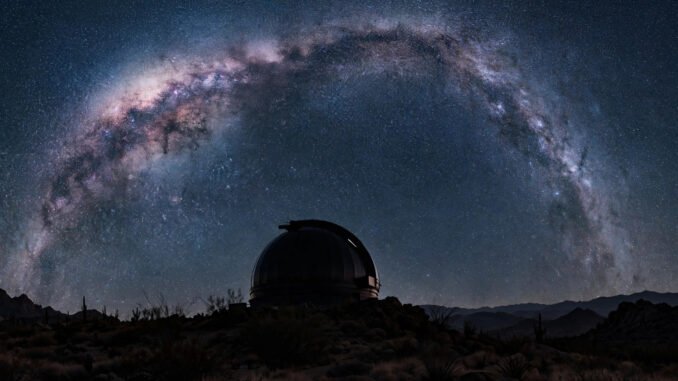
How do you start understanding what a light year means as a complete beginner? It’s one of those terms everyone has heard and almost no one has truly pictured. Here’s the liberating secret: a light year is not a unit of time. It’s a distance — the distance light travels in one year. And once you grasp that single fact plus one vivid comparison, the entire cosmic distance ladder clicks into place. This beginner’s guide builds your intuition step by step: what a light year really measures, how far one actually is (with comparisons your brain can hold), and why astronomers need such an absurdly large ruler.
The Definition: Simpler Than You Fear
Light moves fast — 299,792 kilometers per second (about 186,000 miles per second), the universe’s speed limit. In one year, it covers roughly 9.46 trillion kilometers (5.88 trillion miles). That distance is one light year.
The number is useless to human intuition, so don’t try to feel 9.46 trillion kilometers. Instead, anchor it: light circles Earth’s equator 7.5 times per second. It reaches the Moon in 1.3 seconds, the Sun in 8 minutes 20 seconds. A light year is that speed sustained for a full year — and it’s the small unit astronomers use. The nearest star beyond the Sun, Proxima Centauri, is 4.24 light years away. The Milky Way is 100,000 light years across. The observable universe stretches 93 billion light years wide.
Beginner milestone one: stop converting. Nobody in astronomy thinks “9.46 trillion km” — they think “4 years of light-travel.” The unit is designed to be thought in, not converted from.
The Mind-Bending Part: Looking Back in Time
Here’s where light years get profound. Because light takes time to travel, distance equals lookback time. When you look at the Sun, you see it as it was 8 minutes ago. Proxima Centauri as it was 4.24 years ago. The Andromeda Galaxy — 2.5 million light years away — as it was 2.5 million years ago, before humans existed.
Astronomers exploit this deliberately: the most distant galaxies, seen as they were 13+ billion years ago, are time machines. The James Webb Space Telescope’s deepest images show galaxies as they were when the universe was a few hundred million years old — baby pictures of cosmic history. NASA’s Webb mission pages explain this lookback concept with stunning visuals aimed at the public.
This is also why “how far” and “how long ago” blur in astronomy. Saying a galaxy is 10 billion light years away means its light traveled 10 billion years. One number, two meanings — distance and history fused.
Building Intuition: The Cosmic Distance Ladder
Your brain can’t picture a light year directly, so build it in steps — the way astronomers do:
Rung 1: The solar system (light-minutes and light-hours)
Start small. Sun to Earth: 8 light-minutes. Sun to Neptune: 4 light-hours. The Voyager 1 probe, humanity’s farthest traveler after 45+ years of flight, is about 22 light-hours away — less than a light-day. Our entire interplanetary civilization fits inside one light-day.
Rung 2: The stellar neighborhood (light-years)
Proxima Centauri: 4.24 light years. That’s roughly 40 trillion kilometers — and it’s our nearest neighbor. A car at highway speed would take about 50 million years to get there. This rung teaches the real lesson: space is overwhelmingly empty.
Rung 3: The galaxy (thousands of light-years)
The Milky Way spans ~100,000 light years and holds 100–400 billion stars. The center of our galaxy is 26,000 light years away — light leaving it now left when humans were painting caves. ESA’s Gaia mission pages map billions of these stars with public, explorable data.
Rung 4: The universe (billions of light-years)
Andromeda: 2.5 million light years. The most distant observed galaxies: 13+ billion. The observable universe’s edge: 46.5 billion light years in every direction (space itself expanded while the light traveled — one of cosmology’s delightful subtleties).
Climb one rung per sitting, and in four sittings you’ll have a working mental map of cosmic scale — something most college graduates lack.
Common Beginner Confusions, Cleared Up
“Is a light year a measure of time?” No — it’s distance. The confusion is universal and the fix is instant: “light-year” = the distance light covers in a year, just as a “car-hour” would be the distance a car covers in an hour.
“Why not just use kilometers?” Because the numbers become meaningless — 24,000,000,000,000,000 km tells you nothing; “2.5 million light years” tells you the light is 2.5 million years old. The unit carries meaning, not just magnitude.
“What’s a parsec?” 3.26 light years — astronomers’ professional unit, from “parallax of one arcsecond.” Han Solo’s “12 parsecs” was originally a script error (parsecs measure distance, not time), later retconned into a clever shortcut story. Real astronomers use parsecs; the public uses light years; they’re interconvertible.
“Can we ever travel a light year?” With current technology, no — Voyager would need ~70,000 years to reach Proxima Centauri. Concepts like Breakthrough Starshot (laser-pushed micro-sails at 20% light speed, ~20-year trip) are serious engineering studies, not science fiction — but they’re decades from reality.
Making It Stick: Three Exercises
Understanding sticks through doing. Try these:
1. The powers-of-ten walk. Imagine shrinking the solar system so Earth is a peppercorn — the Sun becomes a bowling ball 26 meters away, and Proxima Centauri is 7,000 kilometers away. Scale models teach emptiness better than numbers.
2. The lookback game. Pick a bright star (Betelgeuse: ~650 light years — its light left around the time of the Black Death). Every star is a history lesson; you’re always seeing the past.
3. The one-dataset habit. Follow Webb’s new images for a month, checking each one’s distance/lookback time. The same habit that sharpens thinking about writing better AI prompts or experimenting with free AI image generators — sustained curiosity about one rich source — builds cosmic intuition fastest.
Conclusion: A Ruler for the Universe
A light year is a distance — 9.46 trillion kilometers — but more importantly, it’s a way of thinking: distance as travel time, the night sky as a time machine, emptiness as the universe’s defining feature. Start with the definition, climb the four rungs from light-minutes to billions of light-years, and play the lookback game with real stars. The universe is incomprehensibly large, but it’s not incomprehensible — it just needs the right ruler. Now you have one.
Frequently Asked Questions
What is a light year in simple terms?
The distance light travels in one Earth year: about 9.46 trillion kilometers (5.88 trillion miles). It’s a unit of distance, not time — despite the name.
How long would it take to travel one light year?
At light speed: one year (by definition). With current spacecraft: tens of thousands of years — Voyager 1, our fastest distant traveler, would need ~70,000 years to cover the 4.24 light years to Proxima Centauri.
Why do astronomers use light years instead of miles or kilometers?
Because cosmic distances make kilometers meaningless (too many zeros), and light years carry double meaning: they tell you both the distance and how old the light is — how far back in time you’re seeing.
What’s the difference between a light year and a parsec?
A parsec is 3.26 light years — the unit professional astronomers prefer, based on stellar parallax measurements. Light years are the public-friendly equivalent. They measure the same thing: distance.
How far is the nearest star in light years?
Proxima Centauri, 4.24 light years away. Its light takes over four years to reach us — so we always see it as it was four years ago.
Leave a Reply