
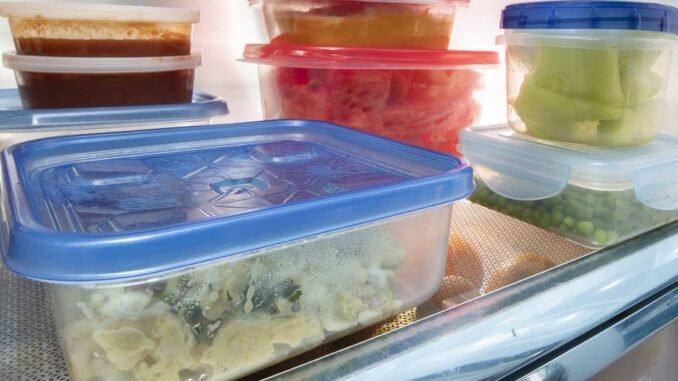
Leftovers are a budget and meal-prep superpower — until they make someone sick. The best way to store leftovers safely isn’t complicated, but the rules are specific: how fast you cool, what you store in, how long it keeps, and how hot you reheat. Foodborne illness sends 128,000 Americans to the hospital yearly per the CDC, and improper leftover handling is a leading home-kitchen cause. I’ve tightened my own leftover game over years of meal prepping, and the system below is USDA-aligned and practical. Here’s the full protocol.
Rule #1: Cool It Fast (The 2-Hour Rule)
Bacteria multiply fastest between 40°F and 140°F (the “danger zone”). Cooked food must go from steaming to refrigerated within 2 hours — 1 hour if the room is above 90°F (summer BBQ rule).
- Divide and conquer: a giant pot of soup cools dangerously slowly — divide into shallow containers (2 inches deep max) to cool fast. Surface area is everything.
- Ice bath: for big batches, set the pot in a sink of ice water and stir — drops temperature in 20–30 minutes.
- Don’t wait for room temp: the old advice to cool completely before refrigerating is wrong — modern fridges handle warm (not steaming) food fine. Get it in within 2 hours; lukewarm is fine.
- Vent the lid slightly until cooled, then seal — trapped steam slows cooling and condenses into the food.
Rule #2: Store It Right
- Airtight containers: glass with locking lids ($25–$35 for a set — Pyrex, Snapware) — no staining, no odor absorption, microwave/oven/dishwasher safe. Plastic is fine too, but BPA-free and never microwave in scratched/cloudy plastic.
- Portion before storing: individual servings cool faster, reheat more evenly, and avoid the reheat-the-whole-batch trap (repeated reheating degrades safety and quality).
- Label everything: masking tape + marker — contents and date. “Mystery container from last week” gets thrown out; labeled food gets eaten. This single habit cuts food waste enormously.
- Fridge organization: leftovers on upper shelves (most consistent temp), raw meat on the bottom shelf (drips can’t contaminate), fridge at 37–38°F (verify with a $5 fridge thermometer — built-in dials lie).
How Long Do Leftovers Last? (The Chart)
- Cooked meat/poultry: 3–4 days
- Cooked fish: 3 days
- Soups and stews: 3–4 days
- Cooked pasta/rice: 3–5 days (rice: cool fast — Bacillus cereus loves room-temp rice)
- Pizza: 3–4 days
- Opened deli meat: 3–5 days
- Egg dishes: 3–4 days
When in doubt, throw it out. The $4 of leftovers isn’t worth the risk — and you cannot taste, smell, or see most foodborne pathogens. “It smells fine” is not a safety test. The USDA FSIS and FoodSafety.gov charts are the authoritative references — bookmark them.
Freezing: The Pause Button
- Freeze at peak freshness (day 1–2), not on day 4 as a rescue — freezing pauses the clock, doesn’t rewind it.
- Leave headspace (liquids expand), remove air (freezer burn is dehydration — vacuum-sealed or water-displacement method in zip bags).
- Freeze flat in zip bags — stacks efficiently, thaws fast.
- Most leftovers freeze 2–3 months at best quality (safe indefinitely at 0°F, but quality degrades).
- Thaw safely: fridge overnight (best), cold water (sealed bag, changed every 30 min), or microwave (cook immediately after). Never thaw on the counter.
Reheating: The 165°F Rule
Reheat leftovers to 165°F internal — steaming hot throughout, not just warm edges. Stir microwaved food halfway (microwaves heat unevenly, creating cold spots where bacteria survive). Sauces and soups: bring to a rolling boil. Reheat only once — repeated cooling/reheating cycles are where safety margins erode. A $15 instant-read thermometer takes the guesswork out. Cool fast, store airtight, label everything, respect the 3–4 day window, reheat to 165°F — that’s the whole religion, and it keeps the meal-prep machine running safely.
Leftover Storage Mistakes to Avoid
- Cooling on the counter for hours: the old “cool completely first” advice is wrong — food must go from cooked to refrigerated within 2 hours (1 hour above 90°F). Divide into shallow containers, refrigerate while still warm-ish. Modern fridges handle it.
- The giant-container cool: a deep pot of soup stays in the danger zone (40–140°F) for hours in the fridge center. Shallow containers (2″ max) or an ice bath — surface area is everything.
- “It smells fine” as a safety test: you cannot taste, smell, or see most foodborne pathogens. 3–4 days for cooked meats (USDA), then out — the $4 of leftovers isn’t worth the risk.
- Reheating the whole batch repeatedly: each cool-reheat cycle erodes safety margins and quality. Portion before storing; reheat only what you’ll eat, to 165°F, once.
Storing Leftovers FAQs
How long do leftovers last in the fridge?
Cooked meat/poultry: 3–4 days. Fish: 3 days. Soups/stews: 3–4 days. Pizza: 3–4 days. Label with masking tape + date — “mystery container” gets thrown out; labeled food gets eaten. When in doubt, throw it out (per USDA FSIS).
Can I put hot food directly in the fridge?
Warm: yes. Steaming: divide first. Modern refrigerators handle warm (not piping-hot) food fine — the real risk is large volumes staying warm in the center for hours. Shallow containers + 2-hour rule is the protocol.
What’s the safest way to thaw frozen leftovers?
Fridge overnight (best), cold water (sealed bag, water changed every 30 min), or microwave (cook immediately after). Never on the counter — the exterior enters the danger zone while the center stays frozen.
How hot should reheated food be?
165°F internal — steaming hot throughout. Stir microwaved food halfway (microwaves heat unevenly — cold spots harbor bacteria). Soups/sauces: rolling boil. A $15 thermometer removes all guesswork.
The Smell Test Myth (Retired)
Let’s retire “it smells fine” as a safety standard — permanently. The pathogens behind most foodborne illness (Salmonella, Listeria, E. coli) are odorless, tasteless, and invisible at infectious doses. Spoilage bacteria (the ones that make food smell bad) and pathogenic bacteria (the ones that make you sick) are different organisms — food can smell perfect and still be dangerous, or smell off and be merely unpleasant. The only reliable safety tools: the 2-hour rule, the 3–4 day window, the 165°F reheat, and a $15 thermometer. Your nose is a quality instrument, not a safety instrument — use it for enjoyment, not for risk assessment.
Leave a Reply