
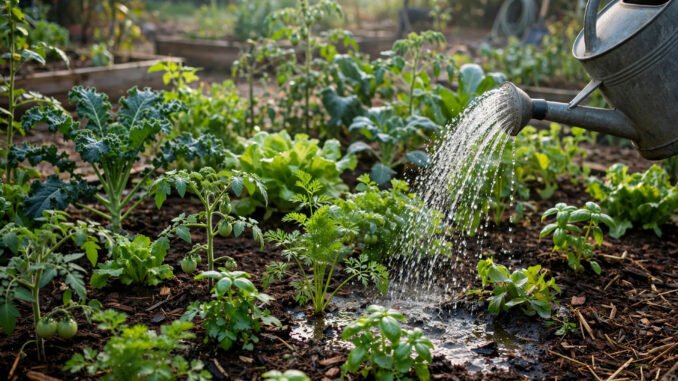
Watering is the first thing most beginners get wrong, and it is also the simplest part of gardening to fix. The core ideas take a single evening to learn. The results take a little longer, but not much: steadier growth and fewer wilted afternoons usually show up inside a month. What follows is the timeline of learning it properly, in order, from the main principle on day one to the quiet confidence of a second season.
Phase 0: The core principle
Everything rests on one idea: water deeply and infrequently. A deep soak that moistens roughly the top 6 to 12 inches of soil does two jobs at once. It gives the plant a real drink, and it trains roots to grow downward, into soil that stays cooler and holds moisture longer.
Daily sprinkles train the opposite habit. Roots stay shallow, hugging the surface, because that is where the water always is. Then one hot afternoon arrives, the surface dries in an hour, and the plant panics. Gardeners call this watering often. The plant experiences it as living on the edge of drought, permanently.
So the schedule question, how often should I water, is really a depth question. Water less often, more thoroughly, and let the soil surface dry a little between drinks. That small dry spell at the top is not neglect. It is the signal that sends roots down.
The finger test: your free moisture meter
Forget the calendar for a moment and learn this five-second check. Push a finger about 2 inches into the soil near the plant. If the soil feels dry at that depth, water. If it feels damp, wait and check again tomorrow.
This simple test beats every app and gadget for one reason: it measures your soil, in your weather, around your plants. An app knows the forecast. Your finger knows the ground. Clay soil, sandy soil, a shaded bed, a windy corner, all of them dry at different speeds, and the finger test adjusts for all of it without a single setting.
There is an upgrade path when you are ready. A basic moisture meter, about $10 to $15, helps with containers, where pushing a finger in can disturb small roots, and it gives a reading deeper down. Many beginners never need more than that. The finger test stays the daily habit; the meter is a helper for pots and problem spots.
Timing: water early in the day
When you water matters almost as much as how much. The best window is early, before about 10 a.m. The plant gets its drink before the heat of the day, less water is lost to evaporation than at midday, and the foliage has the whole day to dry.
Dry foliage is not a cosmetic detail. Leaves that stay wet for many hours are an open invitation to fungal disease, and evening watering leaves plants damp all night, which is exactly what disease organisms like best. Anyone who has spent a season fighting tomato blight on a budget learns this lesson the hard way: wet leaves, warm nights, and crowded plants are how blight spreads through a bed. Morning watering, aimed at the soil rather than the leaves, removes one leg of that stool.
Evening watering is still better than no watering for a plant in real trouble. If a container is bone dry at 7 p.m., water it at 7 p.m. Just treat mornings as the standing routine and evenings as the exception.
The real numbers
The famous rule says most gardens and lawns need about 1 inch of water per week. Treat that as a starting point, not gospel. It assumes average soil, average weather, and established plants, and your garden will regularly break all three assumptions.
Measure what you actually deliver. A rain gauge costs about $5, and a straight-sided tuna can under the sprinkler does the same job free. Run the sprinkler, time it, and read the can. Many beginners discover their quick ten-minute sprinkle delivers almost nothing, while an hour in one spot delivers far more than they guessed. From then on, you are watering by measurement, not by hope.
Know the honest exceptions to deep and infrequent. New transplants and seedlings need consistent moisture for their first two to three weeks while their roots establish. That is the one time frequent, gentle watering is right. Heat changes the math too: a 95-degree week needs more water than a 75-degree week, and a rainy week may need nothing at all, however the calendar scolds you.
Mulch changes the math in your favor. A layer about 3 inches deep shades the soil and slows evaporation, and extension guidance commonly credits mulch with reducing evaporation losses by roughly a quarter to a half. Read up on what mulch does for soil and moisture and you will see why experienced gardeners treat it as part of the watering system, not a decoration on top of it.
The upgrade: drip on a timer
Once the habits make sense, hardware can do the remembering for you. A basic kit, about $30 to $80 for a starter setup, puts water at the base of each plant, slowly, at soil level. Reading about how drip irrigation delivers water slowly shows why gardeners trust it: a simple timer turns it on early in the morning while you are still asleep. No wet foliage, little evaporation, no daily hose duty.
Drip is not required to water well. Plenty of fine gardens run on a hose and a finger test. Think of it as the final phase of the timeline, worth adding in your second season for beds you water constantly, especially containers and vegetables that suffer when their moisture swings.
Week 1: The audit
Your first week is about noticing, not fixing. Finger-test your beds and pots every day and pay attention to what you find. Write it down if that helps. Patterns appear fast.
Most beginners discover one of two mistakes. The first is overwatering: soil still soggy days after the last drink, lower leaves yellowing, tiny fungus gnats hovering over the surface. The second is surface watering: the top looks wet after each sprinkle, yet the soil is dry 2 inches down, and roots never got the memo. Both mistakes are common, both are fixable, and finding yours is the whole point of the audit week.
Weeks 2 to 4: Visible results
Switch to deep watering guided by the finger test, and the garden answers within a few weeks. Growth steadies. The afternoon wilt that used to greet you after work becomes rarer, because roots are drawing on deeper moisture. Seedlings stop keeling over. Containers stop swinging between flood and drought.
This is also when your water use often drops. Deep drinks given twice a week usually total less than nervous daily sprinkles, and mulch stretches each watering further. The results are not magic and they are not instant, but inside a month most beginners can point at specific plants and say, honestly, that looks better than it did.
Months 2 to 3: Intuition develops
Somewhere in the second or third month, the checks get faster and quieter. You glance at the sky, think about when you last watered, press a finger in out of habit, and you simply know. You start adjusting without being told: extra water for the bed in full sun before a hot weekend, none for the shaded bed after two days of rain.
That intuition is the real skill the timeline was building. It cannot be downloaded or bought. It grows out of weeks of small observations in one specific garden, yours.
Season 2 onward: Systems thinking
By the second season, your thinking widens. You stop asking only how often to water a plant and start asking how the whole bed holds water. Soil improves as you add compost and keep it covered. Mulch becomes a habit, not a project. Plant choices start doing the work too: thirsty plants grouped together where watering is easy, tough plants in the dry corners where the hose barely reaches.
At that point the schedule has quietly stopped being a schedule. It is a system that mostly runs itself, with you making small corrections at the edges.
Beginner traps to skip
Calendar watering is the biggest trap: soaking the garden every Saturday whether it needs it or not. Water by the soil, not by the day of the week. A close second is watering the leaves instead of the soil, which wastes water and invites disease. Aim low, at the base of the plant.
The last trap is the rescue flood: ignoring a plant for a dry week, feeling guilty, and drowning it in one huge drink. Stressed roots take up water poorly, and a flood mostly runs off or rots what it touches. Water it well once, then again the next day, and return to the normal rhythm.
An evening to learn the ideas. A week to see your own mistakes clearly. A month to see plants respond. A season to trust your judgment. That is the honest timeline, and it is shorter than most beginners fear when they start.
Leave a Reply