
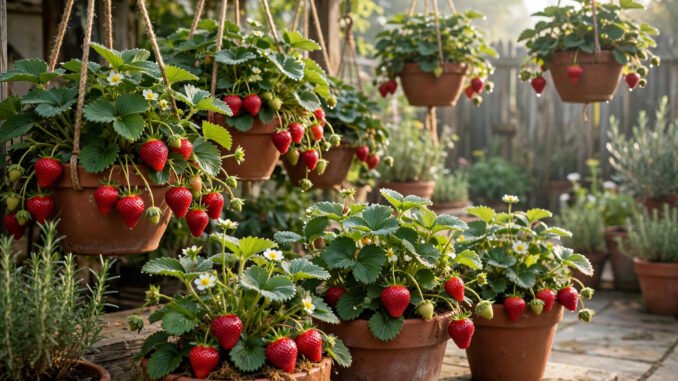
Container strawberries have a reputation as an easy win, and they can be — but the failures follow a pattern so regular you can set your watch by it. A crown buried a half inch too deep. Garden soil shoveled into a pot. One lonely plant sulking in a huge tub, or six plants jammed into a tiny one. Every one of these mistakes is common, every one is fixable in minutes, and the whole project still costs only about fifty dollars when you avoid them. So this guide starts with the mistakes, in the order gardeners make them, and then gives the correct way: the right type of plant for Nashville, the cheapest setup that works, the local calendar, and an honest account of how many berries to expect.
The Mistakes That Kill Container Strawberries
Mistake 1: Burying the crown — or leaving it perched
The crown is the fat, knobbly point where the leaves and roots meet, and its position decides whether the plant lives. Bury it under soil and it rots. Leave it perched high with roots exposed and they dry out. Both errors come from planting in a hurry. The correct depth is exact: the crown sits right at soil level, roots spread below, leaf stems above. This is the number one planting error with strawberries, and it is also the easiest to avoid — plant slowly, check the crown with your fingertip, and firm the mix around it at the right height before watering.
Mistake 2: Garden soil in the pot
Soil dug from the yard behaves badly in a container. It packs down hard, drains poorly, holds water against the roots after rain and then bakes into a brick between waterings. Plants in it sulk, roots suffocate, and the grower blames the variety. Containers need potting mix: a loose, free-draining blend made for pots, which keeps air around the roots while holding enough moisture for a shallow-rooted plant. This is not a place to save money by digging. The mix is the plant’s whole world in a pot, and it has to be the right one.
Mistake 3: Buying the wrong fruiting type
Strawberries come in three types, and buying the wrong one guarantees disappointment even if everything else is right. June-bearing plants give one big crop in late spring, then stop. Everbearing plants give two flushes, usually one in spring and one in fall. Day-neutral plants produce a steady trickle across the season whenever the weather is moderate. A gardener who buys June-bearers hoping for berries all summer will call the plants a failure in July, and a gardener who buys day-neutrals expecting one huge picking day for jam will be let down too. Neither plant failed. The match failed.
Mistake 4: Containers too small, or with no drainage
Strawberries are shallow-rooted, but shallow is not the same as cramped. Each plant wants roughly six to eight inches of soil depth to root into and a container with drainage holes in the bottom — no exceptions. A pretty pot with no holes becomes a swamp after the first hard rain, and roots sitting in standing water rot quietly while the top of the plant still looks fine. If a container you love has no holes, drill them. Five minutes with a drill saves the plant.
Mistake 5: Crowding the plants
Bargain bundles of plants tempt people to plant every single one, packed tight. Crowded strawberries compete for water and food, air cannot move between the leaves, and damp, still air is an open invitation to mould. A good working rule is about one plant per gallon of soil, with plants spaced roughly eight to twelve inches apart in beds or wide planters. Six healthy, well-spaced plants will out-produce a dozen starved, crowded ones, and the berries will be cleaner as well.
Mistake 6: Skipping the mulch
Bare mix under a strawberry plant means ripe berries resting on a wet surface, which is where rot starts. A light layer of straw or pine needles tucked around the crowns keeps fruit clean and dry, slows moisture loss from the pot, and cuts down weeds. It costs almost nothing — sometimes nothing at all — and skipping it is the most avoidable cause of a harvest that moulds on the plant.
The Correct Way: Types and Varieties for Nashville
Start with the type, then the variety. For containers and a long season, day-neutral plants are the best beginner choice: their steady trickle of berries from spring through fall suits pots, small harvests, and learning the plant’s rhythm. Everbearing types are the other sound option, with their two clear flushes. To understand the plant behind these choices — how strawberries grow, fruit and runner — explains why the types behave so differently across a season. For Nashville specifically, day-neutral and everbearing varieties such as Ozark Beauty or Albion are sensible picks, and heat tolerance matters here: Tennessee summers are hard on a plant that prefers cool weather, so a spot with morning sun and some afternoon shade helps containers through July and August.
Buying the plants offers two honest routes. Bare-root crowns are the budget king, at about $8 to $15 for a bundle of 25 — plant six, and share or pot up the rest. They arrive looking like small bundles of roots, which worries beginners, but they establish fast once planted at the right depth. Potted starts cost about $3 to $5 each and give instant results: a leafy plant, already growing, that fruits sooner. Neither route is wrong. Bare-root wins on price, starts win on patience.
The Budget Setup: About $40 to $60, Counted Honestly
Here is a six-plant setup with the arithmetic shown, because a budget claim should add up. Containers: six fabric grow bags at about $3 each come to $18, and they drain well and store flat in winter; the alternatives are 5-gallon buckets, free from bakeries and delis that give them away or about $4 new with drainage holes drilled, or a stacked strawberry planter at about $20 to $30. Potting mix: one bag at about $10, inside the usual $8 to $12 range, fills the six bags. Plants: one bare-root bundle at about $12, inside the $8 to $15 range, covers your six plants with spares to share. Mulch: straw or pine needles at about $3, inside the $0 to $5 range. Add it up — $18 plus $10 plus $12 plus $3 — and the total is $43, inside the $40 to $60 range with room to spare. Swap in potted starts or a stacked planter and you land nearer the top of the range, still inside it. If you are new to growing in pots at all, the basics of container gardening cover the drainage and watering logic that makes any of these setups work.
The Nashville Calendar: Planting and Care
Plant in late March to April in Nashville, once the worst frosts have passed. Set each crown exactly at soil level, roots spread downward, and water the pots in well. Through the season, containers dry out far faster than garden beds, so check moisture with a fingertip every day or two in summer and water when the top inch is dry; feed lightly and regularly, since every watering washes a little food out of the mix. Pinch off runners unless you want new plants, because a runnering plant spends its energy on daughters instead of berries. In winter, containers need protection in cold snaps — group the pots against a sheltered wall, wrap them, or move them into an unheated garage during the sharpest cold, because roots in a pot feel freezes that roots in the ground never notice.
The Honest Yield
Now the part where honesty matters most. A healthy container plant typically gives about 0.5 to 1.5 pounds of berries across a season. Everbearing and day-neutral types sit nearer the lower half of that range per plant, but they spread the picking over months instead of one short rush. Six plants therefore give you several pounds of berries a season — a real harvest of bowls for breakfast and handfuls eaten warm at the pot, not a commercial crop. At typical grocery prices of about $4 to $6 a pint, that harvest roughly covers the setup cost across the first season or two, and since the plants keep producing for about two to three strong years, the later seasons are where the setup truly pays its way. Anyone promising a small pot will bury you in berries in year one is selling something.
Pests and Problems: The Short List
Three problems account for nearly all the trouble. Birds find ripe berries about ten minutes before you do; a simple net draped over the pots once fruit starts coloring ends the contest. Slugs work at night and leave holes in fruit resting low; mulch, dry surfaces, and picking ripe berries promptly keep their damage small. Grey mould appears on wet fruit in still, damp weather — spacing for airflow, mulching so berries stay off wet mix, and removing any soft or mouldy berry the day you spot it stop it from spreading to its neighbors.
Harvest: Picking and Keeping the Berries
Pick strawberries fully red, because they do not ripen further off the plant, and pick them in the cool of the morning when their flavor is at its best. Handle them gently, leave the green cap on until you are ready to eat, and do not wash them until that moment either — water shortens their life in the fridge. A few minutes reading about the best way to clean and store fresh berries will save more of your harvest than any gadget. Then eat some standing in the sun, because that moment — not the savings, not the yield table — is the real reason six plants in pots are worth fifty dollars and a spring of small attentions.
Leave a Reply