
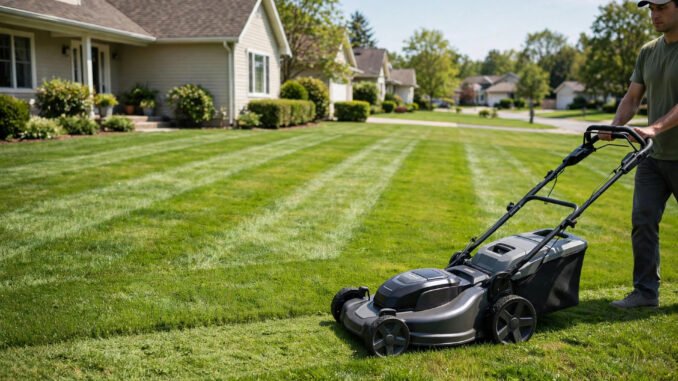
Stand in front of the mower wall at a home center and the choice looks impossible. Gas, battery, corded, reel, robotic, riding — rows of machines in different colors, all promising a perfect lawn, all priced like a serious purchase. Pick wrong and you own a $400 mistake that rusts in the garage while the grass keeps growing. Here is the part the wall does not tell you: your yard has already made most of this decision. Measure three things about the space you actually mow, and the right category picks itself. What follows is a four-step process that starts with those measurements, ranks the mower types honestly for a first-time buyer, and ends with the small amount of care that keeps a machine running for years.
Before Step 1: The Three Facts That Decide Everything
Forget brands for a moment. Three facts about your yard matter more than any feature list: how big the lawn is, how steep it gets, and what kind of grass and storage you are working with. Yard size sets the machine class. Slope sets the safety limits. Grass type and storage space settle the smaller questions, like whether a wide deck fits through your gate and whether a folding handle is worth paying for. Write these three facts down before you shop, because every step below refers back to them.
Step 1: Read Your Yard
Start with size, measured honestly. Pacing the lawn or checking your property listing both work; what matters is the area of grass, not the size of the whole lot. Under about a quarter acre — the typical suburban lawn — a walk-behind mower is the right class. Between about a quarter and half an acre, look at a self-propelled walk-behind, which drives its own wheels so you are guiding rather than pushing, or an entry-level riding mower if the yard is open and flat. Over half an acre, a riding mower or lawn tractor stops being a luxury and starts being the sensible tool. Over two acres, you are in zero-turn or tractor territory, because walk-behind mowing at that scale becomes a multi-hour ordeal you will dread every single week.
Slope comes next, and it is a safety question, not a comfort question. Slopes over roughly 15 degrees rule out riding mowers. A rider carries its weight high, and on a steep bank the rollover risk is genuinely dangerous. Steep yards favor light self-propelled walk-behinds that you can control with your own footing, cutting across the slope in careful passes. If your yard is mostly flat, slope drops out of the decision and size alone leads.
Then look at the grass itself and the life around it. Thick, fast-growing grass in a wet climate rewards a mower with real cutting power and a deck that clears clippings well. Thin, slow grass on a small shaded lot asks far less of a machine. Close neighbors and homeowners association noise rules increasingly favor electric models, which run much quieter than gas. Storage matters too: a battery mower that folds upright can live in a corner of a small garage where a riding mower simply cannot. And if the mowing itself feels like the real burden, it is worth knowing that the yard can change as well as the machine — low-maintenance front yard landscaping ideas can shrink the grass area you have to cut in the first place, which changes every calculation in this process.
Step 2: Pick the Type, Honestly Ranked for Beginners
With your three facts in hand, the types sort themselves out quickly. If you want background on the main types of lawn mower and how they differ, that overview covers the full family; here is how they stack up for someone buying a first machine.
Battery-electric walk-behind: the default for most lawns
For a typical suburban yard, a battery-electric walk-behind is the sensible starting point. Modern 40V to 80V platforms cut as well as gas for most home grass, start with a button instead of a pull cord, and need no oil, no petrol, and no spark plugs. They run at roughly 65 dB against roughly 90 to 95 dB for a gas mower — about the difference between conversation and shouting — which your neighbors will notice even if you do not. Most fold for storage. A typical battery gives about 45 to 60 minutes of runtime, enough for roughly a quarter to a third of an acre, and a typical mower with battery and charger costs about $250 to $550. One warning: the battery platform matters as much as the mower. The same packs often run trimmers, blowers, and other tools from the same brand, so choose an ecosystem you are happy to stay in.
Gas walk-behind: the fading workhorse
Gas still has real strengths. Runtime is unlimited — refuel and keep going — power is strong, and used machines are cheap, at about $100 to $200 on local marketplaces. The costs are the upkeep and the fuss: fuel to store, oil to change, a carburetor that dislikes sitting all winter, and a pull cord on a cold morning. For a large yard far from a power outlet, gas can still make sense. For most beginners, it is more machine and more maintenance than the lawn requires.
Corded electric: the budget sleeper
If your yard is small, flat, and close to an outdoor outlet, a corded electric mower is the cheapest honest option. There is no battery to wear out and almost nothing to maintain. The trade is the cord itself: you mow in a pattern that keeps it behind you, and the yard must be within reach of the outlet. On the right small lot, that trade is well worth it.
Reel mowers: the quiet purist’s choice
A reel mower cuts with a spinning set of blades and no motor at all. It suits small, level lawns that get cut often, because it struggles with tall, overgrown grass and twigs. In return it is silent, needs no fuel or charge, and leaves a clean, scissor-like cut. It is a poor match for a big or bumpy yard and a lovely match for a tiny, tidy one.
Robotic mowers: set-and-forget, at a price
A robotic mower trims a little grass very often, keeping the lawn at a steady height without you pushing anything. If the idea appeals, read up on how robotic lawn mowers work before pricing one, because setup — defining the area it may roam — is part of the deal. These machines cost far more than a walk-behind and suit even, uncomplicated yards best. For a beginner on a budget, they are a later upgrade, not a first purchase.
Riding mowers: the acreage answer
Once a yard passes about half an acre of open, gentle ground, riding stops being indulgent. A lawn tractor also pulls carts and handles attachments, which matters on a property with real chores. Respect the slope limit from Step 1, budget for storage space, and remember that a rider is a small vehicle: it needs the same basic upkeep as one.
Step 3: Ignore the Marketing, Check the Features That Matter
Feature lists are long because confusion sells upgrades. Only a handful of features change your Saturdays. Deck width is the first: wider decks finish faster, but the deck must fit through your narrowest gate with room to spare, so measure the gate before admiring the deck. Next, decide how clippings are handled. Bagging leaves a clean finish and collects debris, mulching chops clippings fine and returns them to the lawn as feed, and side discharge is the simple option for taller grass. Many mowers offer all three; make sure the one you buy does the one you will actually use.
For battery models, check the ecosystem, not just the mower: how many tools share the pack, and what a second battery costs, since a spare doubles your runtime. For any walk-behind, lift it or push it in the store if you can. Weight you can handle on flat ground feels very different on your slope, in summer heat, at the end of a long cut. Self-propelled drive is worth its price on hills and larger yards, and a pleasant extra on small flat ones. Single-lever height adjustment is a small thing you will appreciate every time the seasons change and the cutting height should change with them.
Step 4: The Buying Process — Measure First, Buy Once
The process itself is short. Take your three facts — size, slope, grass and storage — and the type they point to, and shop only inside that category. Comparing two battery walk-behinds is a useful hour; comparing a battery walk-behind against a zero-turn is not. Buy from a seller with a fair return policy, and keep the receipt through the first month. The first three or four mows will tell you the truth about fit: how the machine handles your slope, whether the runtime covers your lawn, whether the deck clears the gate without a wrestling match. If something is wrong, that first month is when fixing it is painless. Buy once, but verify early.
Care: The 30 Minutes a Season That Doubles Working Life
Mowers rarely die from hard work; they die from neglect. About half an hour a season prevents most of it. Keep the blade sharp — a dull blade tears grass instead of cutting it, and the ragged tips brown and invite disease, quite apart from making the mower work harder. Clean the underside of the deck after mowing so wet clippings do not cake and rust the metal. Store batteries indoors, out of freezing and roasting temperatures, since battery packs are both the priciest part of an electric mower and the most sensitive to extremes. For a gas machine, run fuel stabilizer in the last tank of the season or drain the system, so spring does not begin with a clogged carburetor. Check bolts and the air filter while you are at it. That short list, done once or twice a year, is most of what separates a mower that lasts three seasons from one that lasts ten.
The Short Version
Measure the yard first: size picks the class, slope sets the safety limits, and grass and storage settle the details. For most beginners on a typical lawn, that points to a battery-electric walk-behind from a battery platform you are willing to live in. Buy once, test the fit in the first month, and give the machine its thirty minutes of care each season. The mower wall looks bewildering only until your own yard starts answering the questions for you.
Leave a Reply