
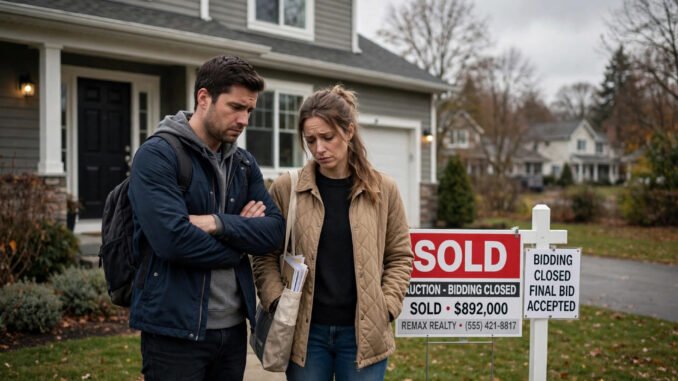
You found the one. Perfect neighborhood in Nashville, the kitchen you have dreamed about, within budget — you submitted what felt like a strong offer. Then the call: someone outbid you at the last minute. Again. If this keeps happening, you are not unlucky — you are underprepared for how Nashville’s market actually works. Being outbid at the last minute has specific causes, specific costs, and — most importantly — specific countermeasures.
This guide breaks down why last-minute outbidding happens in Nashville, what it really costs you (beyond disappointment), and how to stop it from happening again.
Why It Keeps Happening in Nashville
Nashville’s market dynamics create last-minute bidding wars by design:
Systematic underpricing. Listing agents deliberately price 3–5% below expected sale price to generate multiple offers. The “last-minute outbid” is not an accident — it is the strategy working. Your offer at asking price was never competitive; it was the opening bid in an auction you did not know you were in.
Offer deadlines compress competition. Sellers set offer review dates (often 3–5 days after listing), concentrating all bids into a single window. Everyone bids blind against everyone else, and the highest bidders often submit in the final hours — hence the “last minute” feeling.
Cash and escalation clauses dominate. In competitive Nashville segments, 20–30% of winning offers involve cash purchases or escalation clauses (automatic bid increases up to a cap). If you are bidding conventionally against these tools, you are bringing a knife to a gunfight.
Information asymmetry. Listing agents legally cannot disclose competing offer terms in Tennessee, but they signal interest levels (“we have strong activity”). Buyers who misread these signals underbid; experienced buyers’ agents decode them accurately.
What Being Outbid Really Costs
Beyond the emotional toll, repeated outbidding has concrete costs:
Direct costs per failed offer: $400–$600 for inspections you commissioned pre-offer (common in competitive markets where buyers inspect before offering), plus appraisal fees, plus your agent’s time. Five failed offers can easily cost $2,000–$3,000 in sunk costs.
Market drift: while you lose bidding wars over months, prices rise. Nashville’s appreciation means the home you could not win in March costs 2–3% more by September — you are chasing a moving target.
Decision fatigue and desperation: the most expensive cost. After four losses, buyers overbid recklessly on the fifth — waiving inspections, stretching budgets, ignoring red flags. Desperation bidding is how people buy the wrong house at the wrong price. Managing performance anxiety applies here more than you would expect — bidding wars are high-pressure decisions, and calm bidders make better ones.
How to Stop Losing: The Countermeasures
1. Use an escalation clause
An escalation clause automatically increases your offer in set increments above competing bids, up to your maximum. Example: offer $400,000, escalating in $2,500 increments to $425,000. You never pay more than needed to beat the next-highest offer, and you compete in the final hours without being awake at midnight. In Tennessee, escalation clauses are legal and increasingly standard — if your agent has not suggested one, get a new agent.
2. Bid based on sold comparables, not list price
Ignore the list price — it is marketing. Your agent should provide sold comparables from the last 90 days within half a mile, adjusted for condition and features. Bid against where the market clears, not where the listing starts. In hot Nashville neighborhoods, clearing prices run 3–8% over list; your offer must reflect that reality from the beginning.
3. Strengthen terms, not just price
Sellers choose offers on total attractiveness: flexible closing dates, waived (or shortened) inspection contingencies, larger earnest money deposits, appraisal gap coverage (agreeing to cover a shortfall if the appraisal comes low — the defining tool of 2021–2026 competitive markets). A $410,000 offer with appraisal gap coverage beats a $415,000 offer without it when appraisals are uncertain.
Appraisal gap strategy: offering to cover up to $10,000–$15,000 above appraised value removes the seller’s biggest fear (the deal collapsing on appraisal) while capping your exposure. This single term wins more bidding wars than extra price dollars.
4. Get fully underwritten pre-approval
A standard pre-qualification letter is nearly worthless in competition. Fully underwritten pre-approval (lender has verified income, assets, credit — only the property is unknown) closes the gap with cash offers and can shorten closing to 21 days. Some Nashville lenders offer pre-approval with appraisal waivers for strong borrowers — ask.
5. Write the personal letter (where legal)
Note: some states restrict “love letters” over fair-housing concerns. Where permitted, a brief, genuine letter about why this home matters can tip close decisions — sellers are human, and emotional connection breaks ties. Keep it about the house, never about personal characteristics.
When to Walk Away (Protecting Yourself From Yourself)
Set your walk-away number before the bidding war, based on comparables and your budget — not in the heat of competition. Rules that protect you:
Never waive the inspection entirely. Use shortened inspection periods or inspection-for-information-only (you can walk away but not renegotiate) instead. Waiving inspections in Nashville’s older housing stock — foundation issues, termite history, aging systems — is gambling, not strategy. Always understand what a home inspection costs and covers before deciding what to waive.
Cap your overbid. Decide the maximum over comparable value you will pay (2%? 5%?) and hold it. Overpaying 10% to “win” means starting your homeownership underwater — the right buyer’s agent will tell you when to stop, even when you do not want to hear it.
Recognize the sunk-cost trap. Money spent on failed offers is gone. It does not justify overbidding on the next one — that is throwing good money after bad with a mortgage attached.
Conclusion
Being outbid at the last minute in Nashville costs $400–$600 per failed attempt plus market drift and mounting desperation — but it is fixable. The National Association of Realtors tracks bidding-war prevalence by market, and the Consumer Financial Protection Bureau’s homebuying toolkit walks through offer-strengthening options. Bid against sold comparables (not list prices), use escalation clauses, strengthen terms with appraisal gap coverage and full underwriting, and set walk-away limits before competing. The buyers who win in Nashville are not the luckiest — they are the best prepared. Become one of them.
Frequently Asked Questions
What is an escalation clause and is it legal in Tennessee?
An escalation clause automatically raises your offer in increments above competing bids up to your stated maximum. Yes, legal in Tennessee, and increasingly standard in competitive situations. Your agent should be fluent in drafting them.
How much over asking should I offer in Nashville?
Ignore asking price — offer based on sold comparables. In competitive neighborhoods, winning bids typically run 3–8% over list, but the right number depends entirely on how the property was priced relative to comparables. Some “over asking” offers are actually at market value.
Should I waive the home inspection to win a bidding war?
Almost never entirely. Better alternatives: shortened inspection periods (3–5 days), inspection for information only (walk-away rights without renegotiation), or pre-offer inspections. Nashville’s older housing stock hides expensive issues — waiving inspections is the riskiest concession in the toolkit.
What is appraisal gap coverage?
Your agreement to pay the difference if the appraisal comes in below your offer price, up to a stated cap (e.g., $15,000). It removes the seller’s fear of appraisal-related collapse and is often the deciding factor in close bidding wars.
How many offers should I expect to lose before winning?
In competitive Nashville segments, 3–5 lost offers is normal for well-prepared buyers; more than that suggests your strategy (not your luck) needs adjustment — usually stronger terms, better comparable analysis, or a different agent.
Leave a Reply