
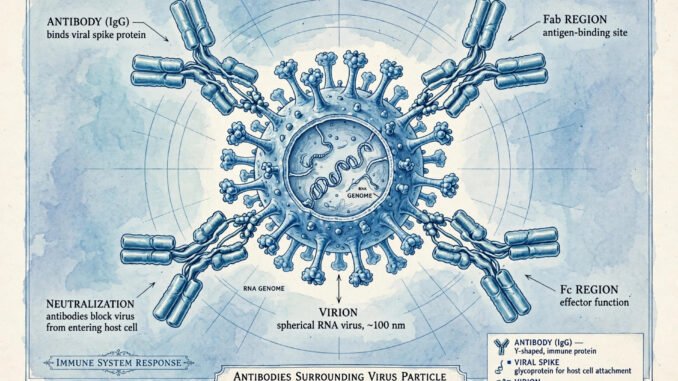
Vaccines are among the most studied medical interventions in history — and among the most misunderstood. The confusion is understandable: the explanations most people receive are either “trust the science” (not an explanation) or dense immunology jargon. But how vaccines work is genuinely fascinating and genuinely comprehensible. It is a story about training your immune system’s memory without paying the price of the actual disease — and understanding it makes every vaccine decision clearer, from flu shots to childhood schedules to the next pandemic’s new vaccine.
Your Immune System’s Two-Layer Defense
To understand vaccines, you need the 60-second version of immunity. Layer 1: Innate immunity — the generalist bouncers. Skin, mucous membranes, fever, inflammation, and patrolling cells (macrophages, neutrophils) that attack anything unfamiliar immediately but crudely. Fast, non-specific, no memory. Layer 2: Adaptive immunity — the specialist forces. B cells produce antibodies (Y-shaped proteins that tag specific pathogens for destruction); T cells either kill infected cells directly (killer T cells) or coordinate the response (helper T cells). Slow the first time (days to weeks to mount a full response) but capable of memory — and memory is the entire ballgame.
When you survive a natural infection, your adaptive immune system keeps memory B and T cells patrolling for years — sometimes decades. Reinfection gets crushed in hours instead of weeks. Vaccines exploit this exact mechanism: they create the memory without the disease. The CDC’s vaccine education resources explain this process with excellent visuals for visual learners.
How Vaccines Create Immunity (The Training Simulation)
Every vaccine presents your immune system with a harmless stand-in for the pathogen — close enough to train on, safe enough to not cause the disease:
Inactivated vaccines
Killed pathogens that cannot replicate (flu shots, polio IPV, hepatitis A). Safe for immunocompromised people; often need boosters because the immune response is milder.
Live-attenuated vaccines
Weakened pathogens that replicate slightly without causing disease (MMR, chickenpox, nasal flu vaccine). Produce strong, long-lasting immunity — but not used in severely immunocompromised people.
mRNA vaccines
Instructions (messenger RNA) telling your own cells to briefly manufacture a single viral protein — typically the spike protein — which your immune system then learns to recognize. The mRNA degrades within days; it never enters the cell nucleus and cannot alter DNA (a persistent myth worth killing: mRNA cannot integrate into your genome — it lacks both the mechanism and the access). COVID-19 vaccines made this platform famous, but the technology had decades of research behind it.
Other platforms
Viral-vector vaccines (a harmless carrier virus delivers pathogen instructions), protein-subunit vaccines (just the key protein fragment plus an immune-boosting adjuvant), and toxoid vaccines (inactivated bacterial toxins, for tetanus and diphtheria).
Whichever platform, the outcome is identical: memory B and T cells trained on the pathogen’s signature, ready to mobilize in hours rather than weeks when the real thing arrives. That time difference — hours versus weeks — is the difference between an exposure you never notice and a disease that hospitalizes you.
Why Boosters Exist (Immunity Is Not Forever)
Immune memory fades — at different rates for different diseases. Measles memory lasts decades; tetanus needs a booster every 10 years; flu needs annual updates because the virus itself mutates (antigenic drift), not just because immunity wanes; COVID boosters target evolving variants. Boosters are not evidence vaccines “do not work” — they are maintenance on a system that naturally decays, like repainting a house. The schedule exists because immunologists measured the decay curves, not because of guesswork.
Herd immunity is the community-level reason your vaccination protects others: when enough people are immune, the pathogen cannot find enough susceptible hosts to sustain transmission — shielding newborns, the immunocompromised, and others who cannot be vaccinated. The threshold varies by disease contagiousness (measles needs ~95% coverage; it is that infectious). Your shot is partly a civic act, and understanding that reframes the decision from purely personal to communal.
Side Effects: What Is Normal, What Is Not
Normal (signs it is working): Sore arm, mild fever, fatigue, headache for 1–3 days — these are your innate immune system responding to the training exercise, not the disease. They resolve on their own. Uncommon but known: Specific vaccines carry small, documented risks (e.g., rare clotting events with certain COVID vaccines, myocarditis signals in young males with mRNA vaccines — almost all mild and resolving, and far rarer than the cardiac risks of actual COVID infection). Seek care for: Signs of severe allergic reaction within minutes to hours (difficulty breathing, facial swelling — extremely rare, which is why you wait 15 minutes post-vaccination), or symptoms persisting beyond a few days.
Risk literacy matters: every medical intervention carries some risk, and the honest comparison is always vaccine-risk versus disease-risk — not vaccine-risk versus zero-risk. For every routine vaccine, the disease’s risks exceed the vaccine’s by orders of magnitude; that is why they are recommended. The National Institutes of Health and the FDA’s vaccine information pages publish the underlying safety data for anyone who wants to read primary sources rather than summaries.
Evaluating Claims (Your Misinformation Toolkit)
Vaccine misinformation follows recognizable patterns — learning them protects against all of it: Anecdote as data: “My cousin got the shot and then got sick” — temporal association is not causation; millions of daily health events coincide with vaccinations by chance. Ingredient alarmism: Listing chemical names (formaldehyde, aluminum) without doses — the dose makes the poison, and vaccine quantities are minuscule compared to everyday exposures (a pear contains more formaldehyde than a vaccine). Fake experts: Credentials in unrelated fields presented as authority; check whether the person publishes in relevant peer-reviewed literature. Conspiracy framing: Claims requiring thousands of scientists, regulators, and doctors across dozens of countries to coordinate silently — extraordinary claims requiring extraordinary evidence that never arrives. Moving goalposts: When one claim is debunked, the goalpost shifts to a new one — a sign the conclusion preceded the evidence.
For health decisions generally, our guides to vitamin D deficiency signs and early diabetes signs model the same evidence-based approach: understand the mechanism, check reputable sources, and beware certainty from non-experts.
Conclusion
Understanding how vaccines work means grasping one elegant idea: they run a safe training simulation for your adaptive immune system, creating memory B and T cells that turn a weeks-long vulnerable response into an hours-long non-event — without you ever suffering the disease. Different platforms (inactivated, live-attenuated, mRNA, subunit) are just different training dummies for the same lesson. Boosters maintain fading memory; herd immunity extends your protection to those who cannot be vaccinated; and side effects are mostly the visible signs of training in progress. It is not faith in science — it is understanding the mechanism, which is better.
Frequently Asked Questions
How do vaccines work in simple terms?
Vaccines expose your immune system to a harmless version of a pathogen (or just its key protein), training memory cells to recognize it. When the real pathogen appears later, your immune system responds in hours instead of weeks — often clearing it before you feel sick.
Can mRNA vaccines change your DNA?
No. mRNA never enters the cell nucleus where DNA lives, degrades within days, and lacks any mechanism to integrate into the genome. This has been confirmed by extensive molecular research.
Why do I need vaccine boosters?
Immune memory naturally fades over time (at different rates per disease), and some pathogens mutate (like flu). Boosters refresh the memory — maintenance on a decaying system, not evidence the vaccine failed.
Are vaccine side effects normal?
Mild ones (sore arm, low fever, fatigue for 1–3 days) are normal signs of immune activation. Severe reactions are extremely rare. The honest comparison is always vaccine risk versus disease risk — the disease is far riskier for every routine vaccine.
What is herd immunity?
When enough people are immune, a pathogen cannot find susceptible hosts to sustain spread — indirectly protecting those who cannot be vaccinated (newborns, immunocompromised). Thresholds vary: ~95% for measles, lower for less contagious diseases.
Leave a Reply