
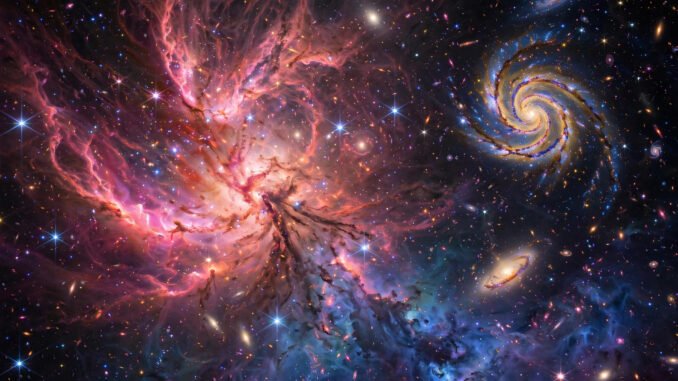
On Christmas morning 2021, the James Webb Space Telescope launched on a million-mile journey to a gravitational parking spot beyond the Moon — carrying the hopes of astronomers and a $10 billion price tag. Four years later, it has rewritten textbooks: galaxies that should not exist, atmospheres on distant worlds, stars being born in unprecedented detail. But the headlines (“NASA finds possible signs of life!”) often outrun the science. Here is what the James Webb Space Telescope has actually found, what it means, and what the breathless coverage gets wrong — no astrophysics degree required.
Why Webb Sees What Hubble Could Not
Three upgrades make Webb revolutionary: Size: Its 6.5-meter gold-coated mirror collects ~6x more light than Hubble’s 2.4-meter mirror — like upgrading from binoculars to a proper telescope. Infrared vision: Webb sees primarily in infrared, the wavelength where the universe’s oldest light arrives. The expansion of space stretches ancient light into infrared (redshift) — Hubble, optimized for visible light, literally cannot see the earliest galaxies; Webb was built for them. Location: Parked at Lagrange point L2, 1.5 million km from Earth, with a tennis-court-sized sunshield cooling instruments to -370°F — the cold, dark stillness infrared astronomy demands.
The result: Webb sees the first few hundred million years after the Big Bang — an epoch no telescope had ever observed. The NASA Webb mission pages host the raw images and peer-reviewed findings behind every headline below.
The Impossible Early Galaxies
Webb’s most shocking discovery: massive, mature galaxies existing just 300–500 million years after the Big Bang — far earlier than cosmological models predicted such structures could form. Galaxies like JADES-GS-z14-0 (existing ~290 million years after the Big Bang) are brighter and more developed than theory allowed, some appearing to contain as many stars as the Milky Way in a fraction of the time.
This does not “disprove the Big Bang” (a favorite misreading) — the Big Bang framework stands on multiple independent evidence pillars. It means our models of galaxy formation were incomplete: early star formation was more efficient than assumed, early black holes grew faster, or our understanding of dark matter’s role needs revision. Theorists are actively updating models — this is science working correctly, not science collapsing. Several candidate “impossibly early” galaxies were later revised to nearer distances on better data, a healthy reminder that extraordinary claims await extraordinary confirmation.
Exoplanet Atmospheres: Reading Alien Air
Webb’s second revolution is exoplanet science. By analyzing starlight filtering through a planet’s atmosphere during transits (spectroscopy), Webb detects atmospheric molecules — water vapor, carbon dioxide, methane — on worlds light-years away. Highlights so far:
K2-18b: A potentially habitable-zone exoplanet where Webb detected carbon-bearing molecules including dimethyl sulfide (DMS) — on Earth, DMS is produced only by life (marine phytoplankton). The 2025 detection made global headlines as a possible biosignature. The crucial caveats: the signal is tentative, DMS can theoretically form abiotically under unknown conditions, and K2-18b may be a magma-ocean world rather than the water world initially hoped. “Possible hint of a possible biosignature” is the honest framing — thrilling, not conclusive.
TRAPPIST-1 system: Webb has been probing these seven rocky worlds around an ultracool dwarf star — mixed results so far, with some planets apparently stripped of atmospheres by stellar activity. The search continues; negative results are also data.
Direct imaging advances: Webb has directly photographed exoplanets and analyzed their atmospheres — including carbon dioxide detections that constrain how planets form. Each atmospheric spectrum is a chemistry lab result from another solar system, and the catalog grows monthly.
Stars, Birth and Death, in Unprecedented Detail
Beyond the headline cosmology, Webb’s infrared eyes have transformed stellar astronomy: the Pillars of Creation reimaged in haunting infrared detail, revealing star-forming knots invisible to Hubble; protostars caught in the act of formation with supersonic jets; planetary nebulae (dying stars) resolved into intricate structures; and the Cartwheel Galaxy‘s collisional rings mapped in star-formation detail. These images are not just pretty — each reveals physics of star birth and death that visible-light telescopes could not access through cosmic dust, which infrared penetrates.
Webb has also weighed in on the Hubble tension — the disagreement over the universe’s expansion rate — with measurements supporting the faster expansion rate, deepening one of cosmology’s biggest mysteries rather than resolving it. And its observations of supermassive black holes in the early universe (overweight relative to their galaxies) are reshaping theories of how black holes and galaxies co-evolve.
What Webb Has NOT Found (Headline Literacy)
A field guide to reading Webb news: “Signs of life detected” almost always means “a molecule that could indicate life was tentatively detected, with major caveats” — the distance from that to confirmed life is enormous. “Breaks physics” means “challenges a specific model,” not the laws of physics. “Older than the universe” stars/galaxies invariably resolve to measurement uncertainties on closer analysis. Pretty-picture stories are real science communication, not fluff — but the image is the press release; the peer-reviewed paper is the finding. Check whether the story cites a published paper (arXiv or a journal) versus a conference presentation or a researcher’s speculation — the evidentiary weight differs enormously. For the medical-science equivalent of this literacy, our guides to vitamin D deficiency and early diabetes signs apply the same evidence standards closer to home.
Miami readers have a local connection: Webb’s images are processed and archived with contributions from institutions across the country, and Florida’s Kennedy Space Center — where so many great observatories began their journeys — remains the gateway for the next generation of space telescopes already in development.
What Comes Next
Webb’s mission is planned for 10+ years (fuel may extend it to 20) — a partnership spanning NASA, the European Space Agency, and the Canadian Space Agency. Coming: deeper surveys of the cosmic dawn, atmospheric characterization of potentially habitable worlds (the true biosignature hunt), and synergy with the next flagships — NASA’s Roman Space Telescope (wide-field surveys feeding Webb targets) and the Habitable Worlds Observatory (designed specifically to image Earth-like exoplanets, launching in the 2040s). The $10 billion investment is amortized over decades of discovery; by any scientific measure, it is already among the highest-ROI instruments ever built.
Conclusion
What the James Webb Space Telescope has found, in brief: unexpectedly mature galaxies in the universe’s first few hundred million years (forcing galaxy-formation models to evolve), the first detailed atmospheric chemistry of distant worlds including a tentative possible biosignature on K2-18b (thrilling, unconfirmed), and transformative views of star birth and death — all while deepening mysteries like the Hubble tension rather than closing them. Read the headlines with the caveats attached, follow the peer-reviewed papers rather than the press releases, and enjoy the genuine wonder: we are watching the universe’s childhood photos develop in real time, and the album keeps getting stranger.
Frequently Asked Questions
What is the James Webb Space Telescope’s biggest discovery so far?
The unexpectedly massive, mature galaxies in the first 300–500 million years after the Big Bang — which are forcing revisions to galaxy-formation models — and the first detailed atmospheric spectra of exoplanets, including a tentative biosignature hint on K2-18b.
Has Webb found signs of alien life?
Not conclusively. Webb detected dimethyl sulfide (a potential biosignature gas) in K2-18b’s atmosphere, but the signal is tentative and non-biological explanations have not been ruled out. It is a lead, not a detection.
How is Webb different from Hubble?
Webb’s mirror is ~6x larger, it observes in infrared (seeing the universe’s earliest light, stretched by cosmic expansion), and it operates from the cold, stable L2 point 1.5 million km away — letting it see epochs Hubble physically cannot.
Did Webb disprove the Big Bang?
No. Early massive galaxies challenge models of galaxy formation speed, not the Big Bang framework itself, which rests on multiple independent lines of evidence. Theorists are updating formation models — normal science.
How long will the Webb telescope operate?
The nominal mission is 10 years, with fuel potentially lasting 20. It will work alongside upcoming observatories like the Roman Space Telescope, with the Habitable Worlds Observatory following in the 2040s.
Leave a Reply