
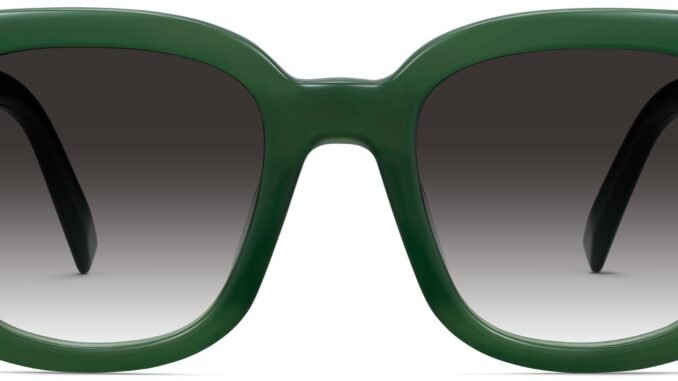
You try on sunglasses and some pairs make you look like a celebrity while others make you look like a confused insect. How do I pick sunglasses that suit my face shape? The difference isn’t price or brand — it’s geometry. The golden rule of eyewear: choose frames that contrast your face shape. Round face? Angular frames add definition. Square face? Round frames soften angles. It’s that simple, and it works every time. I’ve helped enough friends sunglass-shop to know that five minutes of face-shape knowledge saves hours of fitting-room despair.
Here’s how to identify your face shape, the frames that flatter each one, and the universal rules that apply to everyone.
How Do I Pick Sunglasses That Suit My Face Shape? Step 1: Find Your Shape
Pull your hair back, look straight into a mirror, and trace your face’s outline mentally (or literally, with a dry-erase marker on the mirror):
- Oval: forehead slightly wider than chin, face longer than wide, softly rounded — the most versatile shape, suits almost everything.
- Round: roughly equal width and length, full cheeks, soft rounded chin and forehead.
- Square: strong jawline, broad forehead, roughly equal width measurements, angular chin.
- Heart: wide forehead and cheekbones, narrow pointed chin.
- Diamond: narrow forehead and jawline, wide dramatic cheekbones.
- Oblong/rectangular: long and narrow, with a longer forehead-to-chin distance.
Best Frames by Face Shape
- Oval — wear anything, mind the scale. Your only rule: frames shouldn’t be dramatically wider or narrower than your face. Aviators, wayfarers, round, square — all fair game. Lucky you.
- Round — go angular and wide. Rectangular, square, and geometric frames add angles where your face has curves. Wider frames make the face look longer and slimmer. Avoid small round frames (they emphasize roundness).
- Square — go round and soft. Round, oval, and aviator frames soften strong angles. Look for frames slightly wider than your cheekbones. Avoid boxy, angular frames that double down on the squareness.
- Heart — balance the forehead. Bottom-heavy or rimless frames, round styles, and aviators draw attention downward, balancing a wider forehead. Avoid top-heavy or oversized frames that add forehead width. Cat-eyes work beautifully here.
- Diamond — soften the cheekbones. Oval, rimless, and cat-eye frames complement dramatic cheekbones. Avoid narrow frames that emphasize width at the cheeks.
- Oblong — add width. Oversized, wide, and tall frames (wayfarers, large squares) add width to balance length. Avoid small or narrow frames that elongate further.
Universal Rules (Every Face Shape)
- Scale matters as much as shape. Petite faces drown in oversized frames; larger faces look pinched in tiny ones. Frame width should roughly match face width — your eyes should sit centered in the lenses.
- Brow line: the top of the frame should follow (not cross awkwardly through) your brow line. Ideally your eyebrows peek just above the frames.
- Fit check: frames shouldn’t slide down your nose (too wide at the bridge), pinch your temples (too narrow), or touch your cheeks when you smile (too tall). Nose pads are adjustable — use them.
- UV protection is non-negotiable. Style means nothing without 100% UVA/UVB protection (labeled UV400). Price doesn’t determine protection — $15 gas-station shades with UV400 protect as well as $300 designer pairs. Polarized lenses cut glare (great for driving/water) but don’t add UV protection by themselves — check for both.
- Consider your coloring. Warm skin tones (know your best colors) glow in tortoise, gold, warm brown, and amber frames; cool tones suit black, silver, blue, and gray.
Smart Sunglass Shopping
- Try before you buy — or use virtual try-on. Warby Parker, Zenni, and most major retailers offer home try-on (5 frames, free) or AR virtual fitting. Use them — photos reveal what mirrors hide.
- Budget smart. You don’t need designer: Sunski, Goodr ($25–$35, polarized, fun), and Warby Parker ($95, prescription-available) all deliver quality. Keep a cheap backup pair in the car.
- Match lifestyle: sport wraparounds for active use, classic wayfarers/aviators for daily wear, one statement pair for fun. Two pairs (daily + backup) beats one expensive pair you panic about losing.
- Care basics: hard case always (not your pocket), microfiber cloth only (shirt-tails scratch lenses), never leave them on a hot dashboard (heat warps frames and delaminates coatings).
Sunglasses are also a style signature — the right pair becomes your look. And they protect the delicate eye-area skin that sunscreen alone can’t fully cover. For ongoing style inspiration, GQ’s eyewear guides and Who What Wear’s picks track the classics and the trends.
Prescription Sunglasses: Worth It?
If you wear glasses, squinting through summer isn’t your only option. Prescription sunglasses ($100–$200 at Warby Parker, Zenni, or Costco Optical) are transformative — proper UV protection plus clear vision, in frames you chose for your face. Transitions/photochromic lenses ($50–$100 add-on) darken outdoors and clear indoors — convenient, though they don’t get as dark as dedicated sunglasses and don’t activate well behind car windshields (UV-blocked glass). Clip-ons and fit-overs: the budget options — modern magnetic clip-ons are far less dorky than the 90s versions. Contacts + regular sunglasses: maximum flexibility if you tolerate contacts. The wrong choice is doing nothing: squinting causes wrinkles, headaches, and UV damage to eyes. If cost is the barrier, Zenni does prescription sunglasses starting around $40 — there’s no excuse left. Your eyes face the same UV that burns your skin; treat them with the same seriousness.
Storing Sunglasses So They Survive
Sunglasses die from neglect, not wear — scratched lenses, warped frames, lost screws. The system: hard case, always — the soft pouch is for cleaning cloths, not protection. Toss the glasses in a bag uncased and they’ll be scratched within a week. Microfiber only for cleaning — shirt tails, paper towels, and tissues all scratch lens coatings microscopically (the haze builds up over months). Never on your head as a headband — it stretches the frames and they’ll slide down your nose forever after. Never on the dashboard — car interiors hit 170°F in summer, warping frames and bubbling lens coatings. Tighten screws yearly — any optician does it free in 30 seconds. A $30 pair maintained this way outlasts a $200 pair treated carelessly — and scratched lenses aren’t just ugly, they distort vision.
The practical takeaway: identify your face shape, choose contrasting frames (angular for round faces, round for square faces, balanced for heart), match the scale to your face, and never compromise on UV400 protection. The $30 pair that fits your face beats the $300 pair that doesn’t — geometry over brand, every time.
Leave a Reply