
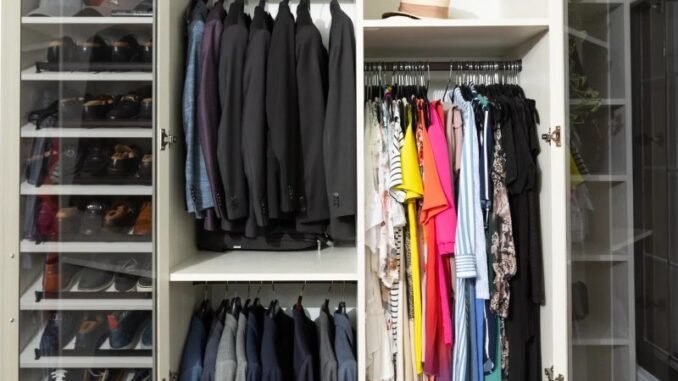
New career, new city, new you — and a closet full of college hoodies and fast-fashion regrets. How do I build a professional wardrobe from scratch? Building from zero is actually an advantage: no bad habits to unlearn, no clutter to work around. You get to build intentionally, piece by piece, ending up with a wardrobe where everything works together — the opposite of the random accumulation most people have. I’ve guided friends through this exact process, and the ones who followed a plan spent less and looked better than the ones who panic-shopped.
Here’s the 90-day system: the foundation, the expansion, and the finishing that makes it all look expensive.
How Do I Build a Professional Wardrobe From Scratch? The Strategy
Build in phases, buy versatile first, and never buy anything that doesn’t match at least 3 things you own. The phases:
Phase 1: The Core 10 (Days 1–30, ~$300–$500)
Ten pieces that generate 20+ outfits. Everything neutral, everything mixable:
Women: navy blazer, black blazer (or one great blazer + cardigan), 3 blouses (white, light blue, one print/solid color), 2 bottoms (dark trousers, pencil skirt or sheath dress), 1 pair pointed flats, 1 pair low heels or loafers, 1 structured tote.
Men: navy suit (the two-piece doubles as blazer + pants separately), 3 dress shirts (white, light blue, subtle pattern), 2 trousers (gray, charcoal — beyond the suit pants), 1 pair brown oxfords, 1 pair black oxfords (or one versatile dark pair + loafers), 2 ties, 1 belt matching primary shoes.
Where to buy: this is the budget professional shopping strategy — thrift for blazers and leather goods, clearance for the rest, Uniqlo/Target/Old Navy for shirts and basics. Quality thresholds: blazers and shoes deserve the best you can afford (they’re the visible 80%); shirts and basics can be budget.
Phase 2: The Expansion (Days 30–60, ~$200–$300)
Once the core works, add personality and coverage:
- Seasonal layer: wool overcoat or trench (thrifted, $30–$60) — the most visible winter piece, worth hunting.
- 3–4 more tops in your accent colors — now that neutrals are covered, add the colors that feel like you.
- Second bottom option: different cut or color for variety.
- Second shoe style: boots for winter, loafers for summer — seasonal rotation.
- Accessories: watch (affordable luxe options), simple jewelry, scarves, quality belt.
Phase 3: The Polish (Days 60–90, ~$100–$200)
- Tailoring blitz: take everything to a tailor at once — hems, waist tweaks, sleeve adjustments. $100–$150 transforms the entire wardrobe. This is the highest-ROI phase.
- Grooming setup: the haircut that works, the skincare basics, nail care. Professional appearance is 50% grooming.
- Fill specific gaps: after 60 days of wearing the wardrobe, you’ll know exactly what’s missing. Buy only those things.
- Occasion piece: one step-up outfit for important meetings, interviews, or events (men’s semi-formal / wedding guest).
The Rules That Make It Work
- Neutrals first, color second. Navy, charcoal, black, white, gray, beige — the foundation. Color comes in Phase 2 as accents. Neutrals all match each other; that’s the whole trick.
- Fit over everything. A $40 blazer tailored ($25) looks like $300. An untailored $300 blazer looks like $40. Budget for alterations from day one — or learn DIY tailoring.
- Cost-per-wear thinking: a $150 blazer worn 100 times = $1.50/wear. A $30 trendy top worn twice = $15/wear. The “expensive” blazer is cheaper. Buy for frequency.
- One in, one out (after Phase 3). The wardrobe is complete — new purchases replace, not accumulate. This maintains the intentionality forever.
- Dress for the job you have, slightly elevated. Observe the office for a week before Phase 2 — match the culture, then add 10% polish. Decode the dress code before investing.
- Maintain ruthlessly: steam/iron weekly, polish shoes monthly, depill knits, repair immediately. A maintained budget wardrobe outclasses a neglected expensive one — see clothing revival.
Common From-Scratch Mistakes
- Buying everything at once. You’ll buy wrong without wearing-data. Phases exist for a reason.
- Ignoring your actual dress code. A wardrobe of suits for a business-casual startup = wasted money. Observe first.
- All statement, no basics. The interesting pieces need boring foundations to work. Basics first, always.
- Skipping the tailor. The #1 difference between “new professional wardrobe” and “looks like a professional.”
- Forgetting lifestyle pieces. You still need weekend clothes — don’t spend the entire budget on workwear and have nothing for Saturday.
Total realistic budget: $600–$1,000 over 90 days for a complete, tailored, professional wardrobe — less than most people spend annually on random clothes that don’t work together. And the system maintains itself: with capsule principles and one-in-one-out, you’ll never “have nothing to wear” again.
For ongoing professional style guidance, Corporette (women) and Primer (men, budget-conscious) are the best long-term resources I’ve found.
The Maintenance System (Keeping It Professional for Years)
A wardrobe is a system, not a purchase — here’s the maintenance that keeps it sharp indefinitely. Weekly (15 min): steam or iron the week’s rotation, check for loose buttons or threads, polish shoes. Monthly: depill knits, condition leather shoes and bags, review what you actually wore (the unworn reveal future donations). Seasonally: the full triage — revive, repair, rehome, retire (see the seasonal revival ritual). Rotate seasonal storage properly. Annually: reassess the whole wardrobe against your current role and life — careers evolve, and the wardrobe should follow. Budget $100–$200/year for maintenance and strategic additions — a fraction of what random shopping costs. The professionals who always look polished aren’t buying constantly; they’re maintaining relentlessly. The system you built in 90 days runs on about 20 minutes a week — less time than most people spend deciding what to wear each morning.
Adapting the Wardrobe as Your Career Evolves
The wardrobe you built for your first professional job won’t be the wardrobe you need at year five — and that’s fine. Promotions: each level up usually means slightly more polish — upgrade fabrics before adding pieces (a wool blazer replaces the polyester one, not alongside it). Industry changes: moving from corporate to startup (or reverse) requires recalibration — observe first, then adjust gradually, not overnight. Remote work: the waist-up wardrobe becomes real — invest in great tops, keep the bottoms simple. The constant: fit, grooming, and quality basics transfer across every career change. Review annually: does this wardrobe match the professional I’m becoming? Evolve it deliberately — a piece or two per quarter — and you’ll never wake up one day feeling like your clothes belong to a past version of you.
The practical takeaway: 90 days, 3 phases — 10 neutral core pieces first ($300–$500), personality and seasonal expansion second ($200–$300), tailoring blitz and gap-filling third ($100–$200). Neutrals first, fit over price, cost-per-wear thinking, and a tailor on speed dial. Build it once, intentionally, and getting dressed is solved for years.
Leave a Reply