
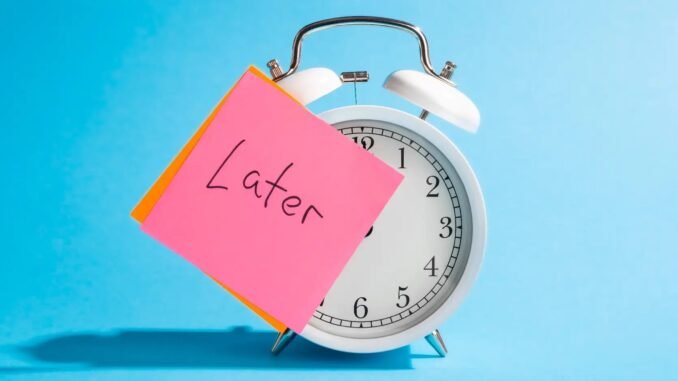
I once spent three hours “researching” the perfect to-do app instead of doing the 20-minute task the app was supposed to organize. That’s procrastination in its purest form — productive-feeling avoidance. If you’re asking how can I stop procrastinating on important tasks, start by forgiving yourself for the misunderstanding: procrastination isn’t a time-management problem or a character flaw. Research consistently shows it’s an emotion-management problem. We delay tasks that make us feel bored, anxious, insecure, or overwhelmed — and we do something mood-repairing instead.
This reframe changes the solution completely. You don’t need more discipline; you need to make the task feel less threatening to start. Everything below is engineered around that single insight.
How Can I Stop Procrastinating on Important Tasks? Shrink the Task Until It’s Silly
Your brain resists big, vague tasks (“do taxes,” “write report”) because it can’t picture the first step. The fix: shrink the task until starting feels ridiculous.
- The 5-minute rule: Commit to just 5 minutes. Open the document and write one sentence. You have full permission to stop after 5 minutes — but you almost never will, because starting was the entire barrier. Psychologists call this behavioral activation: action creates motivation, not the reverse.
- The next-physical-action rule: “Plan vacation” is not actionable. “Open Google Flights and search Denver dates” is. If a task has been on your list for a week, it’s too vague — break it until the next step is a physical action under 10 minutes.
- The 2-minute version: Ask “what’s the 2-minute version of this task?” Reply to one email instead of clearing the inbox. Put on workout clothes instead of “exercising.” Momentum compounds from tiny starts.
Diagnose Your Flavor of Procrastination
Different causes need different fixes. Which one is yours?
- The Overwhelmed: The task feels huge. → Break it into 15-minute chunks on paper. Do chunk one today. A time-management system at work helps when the overwhelm is professional.
- The Perfectionist: You delay because it won’t be good enough. → Set a “shitty first draft” rule: version one is allowed to be terrible. Editing a bad draft beats facing a blank page every time.
- The Bored: The task is dull. → Pair it with something pleasant (music, a café, a podcast for admin tasks) or gamify it: timer, points, a reward after.
- The Anxious: You’re afraid of failing or being judged. → Shrink the stakes: “I’m just exploring options” instead of “I’m making the final decision.” And consider journaling through the worry — naming the fear shrinks it.
- The Deadline-Thriller: You “work best under pressure.” → You don’t; you just only work under pressure. Manufacture earlier deadlines: tell someone you’ll send a draft Friday, book the appointment, make the pressure real but earlier.
Design Your Environment for Starting
Willpower is unreliable; environment is destiny. Set up your space so starting is the path of least resistance:
- The night-before setup: Open the document, lay out the materials, put the running shoes by the door. Morning-you shouldn’t have to make any decisions — just begin. This is the same principle that makes mornings less rushed.
- Remove the competitors: Phone in another room during work blocks. Log out of the distracting sites (don’t rely on willpower — add friction). Close the 47 tabs; each one is a tiny “ooh, shiny” waiting to happen.
- Time-box with visible timers: 25-minute Pomodoros with a physical or phone timer. The ticking clock creates gentle urgency, and “just 25 minutes” feels doable. After 4 rounds, take a real 20-minute break.
- Temptation bundling: Only allow yourself the good podcast / fancy coffee / favorite playlist while doing the avoided task. Your brain starts associating the task with the reward.
The Accountability Layer
For tasks that truly matter — the business launch, the health change, the big project — add social pressure:
- Body doubling: Work alongside someone else (in person or on a silent video call). Just having another person present dramatically reduces the urge to drift. Free body-doubling communities exist on Discord and Reddit.
- The weekly review: Every Sunday, 10 minutes: what got done, what’s stuck, what’s the one priority for next week. Procrastination thrives in vagueness; the review forces clarity.
- Tell someone the deadline. “I’ll send you the draft by Thursday” converts an internal intention into a social commitment — and humans hate breaking those.
The Procrastination Emergency Kit
For the task you’re avoiding right now: 1. The 5-minute start. Set a timer for 5 minutes and begin. You’re allowed to stop when it rings — you won’t. Starting is the entire battle; the brain resists beginnings, not middles. 2. The ugly first draft. Give yourself explicit permission for terrible output. “Write the worst version” removes the perfectionism that’s actually causing the delay. You can edit garbage; you can’t edit a blank page.
3. The environment reset. Phone in another room, one tab open, desk cleared. Every notification is a procrastination accomplice — remove them physically, not with willpower. 4. The body double. Work alongside someone (in person or on a virtual co-working session). Having another human present mysteriously dissolves the urge to drift — it’s why libraries work. 5. The implementation intention. Write: “At [time], in [place], I will [tiny first step].” This specific formulation outperforms vague plans dramatically in behavioral research summarized by the APA. Pick one tool from the kit and use it in the next 10 minutes. The task you’ve been avoiding for a week is 25 focused minutes from being done — the emergency kit just gets you to minute one.
The Evening Shutdown That Prevents Tomorrow’s Procrastination
Procrastination often starts the night before, with a vague plan. End each workday by writing tomorrow’s first task — the specific, tiny first step — on a sticky note. “Open the spreadsheet and fill in column A” beats “work on report.” Your morning self inherits a starting line instead of a decision. Five minutes tonight saves an hour of avoidance tomorrow.
The Bottom Line
You’re not lazy — you’re avoiding an emotion attached to the task. Shrink the task to a 5-minute start, diagnose which flavor of procrastination is yours, set up your environment the night before, and add one layer of accountability. Pick the task you’ve been avoiding longest and do the 2-minute version right now, today. Future you — the one with the thing actually done — will be grateful.
Leave a Reply