
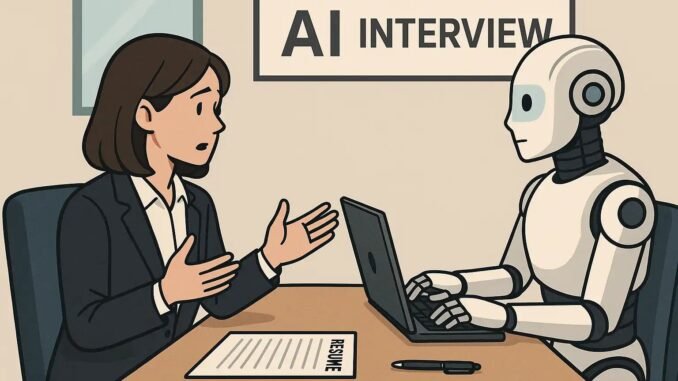
You’ve got the interview. Now the panic sets in: What will they ask? How do I talk about that resume gap? What if they ask the salary question? Here’s the thing most candidates miss — interview performance is a skill, and like any skill, it improves dramatically with practice. The problem has always been finding someone to practice with. AI solves that completely. If you’re asking how can AI help with job interview preparation, here’s the full playbook: AI as your mock interviewer, answer coach, company researcher, and salary negotiation strategist.
The data on this is straightforward: candidates who do mock interviews perform significantly better — they’re more concise, handle surprises calmly, and tell better stories. Most people skip practice because it’s awkward to ask a friend and expensive to hire a coach ($100–$300/hour). AI mock interviews are free, available at midnight, and never judge your rambling first attempts. Let’s use that.
How Can AI Help With Job Interview Preparation? The Mock Interview Method
Set up your AI interviewer
The setup prompt matters. Try:
“You’re a hiring manager at [company] interviewing me for [role]. Here’s the job description: [paste it]. Here’s my resume: [paste it]. Conduct a realistic interview: ask one question at a time, wait for my answer, then give brief feedback (what worked, what to improve) before the next question. Start with ‘tell me about yourself.’ Be tough but fair — ask the hard follow-ups a real interviewer would.”
Then answer out loud — typing defeats the purpose. Use voice mode (ChatGPT’s voice feature or just talk and transcribe). The awkwardness of speaking your answers is the training; polished typed answers don’t transfer to real interviews.
Practice the questions that actually get asked
Ask the AI to cover the full range across multiple sessions:
- Behavioral: “Tell me about a time you failed.” “Describe a conflict with a coworker.” “Give an example of leadership.” (Use the STAR method — Situation, Task, Action, Result — and have AI critique your structure.)
- Role-specific: “Walk me through how you’d [key job task].” Paste the job description so questions target the actual role.
- The hard ones: “Why the resume gap?” “Why are you leaving your current job?” “What’s your greatest weakness?” “Why should we hire you over other candidates?”
- Curveballs: “Now throw in 3 unexpected questions to test how I handle surprises.”
Get feedback that stings (usefully)
After each answer: “Rate my answer 1–10. What specifically weakened it? Rewrite it showing what a 9/10 version sounds like.” The rewrite comparison is where the learning happens — you see the gap between your instincts and strong answers. Common AI feedback themes: too long (cut 50%), too vague (add numbers), no structure (use STAR), buried the lede (lead with the result).
Beyond Practice: Research and Strategy
Company and interviewer research
“I’m interviewing at [company] for [role]. Summarize: what they do, recent news, their culture signals, likely interview focus areas, and 3 insightful questions I can ask them.” Then verify key facts — AI company data can be dated. Asking sharp questions (“I saw you launched X last quarter — how is the team thinking about Y?”) signals genuine interest and separates you from 90% of candidates.
Salary negotiation prep
“The range for [role] in [city] is [$X–$Y]. I have [N] years of experience. What’s a reasonable target, and how do I respond if they offer the bottom of the range?” Then role-play the negotiation itself — AI plays the hiring manager, you practice holding firm without being adversarial. Ground your targets in real data from the Bureau of Labor Statistics Occupational Outlook Handbook, which publishes salary ranges by role and region.
Story bank building
Great interviews run on stories, not adjectives. “Based on my resume, help me identify my 5 strongest career stories and map each to common behavioral questions using the STAR format.” Walk in with 5 polished stories and you can answer 80% of behavioral questions by adapting them.
Follow-up emails
“Draft a thank-you email for my interview with [name] at [company]. Reference [specific topic discussed]. Warm, concise, not desperate.” Send within 24 hours. Small touch, real impact.
What AI Can’t Do (The Human Parts)
- It can’t replicate the pressure. Real interviews have stakes and unpredictable humans. AI practice builds the content; only real interviews build the nerves. Do enough AI reps that the content is automatic, freeing mental bandwidth for the human dynamics.
- It can’t read the room. Body language, energy matching, building rapport — these are human skills. Practice them with real humans (even informal coffee chats count).
- Don’t memorize scripts. AI-polished answers should become talking points, not scripts. Memorized answers sound robotic and collapse under follow-up questions. Know your stories; speak naturally.
- Verify company facts. AI sometimes invents company details. Confirm anything you’ll say in the interview against the company’s actual site and recent news.
Your Interview Prep Timeline
- 1 week out: Research the company + role with AI. Build your story bank. Draft questions to ask them.
- 3–5 days out: 2–3 mock interview sessions (30 min each), different question sets. Focus on weak answers.
- 1–2 days out: Salary negotiation role-play. Prepare your outfit, logistics, documents.
- Day of: 10-minute warm-up — answer “tell me about yourself” out loud once. Review your 3 questions for them. Then stop preparing and trust the reps.
For the resume that got you the interview, our AI resume guide covers getting noticed. And for the career behind the interview, our AI-proof careers analysis helps you aim at durable fields.
Quick Answers: AI Interview Prep
How many mock interviews should I do with AI?
Two to three focused 30-minute sessions beats ten casual ones. Cover behavioral questions (STAR format), role-specific questions from the job description, and the hard ones (resume gaps, salary). Practice answers out loud — typed practice doesn’t transfer to real interviews.
The bottom line: set up an AI mock interviewer with your job description and resume, practice answers out loud across behavioral/technical/hard questions, demand critical feedback with rewrites, research the company, role-play salary negotiation, and build a 5-story bank. Three focused sessions will put you ahead of most candidates — because most candidates don’t practice at all. The interview isn’t a talent contest; it’s a prepared contest. Prepare.
Leave a Reply