
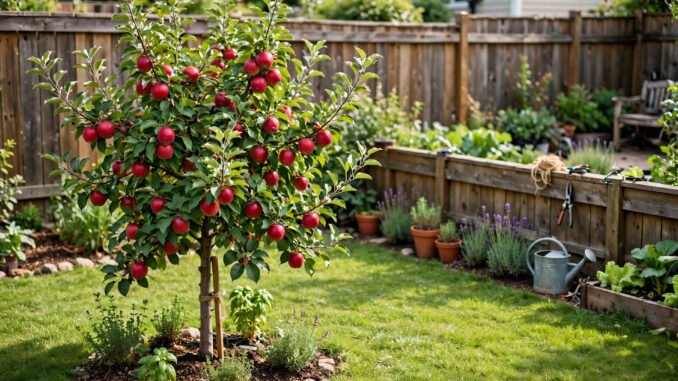
Should you plant a fruit tree now, or wait for a better season? The short answer is that it depends on the season you are standing in. Fall and late winter to early spring are genuine planting windows, so now is right surprisingly often. High summer is the one season where waiting usually wins, unless you can water faithfully week after week. The rest of this guide walks the calendar, the small-space trees, and the two details, pollination and chill hours, that decide whether a tree ever fruits at all.
Fall: The Best-Kept Secret
Fall, roughly October and November, is the insider’s planting window, and beginners rarely hear about it. The air cools, but the soil stays warm for weeks, and roots grow in that cool, warm-soiled gap while the top of the tree rests. A tree planted in fall spends the winter building roots underground, so it wakes in spring already settled, ahead of a tree planted that same spring.
There is one firm cutoff. Plant at least about 6 weeks before the ground freezes solid, so roots get time to grip the soil before hard cold locks it. In zone 7 and warmer, planting can run into December. In zone 5 and colder, finish by about late October. If you are reading this in fall with a few frost-free weeks still ahead, you are not late. You are right on time.
Late Winter to Early Spring: The Classic Window
The classic window runs from late winter into early spring, while trees are still dormant or just waking. This is bare-root season, when nurseries sell trees without pots, lifted while dormant and shipped cheaply. Bare-root trees look like implausible sticks, roots and a short trunk, and they are often the best value in the whole orchard world.
Plant bare-root trees as soon as the soil can be worked and before buds break into leaf. Keep roots damp from the moment the box opens, soak them in water for a few hours before planting if they look dry, and spread them naturally in a hole wide enough to hold them without bending or circling. A spring-planted tree then needs steady watering through its first summer, which is the honest trade for the low price and wide choice.
Summer: The Honest Case for Waiting
Summer planting can work. It simply charges you more for the same tree. A tree planted into heat has to grow roots and hold leaves against hot sun and drying wind at the same time, and it does that only with help. Planting in summer means watering deeply about 2 to 3 times a week through the first summer and mulching heavily to hold moisture and cool the soil.
Miss that rhythm for two hot weeks and a summer-planted tree may drop its leaves, or die back, or survive so weakened that it loses a full year. The same tree planted in fall asks far less of you, because roots establish before leaves demand water. So for most beginners the answer in high summer is wait for fall. Spend the summer choosing the variety, checking your chill hours, and preparing the spot. That is not lost time. It is the part of planting that decides whether the tree thrives.
The exception is a container-grown tree you find at a fair price, in a spot you can water without fail, perhaps near a tap or on a daily route through the garden. If you can honestly promise the water, summer planting is allowed. If the promise depends on remembering during holidays and heat waves, wait.
Trees Made for Small Gardens
The old image of a fruit tree, a 25-foot giant needing ladders and a weekend to prune, is outdated. Modern small gardens get trees bred and grafted to stay small, and they fruit sooner as well. The size of a fruit tree is set mostly by its rootstock, the root system the fruiting variety is grafted onto, which is why learning how dwarfing rootstocks keep fruit trees small is worth ten minutes before you order anything.
Dwarf trees stand about 8 to 10 feet tall at maturity. Grown on dwarfing rootstocks, M27 or M9 for apples and Gisela 5 for cherries, they stay genuinely small, fruit within about 2 to 3 years, and can be pruned and picked from the ground. Two dwarf apples fit a 10-by-10-foot corner, which means a real mini-orchard in the space a trampoline would take.
Columnar trees go narrower still, about 2 feet wide and 8 to 10 feet tall, growing as a single upright cordon with short fruiting spurs along the trunk. Plant them 2 to 3 feet apart as a fruiting hedge along a fence, and a boundary becomes a harvest. They need a yearly tidy rather than real pruning skill, which suits beginners well.
Containers widen the map further. Figs, citrus in warm zones or moved indoors for winter, dwarf peaches, and columnar apples all fruit in about 15 to 20 gallon pots. A pot lets renters grow trees, lets tender trees dodge winter, and lets you place a tree in the sunniest spot you own even if that spot is a patio with no soil at all.
Pollination: The Detail That Decides Everything
A healthy tree that never fruits is a sad and common sight, and very often it is a pollination problem bought by accident. Some varieties are self-fertile. One tree sets fruit on its own, and for the smallest gardens these are the safest buys. Many figs, most sour cherries, and many modern plums and peaches fall into this group, though you should always confirm for the exact variety you order.
Other trees need a partner, a different variety of the same fruit that flowers at the same time, so bees can carry pollen between them. Most apples work this way. Plant one apple alone in a neighborhood with no other apple or crabapple nearby and you may get blossom every spring and fruit never. The fix is simple when you know it at buying time, two compatible varieties, or one self-fertile pick, and painful when you learn it five years later.
Chill Hours: The Invisible Requirement
Fruit trees need a set number of winter hours roughly between 32 and 45 degrees Fahrenheit to break dormancy and fruit properly. These are chill hours. A tree that gets too few wakes unevenly, flowers weakly, and fruits poorly or not at all, no matter how well you feed and water it. Too much chill rarely harms. Too little quietly ruins everything, which is why this requirement stays invisible until a tree disappoints for years.
It helps to understand how chill hours work and why varieties differ before matching a tree to your climate. The standard illustration is the Honeycrisp apple, needing around 800 to 1,000 chill hours, planted somewhere like Phoenix, which gets roughly 300. That tree will struggle every year, and no care fixes a mismatch written into its variety. Plant a low-chill variety in Phoenix instead, and the same garden becomes a good fruit garden.
Check your area’s typical chill-hour count before ordering, through a local extension service or a nursery that sells for your region. Then pick varieties listed at or below your count. This single check, done once, prevents the most puzzling failure in small orchards, the beautiful tree that simply never delivers.
Realistic Timelines and Costs
Dwarf trees fruit in about 2 to 3 years, and container trees follow a similar story. Standard trees take longer, which is another reason small gardens suit dwarfs. Expect the first harvests to be light, a handful of fruit while the tree builds its frame, and judge the tree from its third or fourth year onward.
Yields deserve honest framing. A mature dwarf in the ground can give you tens of pounds of fruit in a good year. A potted tree gives a smaller but real harvest, enough for fresh eating and a few good desserts, not a preserving empire. Plan your space and your hopes around that split, and every harvest will feel like a success rather than a shortfall.
Prices, at typical recent levels, run like this. Bare-root dwarfs commonly cost about $30 to $60. Potted trees cost about $60 to $120. Add a stake, mulch, and perhaps a guard against rabbits in the first winter, and a single well-chosen tree, planted in the right window, is a modest one-time cost for years of fruit.
One winter note belongs with containers. Potted trees in cold zones overwinter best moved under cover or into an unheated garage, because roots in a pot feel far more cold than roots in the ground. A garage that stays just above hard-freezing suits most hardy potted trees. Gardeners weighing a more permanent shelter for tender pots can start by understanding greenhouse basics without wasting money, though for most potted fruit trees the garage is protection enough.
Questions Beginners Ask Most
Can I grow fruit trees in containers permanently?
Yes, if the tree suits pots and the pot is big enough, about 15 to 20 gallons for dwarf trees. Potted trees need more regular watering and feeding than trees in the ground, and a refresh of the top layer of compost each spring helps. Move pots under cover for winter in cold zones.
How many fruit trees do I need for pollination?
One, if the variety is self-fertile. Two compatible varieties, if it needs a partner. Check the pollination note for the exact variety before buying, and remember that a neighbor’s apple or a flowering crabapple nearby can sometimes serve as the partner for apples.
What is the easiest fruit tree for a beginner?
A self-fertile fig in a pot is hard to beat where summers are warm, since it fruits young, shrugs off pruning mistakes, and moves indoors in cold zones. In cooler gardens, a dwarf apple on a dwarfing rootstock, chosen for your chill hours, is the classic first tree.
Do fruit trees need spraying?
Many home trees give good fruit with no spray at all, especially if you pick varieties known for disease resistance and clear fallen fruit so pests cannot cycle. Some regions and varieties benefit from a simple dormant spray in winter. Ask a local extension service what, if anything, your fruit and area actually need before buying products.
How do I find my chill hours?
Look up your area’s typical count through your local extension service, a regional nursery, or the chill-hour maps many fruit nurseries publish. Use the typical count, not one warm winter’s figure, and choose varieties that need that many hours or fewer.
Leave a Reply