
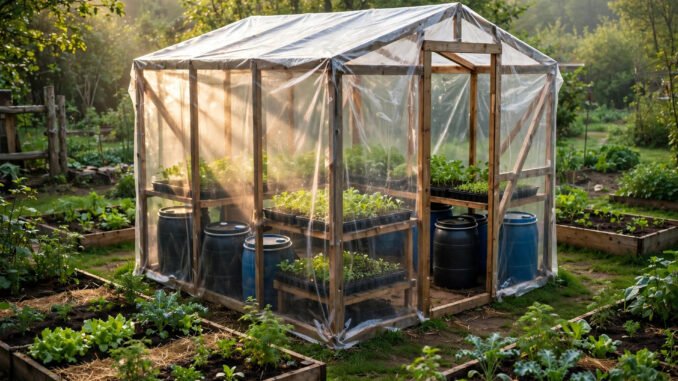
A greenhouse is a sunlight trap — glass or plastic that lets light in, holds warmth, and turns a short growing season into a long one. Gardeners have used the principle since Roman times (emperors ate cucumbers year-round from mica-covered carts), and the Victorians turned it into architecture. Today you can understand everything about how greenhouses work — heat, humidity, ventilation, glazing — without spending a cent, and you can build a working one for less than a restaurant dinner. Here’s the no-waste guide: the physics in plain English, the free learning path, and what to skip.
What a Greenhouse Actually Does
Three mechanisms, that’s all. 1. Solar gain: transparent glazing transmits short-wave sunlight, which strikes soil, plants, and interior surfaces and converts to long-wave heat radiation — which the glazing largely blocks from escaping. That’s the greenhouse effect in miniature (and yes, the same physics as the planetary one). 2. Convection blocking: outside, warmed air rises and blows away; inside, the structure traps it. This matters more than most beginners realize — a huge share of a greenhouse’s warmth is just still air. 3. Thermal mass: water barrels, stone floors, or even the soil itself absorb daytime heat and release it at night, smoothing temperature swings. Humidity is the fourth factor everyone learns about the hard way: trapped air plus transpiring plants equals damp conditions that fungi adore, which is why ventilation — roof vents, louvers, or just a door cracked open — is as essential as the glazing. A greenhouse that can’t vent is a plant sauna; a greenhouse that can’t hold heat overnight is an expensive cold frame. Understanding these five variables (light, heat gain, heat retention, humidity, airflow) means you understand greenhouses, full stop — everything else is sizing and materials.
The Types, From Free to Serious
Cold frame ($0–$30): a bottomless box with a transparent lid, placed over a garden bed. It’s a greenhouse shrunk to one plant’s height — extends the season 4–6 weeks each end, built from scrap lumber and an old window. Hoop house ($50–$200): curved PVC or metal hoops draped with greenhouse plastic over a bed or row. The workhorse of small-scale growers; a 10×20-foot hoop house costs under $150 in materials and meaningfully changes what you can grow. Lean-to ($100–$500): built against a house wall, borrowing the building’s thermal mass and often a water source — the most efficient small greenhouse per dollar. Freestanding hobby greenhouse ($300–$2,000+): the classic glass or polycarbonate structure; kits start around $300 for small polycarbonate models. Heated/greenhouse-plus ($$$): supplemental heat, fans, automated vents — the tier where costs explode and where most beginners should not start. The no-waste principle: start with the smallest structure that solves your actual problem. Want salad greens in March? A cold frame. Want to start tomatoes eight weeks early? A hoop house. Almost nobody’s first-year problem requires a heated glass palace.
The Free Learning Path
Books (library): your public library’s gardening section holds the canon — look for season-extension and greenhouse titles; the good ones are heavy on diagrams of vent placement and thermal mass, which is exactly what you need. Extension publications (free PDFs): every land-grant university’s cooperative extension publishes greenhouse and high-tunnel guides written for growers, not marketers — search “[your state] extension high tunnel” for plans with materials lists. YouTube: channels from market gardeners show real hoop-house builds with real costs, mistakes included — watching someone’s $120 build outperform a $900 kit teaches more than any catalog. In person: botanical gardens and conservatories are working greenhouses you can walk through; study their vent placement, shading, and thermal mass, then steal the ideas at your scale. The National Gardening Association’s resources and The Old Farmer’s Almanac’s growing guides both cover season extension with the practicality of people who’ve actually done it. Total tuition: $0.
Building on a Budget: The $120 Hoop House
The classic budget build: ten 10-foot lengths of ½-inch PVC or ¾-inch metal conduit bent into hoops (a simple jig from plywood), pushed over rebar stakes along a 4×12-foot bed, covered with 6-mil greenhouse plastic (UV-treated — the one thing worth buying proper; cheap construction sheeting degrades in months), ends closed with spare plastic and clothespins or wiggle wire. Ventilation: roll up the sides on warm days — literally just unclip and roll. Thermal mass: black-painted water jugs along the north side. This structure adds roughly one USDA hardiness zone of protection and 6–8 weeks of season extension each end. Salvage upgrades the economics further: old windows become cold-frame lids, sliding glass doors become lean-to glazing (check Craigslist “free” listings and Habitat ReStores). The two budget mistakes: undersized ventilation (a sealed hoop house hits 120°F on a sunny 50°F day and cooks everything — vent early, vent often) and flimsy anchoring (a greenhouse is a sail; stake it like you mean it). For what to grow inside, start with the best plants for beginners with no gardening experience — forgiving crops forgive learning curves — and remember the harvest doesn’t stop at the garden gate: knowing tricks for keeping fresh herbs from going bad so fast means your extended-season bounty actually gets eaten.
What Not to Waste Money On
Heating in mild climates: if your winters are zone 8+, thermal mass plus a small hoop house handles most of it; electric heaters mostly heat the neighborhood. Automated everything: automatic vent openers are genuinely useful ($30–$50 each, wax-cylinder powered, no electricity) — but full sensor-driven climate control on a first greenhouse is hobby money, not garden money. Glass for beginners: beautiful, heavy, fragile, expensive; twin-wall polycarbonate insulates better, costs less, and survives hail. “Greenhouse” seed starting kits with tiny peat pots: a sunny windowsill plus a $5 bag of seed-starting mix does the same job. Exotic glazing films promising miracle yields — the peer-reviewed differences are marginal; orientation, ventilation, and watering dominate results. The pattern: every dollar should go toward structure, glazing, or ventilation — the physics — not toward gadgets that decorate the physics.
Understanding greenhouse basics without wasting money comes down to five variables and one habit: light in, heat held, air moved, humidity managed, mass buffering — learned free from extension guides and other growers’ builds, then applied with the smallest structure that solves your problem. The Romans grew cucumbers in winter with mica and manure heat. You, with a library card and $120 of PVC and plastic, can absolutely grow salad in March.
Frequently Asked Questions
How much does a small greenhouse cost to build?
$0–$30 for a scrap-built cold frame, $50–$200 for a DIY hoop house over a garden bed, $300+ for small polycarbonate kits. The budget sweet spot is a DIY hoop house around $120 — real season extension for little money.
Do I need to heat a greenhouse in winter?
Usually not for season extension. An unheated greenhouse with thermal mass (water barrels, stone) handles cool seasons in most climates; heating is for tropical plants or deep-winter growing and is where operating costs explode. Ventilation matters more than heating for beginners.
What’s better: glass or polycarbonate?
For beginners, twin-wall polycarbonate: cheaper, lighter, better insulating, and hail-proof. Glass is prettier and lasts longer but costs more, weighs far more (needing a stronger frame), and shatters. Most hobby growers choose polycarbonate.
Why did my plants die in my new greenhouse?
Almost always heat or humidity: an unvented greenhouse can exceed 120°F on a sunny cool day, cooking plants in hours. Vent early and often, add shade cloth in summer, and water in the morning so foliage dries before night.
Can a greenhouse really extend my growing season?
Yes — typically 6–8 weeks on each end for simple structures, effectively adding a hardiness zone. Cold frames and hoop houses are the highest return per dollar; they turn “too cold to plant” into “already harvesting.”
Leave a Reply