
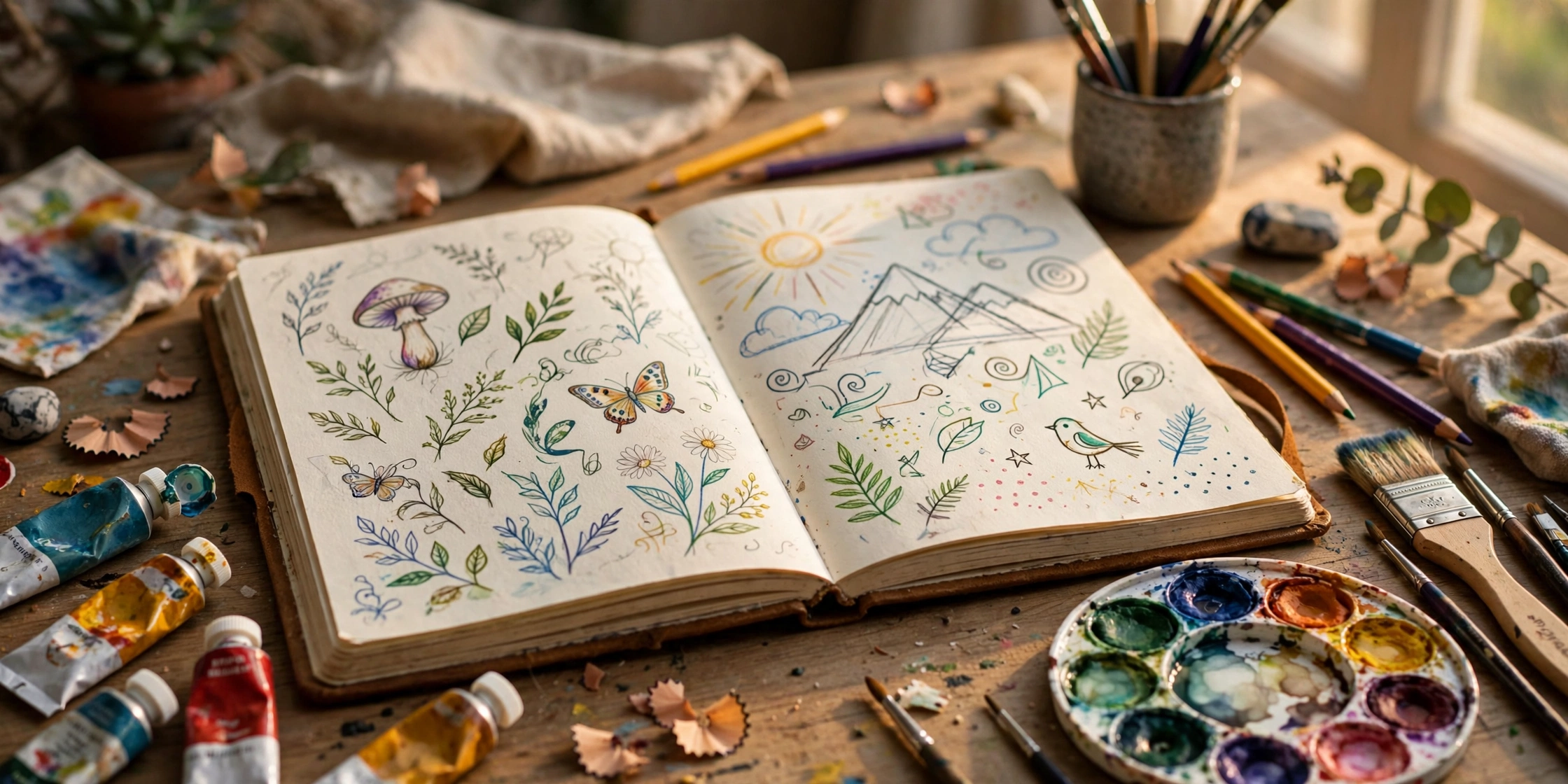
Every artist knows the feeling: a blank page, a willing hand, and absolutely nothing in your head. Learning how to find art inspiration is not about waiting for a lightning bolt — it is about building habits and systems that keep ideas flowing even on uninspired days.
These 15 ideas are practical, tested, and free or cheap. Some will click immediately; others are worth trying once before you judge them. And if you ever wonder why humans make art at all, read what art means across cultures — the answers are fascinating.
1. Keep a Daily Sketchbook (No Pressure)
The single most effective habit. Draw something small every day — a coffee cup, your hand, a stranger on the bus — with zero expectation of quality. The humble sketchbook is where most professional artists say their best ideas actually start: not as masterpieces, but as messy notes to their future selves.
2. Visit Museums and Galleries
Standing in front of real artwork does something no screen can replicate. You see the texture, the scale, the brushwork. Do not just look at art in your own medium — a painter can learn composition from sculpture, and a photographer can learn light from oil paintings.
3. Take a Long Walk With Your Eyes Open
Leave your phone in your pocket and walk slowly. Notice the colour of a door, the shape of a shadow, the way light hits a puddle. Many artists carry a small viewfinder (or just make a frame with their hands) to ‘crop’ the world into compositions. The ordinary becomes extraordinary when you frame it deliberately.
4. Work in a Different Medium
Painters: try collage. Photographers: try charcoal. Digital artists: try ink. A new medium removes your usual crutches and forces fresh thinking — and the ideas you generate often translate back into your main work in surprising ways.
5. Set Constraints
Paradoxically, limits boost creativity. Try: only three colours, only circles, a 10-minute time limit, or a canvas no bigger than your palm. Constraints silence the inner critic (‘it doesn’t have to be good, it’s just an exercise’) and the results are often your most original work.
6. Copy the Masters (For Learning)
Reproducing a favourite painting or drawing teaches you how the artist thought. You notice decisions you would never see by just looking. Keep these as studies — learning tools, not work to exhibit — and the techniques seep into your own style.
7. Photograph Everything
Your phone is a portable inspiration archive. Photograph interesting textures, colour combinations, faces, buildings, and accidents of light. Review the roll monthly; you will be amazed how many future pieces are hiding in your camera roll.
8. Read Outside Your Field
Poetry, science writing, history, cookbooks — ideas cross-pollinate. A paragraph about deep-sea creatures can inspire a whole series of paintings. The broader your inputs, the more original your outputs.
9. Join a Challenge or Group
Inktober, daily drawing challenges, local art groups — external structure and community accountability work. Seeing how fifty people interpret the same prompt is itself a masterclass in creative thinking.
10. Revisit Old Work
Dig out sketchbooks from years ago. You will find half-formed ideas your younger self abandoned that your current skills can actually execute. Artists often describe this as ‘collaborating with your past self.’
11. Change Your Environment
Draw in a café instead of your studio. Paint outdoors. Visit a neighbourhood you have never explored. Brand new environments supply fresh visual information, and your brain cannot help but respond.
12. Listen to Music or Podcasts While Working
Sound changes what your hand does. Fast music produces energetic marks; ambient sound produces meditative ones. Some artists build whole series around albums. Try working to a musical genre you would normally never choose and watch what happens.
13. Embrace Boredom
Constant stimulation kills the daydreaming state where ideas form. Take a long bath, stare out of a train window, do the washing up without a podcast. Boredom is not the enemy of creativity — it is the waiting room.
14. Teach Someone Else
Explaining a technique to a beginner forces you to articulate what you do instinctively — and you will spot gaps and possibilities in your own understanding. Teaching is one of the fastest ways to see your own work with fresh eyes.
15. Give Yourself Permission to Make Bad Art
The fear of wasting materials or time is the biggest inspiration-killer of all. Designate cheap paper and 20-minute sessions as ‘play time’ with no outcome required. Ironically, the work made without any pressure is very often the work that ends up mattering most.
When Inspiration Still Won’t Come
Sometimes a block is really exhaustion, not emptiness. If you have tried everything and still feel flat, rest is the answer — not another technique. Sleep, exercise, and time away from the easel restore the mental resources that creativity draws on. The ideas will still be there when you return.
And remember that inspiration is only half the equation; craft is the other half. Our guide on how long acrylic paint takes to dry covers the practical side of actually executing your ideas, while pressing flowers in a book is a gentle, no-pressure craft for days when painting feels like too much.
Building a Long-Term Inspiration System
Individual ideas are sparks; a system is the engine. Here is a simple setup that keeps working year after year:
- Capture everything. Keep a notes app or pocket notebook for ideas, and record them the moment they appear. Ideas are slippery — the brilliant thought in the shower is gone by breakfast unless you write it down.
- Review monthly. Spend 30 minutes each month looking through your captures, photos, and sketches. Circle the three most exciting and schedule time to develop one.
- Run seasonal projects. Give each season a loose theme or constraint — ‘blue paintings this autumn,’ ‘portraits this winter.’ Themes focus your looking without limiting your making.
- Keep an inspiration shelf. Physical objects — interesting stones, fabric scraps, postcards, dried flowers — arranged where you work. Handling real things triggers ideas that screens cannot.
- Protect input time. Block an hour a week purely for looking: galleries, photobooks, films, long walks. Treat it as seriously as studio time, because it is studio time.
- how to press flowers in a book
Frequently Asked Questions
How do professional artists stay inspired?
Mostly through routine, not lightning bolts: daily sketching, regular gallery visits, and working through blocks instead of waiting for motivation.
What should I do when I hate everything I make?
Take a short break, switch mediums, or work smaller. Hating your work usually means your taste has outgrown your current skills — which is actually a sign of growth.
Is creative block a real thing?
Yes — though it is usually exhaustion, fear, or perfectionism rather than a true absence of ideas. Naming the actual cause points you to the actual fix.
Can you force inspiration?
You cannot force the feeling, but you can force the conditions: show up, set a timer, and start. Inspiration usually arrives about 15 minutes into the work, not before it.
Leave a Reply