
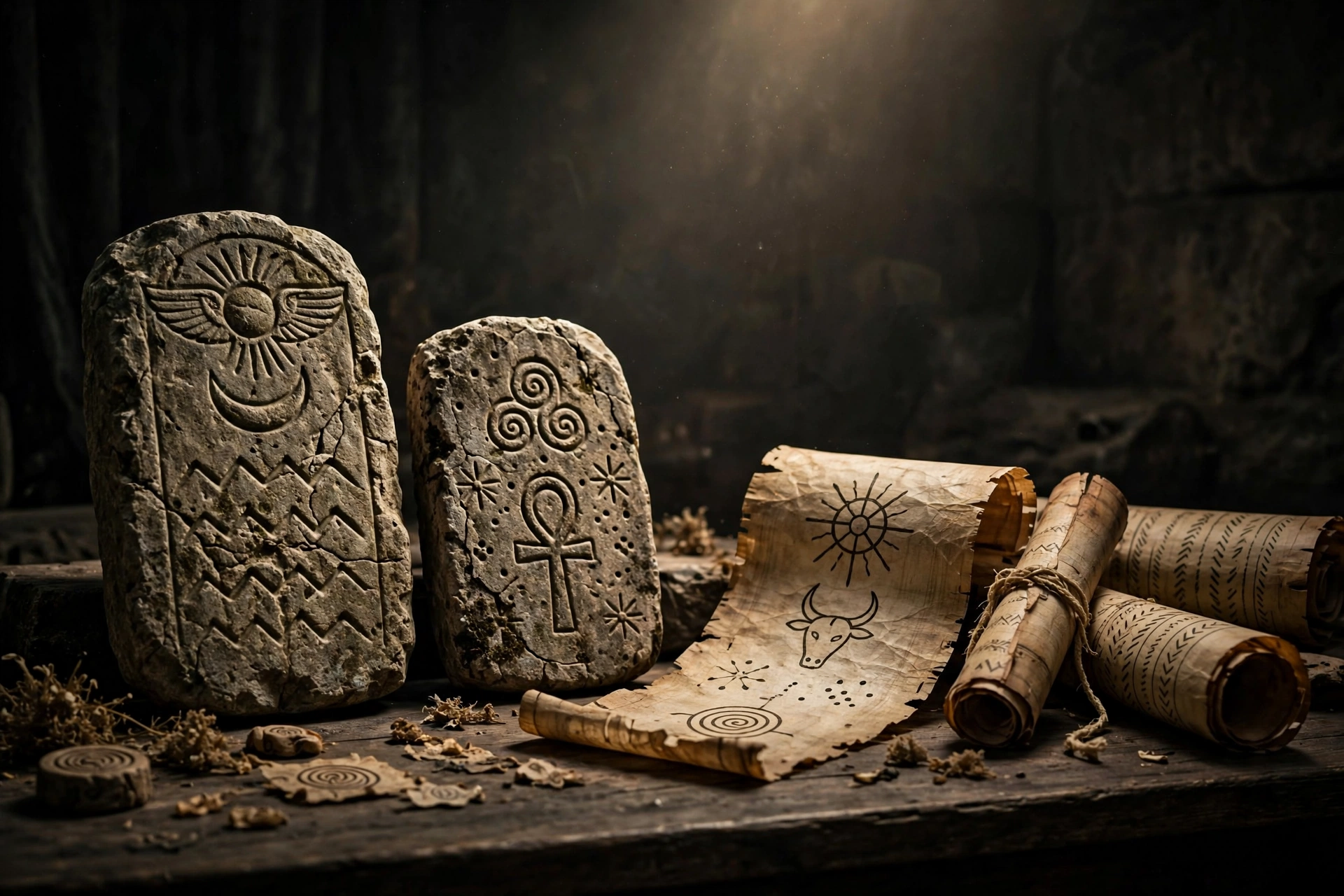
“How did God become God?” sounds like a riddle, but it’s one of the most serious questions in the history of religion. Every major faith has an answer — and the answers are wildly different. Some say God never “became” anything because God always existed. Others describe a God who emerged, evolved, or was elevated over centuries of human belief. This article walks through what history, theology, and anthropology actually say.
The Theological Answer: God Didn’t “Become” — God Always Was
In classical monotheism — Judaism, Christianity, and Islam — the question itself rests on a misunderstanding. God is defined as eternal: without beginning or end. The Bible opens with “In the beginning, God” — God is already there when the story starts. The Quran describes Allah as Al-Awwal (the First) and Al-Akhir (the Last). Asking how God “became” God is, in this framework, like asking what the number 7 was before it was 7 — a category error.
Philosophers gave this a technical vocabulary: God is “necessary being” (exists by nature, couldn’t not exist) as opposed to “contingent being” (everything else, which could have not existed). Thomas Aquinas, Avicenna, and Maimonides all built elaborate arguments — the cosmological and ontological arguments — for why a necessary being must exist. Whether you find those arguments convincing, they show how seriously the tradition takes God’s eternality.
The Historical Answer: How the Concept of God Evolved
Historians of religion tell a very different story — not about God, but about the idea of God, which demonstrably changed over time. The historical development of the concept of God is one of the best-documented stories in religious studies:
From many gods to one
Ancient Israelite religion began as polytheistic — the early texts casually mention multiple gods. Yahweh was originally a regional deity, possibly a storm or warrior god, worshipped alongside others like Baal and Asherah. Over centuries — through the reforms of kings like Josiah, the trauma of the Babylonian exile, and the writings of the prophets — Yahweh absorbed the attributes of all other gods and became the sole, universal God. Monotheism wasn’t the starting point; it was the destination.
The philosophical upgrade
When Jewish and later Christian thinkers encountered Greek philosophy, the concept of God absorbed philosophical attributes: omnipotence, omniscience, timelessness, immateriality. The God of the philosophers merged with the God of Abraham, producing the classical theism most people mean by “God” today.
Christianity’s innovation: the Trinity
Early Christians had to reconcile monotheism with their experience of Jesus as divine and the Holy Spirit as divine presence. The result — hammered out over centuries of councils and controversies — was Trinitarian doctrine: one God in three persons. It was a genuine conceptual revolution in what “God” means.
Islam’s restoration claim
Islam presents itself not as a new idea of God but as the restoration of the original monotheism of Abraham, corrupted over time. The Quran’s Allah is radically one (tawhid), transcendent, and without partners — a direct response to both Arabian polytheism and Christian Trinitarianism.
The Anthropological Answer: How Humans Invented Gods
Anthropologists and cognitive scientists approach the question from the other direction: why do human minds produce gods at all? The leading theories:
- Agency detection: Humans evolved to detect agents (predators, people) quickly — better safe than sorry. This “hyperactive agency detection” misfires on rustling bushes and thunderstorms, producing a sense of unseen beings.
- Theory of mind: We naturally attribute beliefs and desires to others. Extended to the universe, this produces gods who watch, judge, and care.
- Social function: “Big Gods” — moralizing, watchful deities — appear historically alongside large, complex societies. They may have helped strangers cooperate by making everyone feel watched by a higher power.
- Existential comfort: Gods answer unanswerable questions (why are we here? what happens when we die?) and provide comfort in the face of mortality.
In this view, God “became” God through a long co-evolution of human cognition, social complexity, and cultural storytelling — from ancestor spirits to nature gods to a single universal deity.
What About Jesus, Buddha, and Deified Humans?
Some figures literally “became” divine in their traditions’ telling:
- Jesus: Christians believe he was divine from eternity; historians note that the explicit doctrine of his full divinity developed over the first few centuries CE.
- Roman emperors: Were formally deified by the state — “becoming gods” by decree.
- Buddha: Explicitly not a god in original Buddhism, but later Mahayana traditions elevated him to a transcendent, almost divine status.
- Saints: In Catholic and Orthodox Christianity, humans recognized as sharing in divine life — venerated, not worshipped, but occupying a god-adjacent role.
The Mormon Answer: God Was Once Like Us
One tradition answers the question with striking directness. Latter-day Saint theology teaches that God the Father was once a mortal being who progressed to divinity — summarized in the couplet “As man now is, God once was; as God now is, man may be.” It’s the most literal “how God became God” answer in any major religion, and it remains one of Mormonism’s most distinctive (and controversial) doctrines.
So Which Answer Is Right?
It depends on what you’re asking. Theology answers “what is God?” History answers “how did the idea develop?” Anthropology answers “why do humans believe?” These aren’t competing answers to one question — they’re answers to three different questions that happen to share words.
What’s remarkable is the convergence: whether you see it as revelation unfolding, ideas evolving, or brains projecting, the human concept of God moved over millennia from many small gods to fewer bigger ones to — for billions of people — one ultimate reality. That trajectory itself is one of the most fascinating patterns in human history.
For more on humanity’s earliest stories about the divine, see how Adam and Eve populated the Earth — and for the human side of relating to God, how to ask God for forgiveness.
Monotheism Wasn’t Inevitable
One of the most striking findings in religious history is that monotheism was a late and unusual development. The evolution of monotheism shows that for most of human history, most people worshipped many gods — and the shift to one wasn’t a natural progression but a series of specific historical events: prophetic reforms, exiles, philosophical encounters, and imperial politics. Ancient Egypt’s brief Aten experiment under Akhenaten, Zoroastrianism’s elevation of Ahura Mazda, and Israel’s Yahweh-alone movement were independent experiments, not steps on a ladder. Monotheism won historically, but it wasn’t destined to.
The God of the Philosophers vs. the God of Religion
There’s a productive tension most believers live with but rarely name: the God of classical theology (timeless, changeless, impassible) versus the God of scripture (who regrets, relents, gets angry, and changes plans). Philosophers from Aristotle to Aquinas refined God into metaphysical perfection; the Bible portrays a God in dynamic relationship with people. Theologians have spent two millennia reconciling these — through analogical language, process theology, open theism, and other frameworks. The tension itself is revealing: it shows the concept of God being pulled between philosophical coherence and lived religious experience, and never fully settling on either side.
How Different Religions Answer “Why Only One?”
- Judaism: The Shema — “Hear, O Israel: the Lord our God, the Lord is one” — is both theology and identity, forged in resistance to surrounding polytheism.
- Christianity: Affirms one God while understanding that oneness as Trinity — unity complex enough to include relationship within itself.
- Islam: Tawhid (divine unity) is the absolute foundation; associating partners with God (shirk) is the one unforgivable sin.
- Sikhism: Ik Onkar — “One Universal Creator God” — opens the Guru Granth Sahib, rejecting both Hindu polytheism and Islamic legalism.
- Hinduism: Famously both: millions of deities understood as facets of one ultimate reality (Brahman) — monism wearing polytheism’s clothes, or vice versa.
Each tradition’s answer to “why one?” reveals what it values most: covenant loyalty, relational love, absolute transcendence, or ultimate unity.
Leave a Reply