
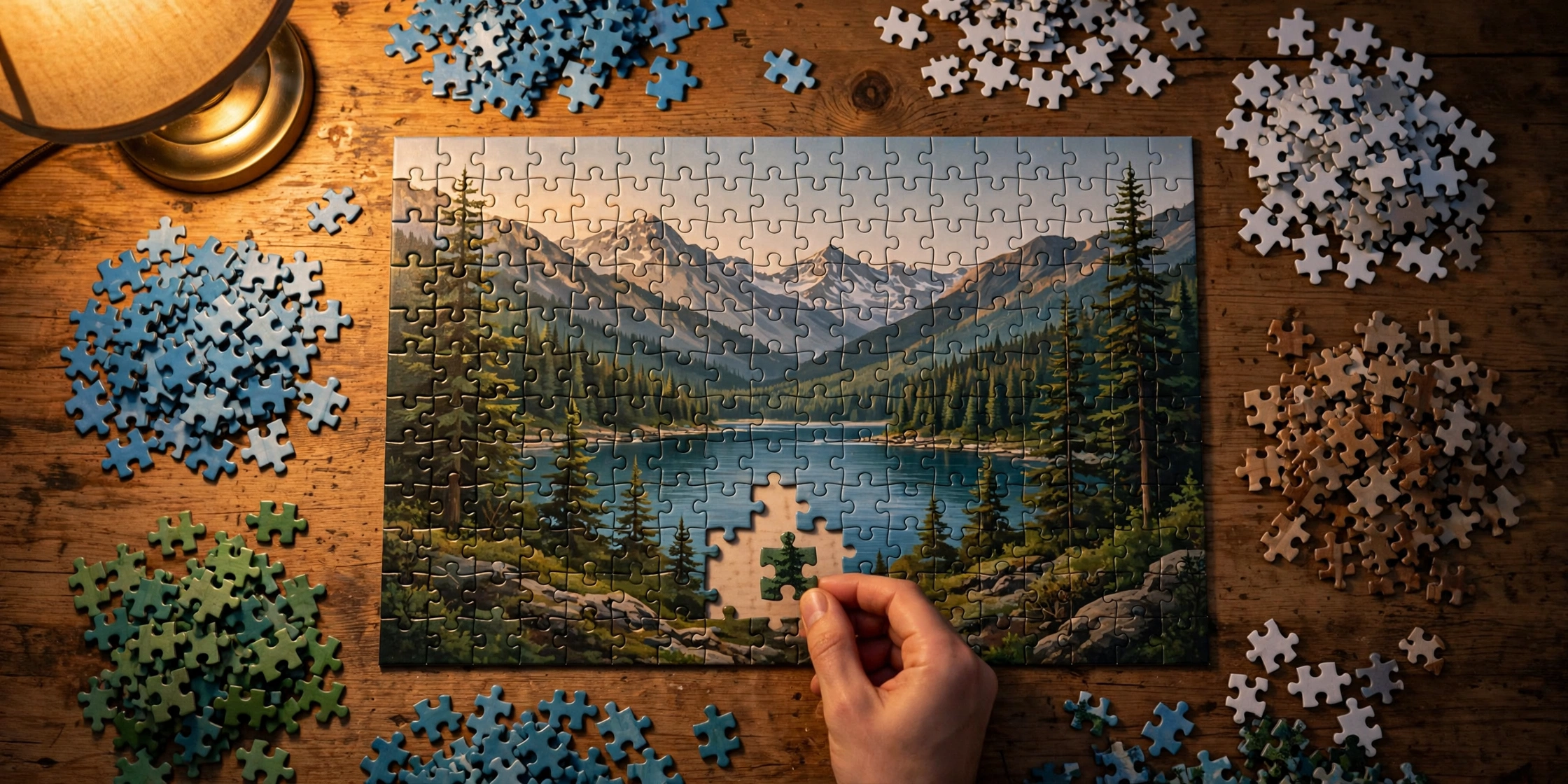
There is a special satisfaction in placing the final piece of a jigsaw — and a special frustration in staring at a half-finished sky for an hour. If you want to know how to solve a puzzle faster and with less agony, the secret is that experienced puzzlers do not just try harder; they use a system.
This guide covers the strategies that actually work, from sorting methods to the techniques competitive speed-puzzlers use. The history of puzzles as a pastime stretches back centuries, but the modern methods below are what win today. Whether it is a relaxed 500-piece family puzzle or a fearsome 2,000-piece monster, the underlying approach is exactly the same.
Start Right: Setting Up for Success
Before you place a single piece, set up properly. It sounds fussy, but it saves hours:
- Good lighting matters enormously. Natural daylight is best; a bright white lamp is second best. Warm yellow bulbs wash out subtle colour differences.
- Use a large, flat surface you can leave undisturbed — a dedicated puzzle table, a board you can slide under a sofa, or a felt puzzle mat that rolls up.
- Keep the box lid visible. Prop it up as your reference. For very hard puzzles, some people photograph it and zoom in on their phone.
- Sort your pieces first. This is the step beginners skip and experts never do. More below.
- how can i frame a puzzle
The Sorting System: Your Biggest Time-Saver
Sorting feels slow, but it is the highest-value activity in puzzling. The standard method, used by everyone from casual puzzlers to competitors, is well documented on the jigsaw puzzle Wikipedia page and in speed-puzzling communities:
- Separate edges from middles. Pull out every single piece with at least one straight edge. This is your frame.
- Sort the middles by colour and pattern. Use trays, muffin tins, or just piles: all the sky pieces together, all the grass together, all the red roof together.
- Sort by piece shape within colours if you are feeling ambitious — knobs and holes patterns help enormously in tricky areas.
- Set distinctive pieces aside. Text, faces, signs, and high-contrast details are landmarks; keep them where you can see them.
Build the Frame First
Always assemble the border before anything else. It is the easiest part, it defines your working area, and it gives you an early win that builds momentum. With the frame done, you have a bounded space and a clear sense of scale.
Tip: if two edge pieces look similar, check the box image — and remember that corner pieces have two straight edges, which makes them the easiest of all to identify.
Work From Landmarks Outward
After the frame, do not just grab random pieces. Identify the most distinctive areas of the image — a bright red barn, a person’s face, bold text — and build those first. These ‘islands’ of completed puzzle then grow outward and eventually connect.
This is the opposite of what beginners do (picking up piece after piece hoping for a match). Landmark-first puzzling is dramatically faster because every piece you try has a small, defined search area instead of the whole puzzle.
Strategies for the Hard Parts
Large Areas of Sky, Sea, or Grass
The dreaded monochrome zones. Strategies that help:
- Sort by piece shape — in a uniform area, shape is your only guide.
- Work from the edges of the zone inward, using the frame and adjacent completed areas as anchors.
- Look at the piece backs — subtle manufacturing variations are sometimes visible.
- Take breaks. Fresh eyes spot shape matches that tired eyes miss completely.
Repetitive Patterns
Wallpaper-like patterns are deceptive: many pieces look identical but are not. Here, the box image is essential — match the exact position of each motif rather than trusting your eye.
What Speed Puzzlers Do Differently
Competitive jigsaw puzzling is a real sport, with championships and world records (a 500-piece puzzle in under 40 minutes by top teams). Their techniques, adapted for normal humans:
- Two-handed sorting: they sort the entire puzzle in the first few minutes — an investment that pays off hugely.
- Shape-first in hard zones: they identify piece shapes (number of ‘innies’ and ‘outies’) before colours in difficult areas.
- No piece left unplaced: every piece they pick up gets either placed or deliberately set aside — never just put back in the pile.
- Work in parallel: in team events, each person owns a zone. Solo, you can still mentally divide the puzzle into zones.
Common Mistakes That Slow You Down
- Skipping the sort. The number one beginner error, by a mile.
- Forcing pieces. If it does not fit easily, it does not fit. Forcing damages pieces and wastes time.
- Working in bad light. Colours that look identical under a dim lamp are obviously different in daylight.
- Marathon sessions. Puzzling tired is like proofreading tired — you miss obvious things. Short, fresh sessions beat exhausted marathons.
- Losing pieces. Count your pieces at the start if the box does not seal well, and keep pets and small children away from the table.
Choosing Your Next Puzzle
Match difficulty to your patience, not your ambition. As a rough guide: 500 pieces is a pleasant weekend, 1,000 pieces is a solid week of evenings, and 2,000+ is a genuine project. Look for images with varied colours and clear details while you are learning — save the all-white ‘impossible’ puzzles for when you hate yourself a little.
And when you finish a puzzle you love, do not just break it up — our guide on how to frame a puzzle shows you how to preserve it as wall art. For a different kind of game night, try organising a movie quiz night.
Storing an Unfinished Puzzle
Not everyone has a table they can abandon for a week. Options for puzzlers short on space:
- Felt puzzle mats: roll the whole puzzle up between sessions. Cheap and surprisingly effective, though very large puzzles can shift.
- Puzzle boards with covers: rigid boards with a lid — slide the whole thing under a bed or sofa.
- Stackable sorting trays: keep your sorted pieces organised and dust-free between sessions.
- The spare-room table: if you have the space, a folding card table dedicated to puzzles is the gold standard.
Whatever you use, keep the puzzle away from direct sunlight during long builds — UV fades the printed image unevenly, and you will notice it if the puzzle takes weeks.
Frequently Asked Questions
How long does a 1000-piece puzzle take?
Most casual puzzlers take 5 to 10 hours spread over several days. Experienced puzzlers can do it in 3 to 5 hours.
Should I glue a puzzle I want to keep?
Yes — puzzle glue or Mod Podge on the front, and ideally something on the back too. See our framing guide for the full method.
What is the hardest jigsaw puzzle?
Solid-colour puzzles (all white or all black) are considered the hardest, along with double-sided and spherical puzzles. Some manufacturers sell deliberately ‘impossible’ puzzles with false edges for masochists.
Are jigsaw puzzles good for your brain?
Research suggests puzzling supports visual-spatial reasoning, short-term memory, and problem-solving. It is also a genuinely relaxing, screen-free way to unwind — benefits that show up long before you finish the puzzle.
Leave a Reply