
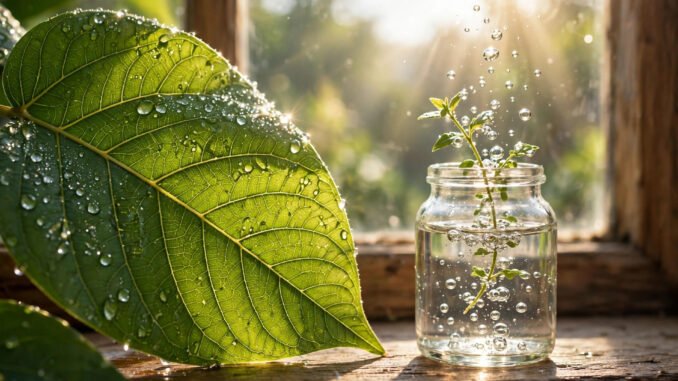
Photosynthesis is the most important chemical reaction on Earth, and also one of the most overcomplicated by textbooks. Strip away the jargon and it’s this: plants eat sunlight. They take light, water, and air, and turn them into sugar and the oxygen you’re breathing right now. Every bite of food you’ve ever eaten traces back to it. The good news for a curious Chicagoan on a tight budget is that photosynthesis is one of the cheapest things in science to truly understand — the laboratory is a windowsill, the textbook is free, and some of the world’s leading research on it happens about 130 miles south of you. Here’s the plain-English version and the $0 path to learning it well.
The 30-Second Version
A plant’s leaf absorbs sunlight with a green pigment called chlorophyll. Roots pull up water; tiny pores called stomata breathe in carbon dioxide from the air. Inside the leaf’s chloroplasts, light energy splits water molecules (releasing oxygen as a byproduct — the air you breathe), and that captured energy is then used to assemble carbon dioxide into glucose, a sugar the plant uses for energy and growth. In words: sunlight + water + CO₂ → sugar + oxygen. That’s the whole trick. Everything else is elaboration — important elaboration, but elaboration. If you remember only one thing, remember that plants build their bodies substantially out of thin air: the carbon in a tree trunk came from atmospheric CO₂, not from the soil.
The Slightly Deeper Version (Still Plain English)
Photosynthesis runs in two linked stages. The light reactions happen in the chloroplast’s thylakoid membranes: photons strike chlorophyll, energizing electrons, which cascade through a chain of proteins, pumping protons and generating the energy carriers ATP and NADPH. Splitting water to replace those electrons releases oxygen. Then the Calvin cycle (the “dark reactions,” though they usually run in daylight too) uses that stored energy to fix CO₂ into three-carbon compounds, eventually building glucose. Why are leaves green? Chlorophyll absorbs red and blue light efficiently but reflects green — the color you see is literally the light the plant throws away. Why do leaves turn colors in fall? The tree dismantles chlorophyll first (recovering valuable nitrogen), unmasking the yellow and orange carotenoids that were there all along. None of this requires a chemistry degree — it’s a story about energy being caught, stored, and spent, and once you see it that way, the details slot in naturally.
The Free Chicago Learning Path
Chicago is almost unfairly good for learning this free. Start with Khan Academy’s free biology course, whose photosynthesis unit — videos plus practice questions — takes about two hours and genuinely teaches the two stages with animations better than most paid textbooks. Then go see it in person: the Garfield Park Conservatory offers free general admission and houses thousands of plants under glass on the West Side, while the Lincoln Park Conservatory (free, reservations sometimes required) is a Victorian glasshouse full of exactly the leaf diversity your new knowledge will decode. The Chicago Public Library stocks approachable plant biology books and, crucially, the children’s science section — the best plain-English photosynthesis explanations are often written for ten-year-olds, and there’s no shame in starting there. Finish with YouTube: search for the classic “photosynthesis song” mnemonics if the Calvin cycle won’t stick, and university lecture recordings if you want the full biochemical depth.
See It Happen for $0: Three Home Experiments
Reading about photosynthesis is fine; watching it is better, and it costs nothing. Experiment one: the bubble jar. Put a sprig of pondweed or aquarium plant in a clear jar of water on a sunny windowsill and watch tiny oxygen bubbles stream from the leaves — photosynthesis made visible. Move it to shade and the bubbling slows. Experiment two: the foil mask. Cover part of a houseplant leaf with aluminum foil for three days, then hold the leaf up to bright light — the covered section looks paler, demonstrating that light drives the process. Experiment three: the starch test with a twist. The classic version needs iodine, but you can observe the prerequisite for free: compare a plant kept in a dark closet for two days with one on the sill, and notice how the dark-kept leaves go limp and pale as they burn through stored sugars with no income. These are real experiments, not demos — you’re manipulating variables and observing outcomes, which is the actual method of science. For a steady supply of test subjects, check out the best beginner-friendly plants that survive enthusiastic experimentation, and if home botany grabs you, it joins a fine list of hobbies to start as an adult.
Why It Matters Beyond Biology Class
Photosynthesis underpins essentially everything: the food system, the oxygen atmosphere, the fossil fuels we’re burning (ancient photosynthesis, compressed). It’s also an active research frontier with a Chicago-area connection worth knowing: the RIPE project (Realizing Increased Photosynthetic Efficiency) at the University of Illinois Urbana-Champaign has spent a decade re-engineering photosynthesis itself — tweaking how plants handle excess light and photorespiration — and demonstrated yield increases of 20%+ in field trials of soybeans and other crops. That’s not incremental; that’s a potential lever on global food security. Meanwhile, artificial photosynthesis — using sunlight to split water or reduce CO₂ into fuels — is one of the most exciting areas in energy research. Understanding the natural version first means the artificial version actually makes sense when you encounter it. A process you can watch in a jar on your windowsill turns out to be the engine of civilization and possibly its future fuel supply. Not bad for a free education.
So yes — you can understand photosynthesis simply, on a tight budget, in Chicago, because the subject conspires to be learnable: the core idea fits in a sentence, the best explanations are free online, the conservatories are free to enter, and the experiments run on sunlight and tap water. Start with the 30-second version, graduate to the two stages, then go watch bubbles rise in a jar and know exactly what you’re seeing: the planet’s most important chemistry, happening on your windowsill.
Frequently Asked Questions
Do plants really “breathe in” carbon dioxide?
Yes, through microscopic pores called stomata, mostly on leaf undersides. They take in CO₂ and release oxygen and water vapor. Stomata open and close to balance CO₂ intake against water loss — a constant optimization problem the plant solves automatically.
Why aren’t plants black if they want to absorb light?
Evolution settled on “good enough.” Chlorophyll absorbs red and blue efficiently; absorbing green too would capture more energy but the molecular machinery to use it safely (excess light damages cells) never evolved. Some algae and deep-water plants do use different pigments to harvest green light.
Does photosynthesis happen at night?
The light reactions stop without light, but the Calvin cycle can briefly continue using stored energy carriers until they run out. At night, plants switch to respiration — burning sugars for energy, like animals do — which is why a plant in a dark closet slowly starves.
What is the RIPE project?
Realizing Increased Photosynthetic Efficiency, a research project based at the University of Illinois that re-engineers photosynthetic pathways in crops. Its field trials have shown significant yield gains, making it one of the most promising approaches to improving crop productivity for a growing population.
Can I do real photosynthesis experiments without buying anything?
Absolutely. The bubble-jar, foil-mask, and dark-closet observations need only a plant, water, sunlight, and foil from your kitchen. They demonstrate oxygen release, light dependence, and energy storage — the three pillars of the process — with zero purchased equipment.
Leave a Reply