
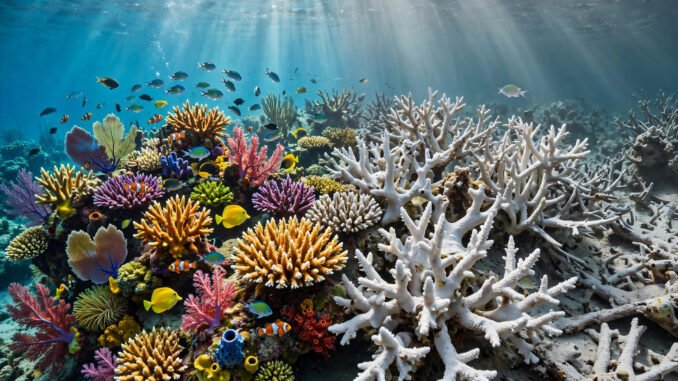
Coral bleaching sounds like something from a disaster movie, and the satellite photos — vast reefs turned bone-white — certainly look the part. But the actual science is elegant, graspable, and completely free to learn. Bleaching is not coral dying on contact; it’s a stress response, a breakup between an animal and the algae living inside it. Understand that relationship and you understand 80% of the story. The rest — why it’s accelerating, how scientists track it from orbit, what actually helps — is all public knowledge, published by government scientists who want you to know it. Here’s the whole picture, no paywall required.
What Coral Bleaching Really Is
A coral is an animal — a colony of tiny polyps — and most reef-building corals host microscopic algae called zooxanthellae inside their tissues. It’s one of nature’s great partnerships: the algae photosynthesize and share up to 90% of the coral’s energy needs, and in return get shelter and nutrients. The algae are also what give corals their color. When ocean temperatures spike even 1–2°C above the local summer maximum and stay there, the partnership breaks down — the algae’s photosynthesis goes haywire and produces toxins, so the coral expels them. Without the algae, the coral’s white calcium-carbonate skeleton shows through its transparent tissue. That’s bleaching: white, but not dead. A bleached coral is starving and vulnerable, but if temperatures drop within weeks, it can take the algae back up and recover. If the heat persists for months, it starves, disease moves in, and the reef can collapse into algae-covered rubble. The distinction matters because it means every bleaching event is a race against time, not an instant obituary.
Why It’s Happening More Often
Corals evolved for stable tropical temperatures, and the ocean is no longer stable. NOAA’s Coral Reef Watch program confirmed the fourth global bleaching event in 2023–2025 — the largest on record, hitting reefs in the Atlantic, Pacific, and Indian Oceans, including parts of the Great Barrier Reef and Florida’s Coral Reef. Scientists measure heat stress in “degree heating weeks” (DHW): one DHW means temperatures ran 1°C above the bleaching threshold for a week, and bleaching typically starts around 4 DHW with mortality risk climbing past 8. The grim trend is the shrinking recovery window — reefs that once had a decade or more between bleaching events to regrow now sometimes get hit every few years. Some reefs show surprising resilience, and researchers are studying heat-tolerant coral genotypes and symbiont shuffling (corals swapping in tougher algae strains), but the underlying driver is straightforward: the ocean has absorbed the vast majority of excess heat from greenhouse warming, and marine heatwaves are getting longer and hotter.
How Scientists Watch It From Space (Free for You Too)
Here’s the delightful part: the same satellite dashboards the scientists use are public. NOAA Coral Reef Watch publishes 5-kilometer-resolution sea surface temperature data, bleaching alert maps, and “virtual stations” for individual reef sites, updated daily. You can pull up the Florida Keys station right now and see the current heat stress value in degree heating weeks — the exact number reef managers are watching. The data comes from a blend of polar-orbiting satellites measuring ocean skin temperature, calibrated against buoys. Beyond the dashboards, NOAA’s site hosts tutorials explaining how to read the products, and the alert system runs on a simple scale from “no stress” through “watch” and “warning” up to “alert level 2.” Spend an hour clicking through a bleaching event’s archive and you’ll understand the phenomenon more concretely than any textbook chapter could deliver — you’re watching heat accumulate on a living coastline in near-real time.
The Free Learning Path
Start with NOAA’s ocean education resources, which include coral-specific lesson modules written for clarity, not for specialists. Then watch Chasing Coral, the 2017 documentary that follows divers and photographers documenting bleaching as it happens — it’s available on low-cost streaming tiers and frequently free through library apps, and it converts the abstract idea of “a degree of warming” into something you’ll never unsee. For the deeper cut, the scientific review papers on mass bleaching are open access; search for the Hughes et al. papers on the Great Barrier Reef for the definitive account. If you want to contribute rather than just learn, Reef Check runs volunteer reef monitoring programs where trained citizen scientists survey real reefs — the training is the education, and the data feeds actual research. And if reefs make you want to see one, look into US national parks to visit with kids — coastal parks put living reefs within reach of a family trip — or browse free things to do in Washington, DC, where the Smithsonian museums offer world-class ocean exhibits without an admission fee.
What Actually Helps (and What’s Just Vibes)
Honesty requires saying the main driver — global ocean heat — isn’t fixable by individual reef-friendly choices. But local stressors genuinely matter for reef resilience: agricultural runoff, sewage, overfishing of herbivorous fish that keep algae in check, and physical damage from anchors and careless diving. Marine protected areas with real enforcement consistently show better bleaching recovery, which is why supporting them (including just visiting responsibly) counts. Coral restoration — growing fragments in nurseries and outplanting them — works at local scales and is improving fast, though it can’t outpace repeated severe bleaching alone. What doesn’t help much: symbolic gestures disconnected from reef stressors, and “adopt a coral” schemes with no published survival data. The most honest free actions: learn the dashboard, talk about degree heating weeks like you talk about the weather, vote with reefs in mind, and if you dive or snorkel, master buoyancy before you go near a reef — a single fin kick can destroy decades of coral growth.
Coral bleaching, stripped of jargon, is a story about a partnership under heat stress — and about scientists who put their monitoring tools on the public internet because they want an informed public. You can now read a bleaching alert map, explain zooxanthellae at a dinner party, and know exactly which claims about “saving the reefs” hold water. Total cost: nothing but attention.
Frequently Asked Questions
Is bleached coral dead?
Not necessarily. Bleached coral has expelled its symbiotic algae and is starving, but it’s still alive. If water temperatures return to normal within weeks, corals can recover their algae and bounce back. Prolonged heat — typically beyond 6–8 weeks of severe stress — leads to starvation, disease, and death.
Can reefs recover from mass bleaching?
Yes, given time. Reefs have recovered from past bleaching events when they get roughly a decade of calm water to regrow. The concern now is frequency: some reefs are being hit every few years, which outpaces natural recovery and shifts the ecosystem toward algae-dominated states.
What are degree heating weeks?
A metric of accumulated heat stress: 1 DHW equals one week at 1°C above the local bleaching threshold. Bleaching risk starts around 4 DHW; widespread bleaching and mortality become likely above 8 DHW. NOAA publishes DHW values for reef sites worldwide, updated daily.
Does sunscreen really harm coral reefs?
Certain UV-filter chemicals (notably oxybenzone and octinoxate) harm coral larvae and contribute to bleaching in lab studies, which is why Hawaii and some other places restrict them. It’s a real but secondary stressor compared to ocean heat — worth addressing, not a substitute for addressing warming.
Where can I see the bleaching data myself?
NOAA Coral Reef Watch’s website offers daily-updated bleaching alert maps, sea surface temperature data, and virtual station pages for individual reefs — all free, no account needed. It’s the same operational data reef managers use.
Leave a Reply