
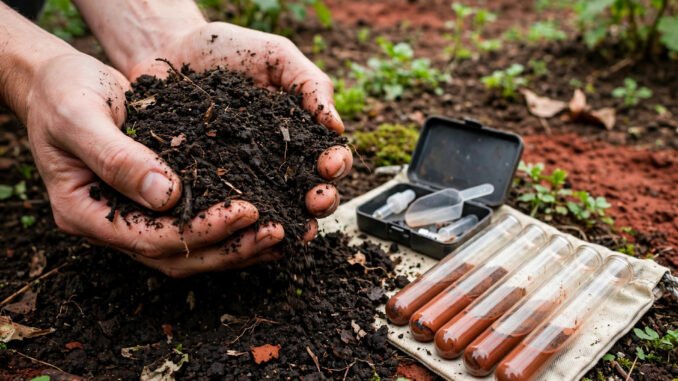
Atlanta gardeners can water faithfully, feed generously, and still watch vegetables stall, season after season, without ever learning the one number that explains most of it. That number is soil pH. It decides whether the nutrients already sitting in your soil can actually reach your plants, and in Atlanta’s red clay it starts out working against vegetables. The good news is how cheap the knowledge is: the test costs less than a single bag of fertilizer, and the fixes, done slowly and in the right amounts, cost little more.
What pH actually is, and why plants care
pH measures acidity on a scale from 0 to 14. A reading of 7 is neutral. Below 7 is acidic, above 7 is alkaline. The scale is not gentle: each whole step is a tenfold change in acidity. Soil at pH 5 is ten times more acidic than soil at pH 6, and a hundred times more acidic than soil at pH 7. Small numbers on the report mean large differences in the ground, which is why guessing at amendments goes wrong so easily. For the underlying chemistry, soil pH and how it is measured repays a short read before you spend anything.
Plants care because acidity controls the pantry door. In sour soil, key nutrients such as phosphorus, calcium, and magnesium become chemically locked away. They are present in the soil, sometimes in generous amounts, but roots cannot take them up. The plant starves in a full pantry: pale, stunted, and slow, while the gardener adds more fertilizer that the plant still cannot use. Other nutrients behave the opposite way and become too available in strong acidity, which adds its own stress.
Most vegetables do their best work in a band around pH 6.0 to 7.0, slightly acidic to neutral. Inside that band, the main nutrients stay available at once and soil life thrives. That band is the target for a vegetable bed. It is not the target for every plant in the yard, as the next section shows, and chasing one number across a whole property is a beginner error.
Atlanta’s soil: why the red clay starts acidic
Georgia’s famous red clay belongs to a soil family called Ultisols, Georgia’s red-clay soils. These are ancient soils, washed by heavy rain over very long periods. Rain leaching has carried away much of the mineral content that would normally buffer acidity and hold nutrients, leaving soil that sits naturally acidic, often around pH 5.0 to 5.8 in unamended Atlanta ground. The red colour comes from iron, which is plentiful. Fertility and buffering power are what the years took away.
For vegetables, that starting point has visible consequences. Below pH 6.0, many vegetables sulk: growth slows, fruit set disappoints, and leaves can show the pale, hungry look of nutrient lockout even in fed soil. Tomatoes may show blossom-end rot more readily in this setting. Be precise about that problem, because the fix depends on it. Blossom-end rot is a calcium and watering disorder. The fruit’s far end suffers when calcium delivery falters, usually because watering swings between dry and soaked. Acidity aggravates it, since low pH makes calcium harder for the plant to take up in the first place, but acidity is not the whole cause, and lime alone will not cure rot in a bed that is watered unevenly.
The same acidity is home ground for another set of plants. Blueberries want pH 4.5 to 5.5 and often thrive in unamended Georgia soil with little help. Azaleas, camellias, and gardenias evolved for acid conditions and look superb across Atlanta for exactly that reason. Work with this split instead of fighting it. Raise pH where the vegetables grow. Leave the acid beds acid, and plant them with the shrubs and berries that prefer it.
Testing on a budget: three honest options
You cannot manage a number you have not measured, and measuring is cheap. The best value in Atlanta gardening is a county extension test, run through the University of Georgia’s labs. For roughly $10 to $30, depending on county and the panel you choose, you get your pH, your main nutrient levels, and an exact amendment recommendation stated by weight per area for your soil. That last part is what makes it the best buy. It converts guessing into a recipe written for your ground.
The second option is a do-it-yourself colour kit from a hardware store, roughly $10 to $15. You mix soil with the kit’s solution and match the colour to a chart. Expect accuracy to about half a point. That is crude beside a lab report and still genuinely useful: half a point is enough to know whether you are clearly acidic, near the vegetable band, or over-limed. Use it for a quick first reading or a mid-season check.
The third option costs nothing: observation. What thrives and what sulks in your beds is a real cross-check on any number. Blueberries flourishing while beans sulk fits an acid reading. Moss, sorrel, and other acid-tolerant weeds hint the same way. Treat observation as a supporting witness, never as the measurement itself. Eyes can confirm a test. They cannot replace one.
A sensible rhythm keeps the whole thing under $30 a year: a DIY kit now for a first reading, then an extension test about once a year, ideally in autumn, so amendments have winter to work. Sample properly for either test. Take small cores from several spots in the bed, mix them, and test the mix, rather than trusting one scoop from one corner.
Raising pH: the common Atlanta job
Most Atlanta vegetable beds need pH raised, not lowered, and the standard tool is garden lime, which is calcium carbonate. A 40-pound bag typically runs roughly $5 to $10 at recent prices. Where your test also shows low magnesium, dolomitic lime is the usual choice, since it supplies calcium and magnesium together. Plain lime where magnesium is already fine, dolomitic where it is low. Your test report tells you which situation you are in.
Here is the discipline that matters more than the product: the extension test’s own recommendation outranks any general rate, including any rate you read in general gardening advice. Clay soils need more lime than sandy soils to move the same distance, and beds differ in size, depth, and history. Your report sets the rate by weight per area for your soil. Follow it. Do not borrow a neighbour’s amount or a generic handful-per-bed rule and call it a plan.
Lime also works slowly, over months, as it reacts with the soil. That slowness is normal, not a product failure. Autumn application is the classic timing for this reason: spread and dig in the lime in fall, and the bed is closer to target by spring planting. Re-test before adding more. Gardeners who stack a second full dose in spring, impatient at the unchanged early reading, often overshoot into alkaline soil, which locks away a different set of nutrients and takes longer to bring back.
Wood ash offers a mild, free liming option for gardeners with a wood stove or fireplace. It raises pH gently and adds some potassium. Use it modestly, never on acid-loving plants such as blueberries and azaleas, and never as your main correction for a bed that is far below target. Count it as a small annual nudge, measured against your test results, not a substitute for lime where lime is what the report calls for.
Lowering pH: the rarer Atlanta job
Lowering pH is uncommon here, since the native soil already leans acid, but two cases call for it. The first is blueberries or other acid-lovers planted into a bed that was limed for vegetables in past years. The second is an over-limed bed, usually the result of repeated guessing without a test, which is one more reason the test comes first.
The standard material is elemental sulfur. Soil bacteria convert sulfur into acid slowly, over weeks to months, so this is a gradual correction, not a quick fix, and rates again come from your test report rather than from habit. Work in modest amounts, water the bed, and re-test before repeating. For blueberries, many Atlanta gardeners take the simpler route of planting in a dedicated hole or bed amended for acidity, leaving the vegetable beds at their higher target. Separate beds with separate targets beat one compromised bed that suits nothing well.
The free long game: organic matter
Compost and other organic matter will not, on their own, drag a pH 5.2 bed up to 6.5, and honest advice should say so. What they do is arguably more valuable over years. Organic matter buffers pH swings, so the soil resists sudden shifts in either direction. It feeds the soil biology that cycles nutrients to roots, improves clay structure so roots and water move better, and helps the gains from liming hold instead of washing away. Think of compost as the stabiliser and lime as the correction. A bed needs the first every year and the second only when a test calls for it. Practical ways to build that supply are covered in composting food waste at home without wasting money.
Mulch protects the whole system. A steady cover of leaves, straw, or wood chips over beds limits the leaching that pushed Atlanta soil acidic in the first place, keeps moisture even, and that even moisture matters for calcium delivery and blossom-end rot prevention as much as any amendment does. Add compost each season, mulch always, test yearly, and lime only to the report. Follow that quiet routine and pH stops being a mystery you fight. It becomes a number you check once a year, adjust slowly when needed, and otherwise leave alone while the garden gets on with growing.
Leave a Reply