
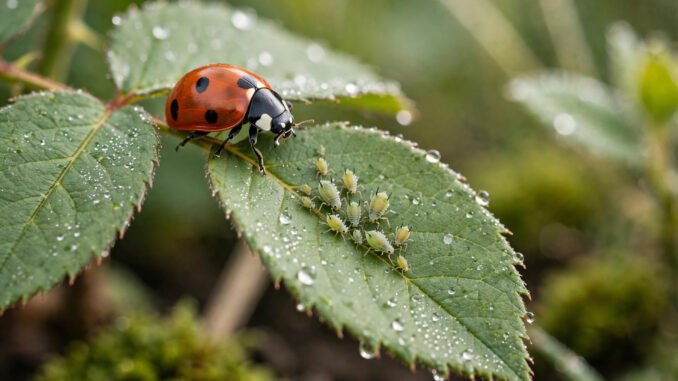
You found them this morning: tiny pear-shaped insects packed tight on the rose buds, clustered along the soft new stems, as if they had moved in overnight. The garden center sells a spray that promises instant death, and the urge to buy it is strong. Hold off. The checklist below gets rid of aphids without wiping out the insects that would have eaten them for free, and it costs little or nothing to run.
The checklist up front
Work through these steps in order. Each one is stronger than doing nothing and gentler than a broad spray.
1. Blast them off with water. A strong jet from the hose, aimed at buds, stems, and leaf undersides, knocks aphids loose. Most cannot climb back.
2. Back the insects that eat aphids. Ladybug larvae, lacewing larvae, hoverfly larvae, and tiny parasitic wasps all hunt aphids for you, free of charge, every day.
3. Use insecticidal soap or neem oil on the clusters that remain. Both are targeted, both break down fast, and both leave most helpful insects alone when used with care.
4. Plant and shield with companions and barriers. Strong-smelling plants nearby can confuse aphids, and sticky barriers on stems stop the ants that farm and guard them.
5. Prune and wait when the damage is small. Cutting off one badly covered tip, then giving predators a few days to arrive, often ends a small outbreak on its own.
The two-week battle plan, day by day
Days 1 to 3: blast every infested plant with water each morning. Prune off the worst clusters and drop them in the trash, not the compost. If you see ants marching up the stems, add a sticky barrier, because ants protect aphids from predators.
Days 4 to 7: keep up the water blasts every two or three days. In the evening, spray insecticidal soap on the clusters that are still there, soaking the undersides of the leaves where aphids hide.
Week 2: check the plants and count honestly. Numbers should be falling hard by now. Keep blasting any fresh clusters, protect the predators that have shown up, and shift to weekly checks once the outbreak breaks.
Know your enemy
Aphids are small, soft-bodied insects, about 1 to 3 mm long, that feed by piercing soft plant tissue and sucking out the sap. They gather where the plant is weakest and sweetest: new growth, flower buds, and the undersides of young leaves. A single aphid can start producing live young without mating, which is why a clean plant on Monday can be covered by Friday.
As they feed, aphids push out a sticky, sugary liquid called honeydew. It coats leaves, turns black with mold, and draws ants, which value it as food. Ants will even defend aphids against ladybugs to keep their supply safe. Reading up on what aphids are and how they feed makes their weak spots clear: they are slow, soft, and nearly helpless once knocked off a plant.
The damage they do is real but rarely fast. Heavy feeding curls leaves, stunts new growth, and weakens a plant over weeks. Aphids can also carry plant viruses from one plant to another as they feed. Still, a healthy plant can stand a light load of aphids for a while, and that pause is what gives the natural system time to work.
Why natural methods win
A broad insect spray feels decisive, but it kills on a wide front. It kills the aphids it touches, and it also kills the ladybug larvae, lacewing larvae, and parasitic wasps that were eating aphids around the clock. The aphids, breeding fast and hidden under leaves, often return in bigger numbers a few weeks later, because their enemies are gone.
This rebound pattern is the main reason sprayed gardens can end up worse off than unsprayed ones. Natural methods work with the balance instead of resetting it. Water, soap, and neem hit aphids directly and then fade, while the predator population stays alive and keeps hunting. You are not just removing aphids today. You are keeping an unpaid patrol on duty all season.
The arsenal in detail
The water blast
This is your first move and often your best one. Use a hose nozzle that gives a firm jet, not a mist. Work in the morning so wet foliage dries during the day, which lowers the risk of fungal trouble. Aim up under the leaves and along the stems. Repeat every two or three days for two weeks, because eggs and new arrivals keep the cycle going for a while. The cost is zero, and there is nothing to store, mix, or rinse.
Beneficial insects
The long game is played by hunters. A single ladybug larva eats several hundred aphids before it pupates, and the larva, a spiky dark creature with orange marks, eats far more than the cute adult beetle does. Lacewing larvae, nicknamed aphid lions, hunt with the same hunger. Parasitic wasps do quieter work: they lay eggs inside aphids, and the dead aphids swell into dry, papery shells called mummies, a sure sign the wasps are on the job. Hoverfly larvae feed on aphids too, often right under your nose on infested stems.
You can buy ladybugs, about $10 to $15 for 1,500 at typical prices, but buying them is the weak version of this step. Released beetles often fly away by morning. If you do buy them, release them at dusk onto plants you have watered well, and give them flowers, shelter, and water so some choose to stay. The stronger version is free: skip broad sprays, plant flowers that feed adult predators, and let the local hunters move in on their own.
Insecticidal soap and neem
When clusters survive the hose, insecticidal soap is the next step. It costs about $8 to $12 for a concentrate that makes a lot of spray. It works on contact, so the spray has to hit the aphids themselves, and it is worth reading about how insecticidal soap kills soft-bodied insects before you start: it breaks down their outer cell layers, and once the spray dries, it leaves little behind to harm other insects. Cover the undersides of leaves, work in the evening to spare active pollinators, and repeat after a few days if new clusters appear.
Neem oil, about $10 to $15 a bottle, works differently. It puts aphids off feeding and disrupts how the young ones grow and reproduce. It is slower than soap and best used on a problem that is building rather than exploding. As with soap, spray the insects, not the whole garden, and keep it off open blooms where bees are working.
Companion planting, barriers, and pruning
Strong scents can make a plant harder for aphids to find. Garlic, chives, and other alliums near roses are a common pairing, and flowers that draw predators do double duty. Barriers help where ants are the real guards: a sticky band around a stem or trunk keeps ants from reaching their herd.
Pruning is the blunt tool, used sparingly. If one shoot tip is solid with aphids while the rest of the plant is clean, cut the tip off and bin it. You remove hundreds of aphids in one snip and lose almost nothing. After that comes patience: early outbreaks often collapse on their own once predator numbers catch up, two or three weeks into the season.
Honest escalation
Here is the part many natural guides skip. Sometimes a plant is being destroyed. You have blasted, soaped, waited the full two weeks, and the aphids are still winning, the growth is stunted, and the plant is going backwards. In that case, say so plainly and act. Targeted products exist for exactly this moment. Using one, carefully, on one struggling plant, following the label, is not a moral failure and does not undo your season of good practice.
The honest rule is order, not purity. Natural steps first, because they usually work and they protect the system that protects you. Stronger steps last, aimed narrowly, when the evidence in front of you says the gentle route has had its fair chance.
Prevention: the garden that resists aphids
Prevention is mostly a habit. Once a week, spend thirty seconds looking at new growth on your key plants. Catching ten aphids with a quick blast beats fighting ten thousand later, and a weekly look makes the ten-aphid stage the one you always catch.
Feed with a light hand. Heavy doses of nitrogen fertilizer push out soft, sappy growth, and soft growth is aphid food. Steady, moderate feeding grows tougher plants that aphids find less inviting. Give plants the sun, water, and spacing they need, since stressed plants call in more pests than thriving ones.
Learn to tolerate a low background level of aphids. A few dozen on a rose bush are not a crisis. They are food that keeps ladybugs and wasps living in your garden, ready for the next outbreak. Roses are the classic first battleground for this whole lesson, so if you are new to them, the guide to growing roses for beginners pairs well with the routine here.
Add up the cost and the picture is friendly. Water is free. Soap concentrate is about $8 to $12 and can last for years. Neem is optional. Bought ladybugs are optional too. The full natural plan runs from $0 to about $25, and what it buys you is bigger than one cleared rose bush. It buys you a garden that defends itself, season after season, while you do the light work of looking, blasting, and letting the hunters hunt.
Leave a Reply