
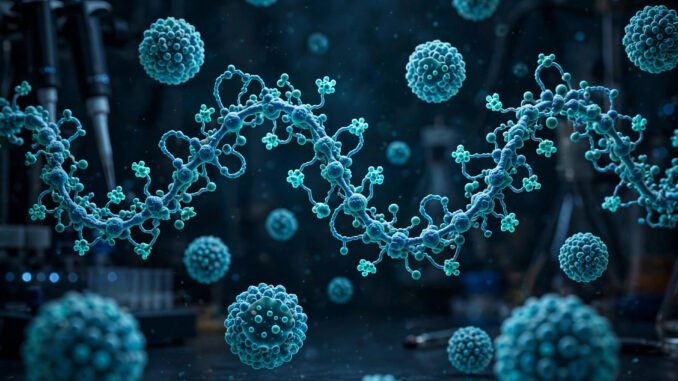
What is mRNA technology, and how does it actually work? For most Americans, those letters entered their lives in 2020 with the COVID-19 vaccines — and promptly got tangled in the loudest misinformation storm of the decade. Strip away the noise and mRNA is one of the most elegant ideas in modern medicine: instead of injecting a weakened virus or a manufactured protein, you inject instructions and let your own cells do the manufacturing. This guide explains how mRNA technology actually works — the real molecular mechanism, why it was decades in the making, what it can do beyond vaccines, and what it genuinely can’t do.
The Central Idea: Your Cells as the Factory
Every cell in your body already runs on mRNA. Your DNA holds the master blueprints; messenger RNA (mRNA) carries short-lived working copies of individual instructions from the nucleus to the ribosomes, the cell’s protein-building machines. The ribosome reads the mRNA and assembles the specified protein. Then the mRNA degrades — it’s designed to be temporary, like a sticky note rather than a permanent file.
mRNA technology hijacks this existing system. Scientists synthesize an mRNA strand encoding a protein of interest, package it in a tiny fat bubble called a lipid nanoparticle (which sneaks it past the cell membrane), and inject it. Your cells take up the particles, ribosomes read the instructions, and for a few days your body manufactures the target protein itself. Then the mRNA breaks down and disappears. Nothing enters the nucleus. Nothing touches your DNA.
That last point deserves emphasis because it’s the most lied-about fact in the field: mRNA cannot alter your DNA. It never enters the nucleus where DNA lives, human cells lack the machinery to convert mRNA back into DNA, and the molecule degrades within days. The National Human Genome Research Institute’s mRNA explainer states this plainly, and it’s among the most settled facts in molecular biology.
How an mRNA Vaccine Actually Works, Step by Step
Take the COVID-19 mRNA vaccines as the worked example:
Step 1: Injection and uptake
The shot delivers lipid nanoparticles containing mRNA encoding the coronavirus spike protein into your arm muscle. Nearby muscle cells and immune cells absorb the particles.
Step 2: Protein production
Ribosomes read the mRNA and build spike proteins, which the cells display on their surfaces. Your body is now temporarily manufacturing a harmless fragment of the virus — not the virus itself, which is why the vaccine cannot give you COVID.
Step 3: Immune training
Your immune system detects these unfamiliar spike proteins as foreign and mounts a full response: antibodies, helper T cells, killer T cells, and — crucially — memory cells that persist long after the mRNA and spike proteins are gone. This is the entire point: a practice drill against a harmless target, so the real virus meets a prepared defense.
Step 4: Cleanup
Within days, cellular enzymes degrade the mRNA. Within weeks, the spike proteins are cleared. What remains is immunological memory — the same kind natural infection leaves, without the disease.
Why It Took 30 Years: The Katalin Karikó Story
If the idea is so simple, why did mRNA vaccines arrive in 2020 and not 2000? Because synthetic mRNA had a fatal flaw: the immune system recognized it as a viral invader and destroyed it, triggering dangerous inflammation. For decades, mRNA research was a career-killing backwater.
The breakthrough came from Katalin Karikó and Drew Weissman at the University of Pennsylvania. In 2005, they discovered that swapping one building block — replacing uridine with pseudouridine — made synthetic mRNA invisible to the immune system’s alarms while still readable by ribosomes. It was a tiny chemical tweak with civilization-scale consequences, earning the 2023 Nobel Prize in Physiology or Medicine. Combined with lipid nanoparticle delivery (refined over years of work), the platform was ready when the pandemic struck — which is why effective vaccines existed within a year of the virus’s sequencing, the fastest vaccine development in history.
The lesson for understanding science: “overnight successes” are usually decades of unfashionable work by people like Karikó, who was demoted and struggled for grants for years. The Nobel Prize summary of the 2023 award tells her story and is genuinely moving.
Beyond Vaccines: What mRNA Can Do Next
Vaccines were the proof of concept. The platform’s real promise is that it’s programmable: once the delivery system works, new therapies just need new mRNA sequences — software updates for medicine. In 2026, the pipeline includes:
Personalized cancer vaccines. The most exciting frontier: sequencing a patient’s tumor, identifying its unique mutations, and manufacturing an mRNA vaccine encoding those neoantigens — training the immune system to attack that specific cancer. Moderna and Merck’s mRNA-4157 showed promising melanoma results in trials, and multiple candidates are in late-stage testing.
Rare genetic diseases. For conditions where patients can’t make a needed protein, mRNA could provide temporary replacement — redosed as needed, without permanent genetic changes.
Flu, RSV, and combination vaccines. mRNA flu vaccines are in trials; the platform’s speed means vaccines can be updated faster to match circulating strains, and multiple pathogens could eventually be covered in one shot.
None of this is guaranteed — clinical trials fail more often than they succeed — but the platform has crossed the fundamental threshold from theory to deployed medicine.
What mRNA Can’t Do (Honest Limits)
A clear-eyed understanding includes the limits. mRNA is temporary by design — great for vaccines, awkward for conditions needing permanent fixes (that’s gene therapy’s job, a different technology). The lipid nanoparticles can cause short-term side effects (sore arm, fever, fatigue — signs the immune system is responding, which is the point). Rare serious effects exist and are tracked: the CDC’s vaccine safety monitoring systems publish their findings openly, which is exactly how rare signals like myocarditis in young males were detected, quantified (rare, mostly mild, treatable), and weighed against COVID’s far higher cardiac risks.
And the deepest limit: mRNA is a delivery mechanism for instructions, not a cure-all. It can’t fix what we don’t understand — it needs a known protein target. The technology is only as good as the biology behind it.
Understanding mRNA Makes You a Better Health Citizen
Here’s the underappreciated payoff: understanding this one technology upgrades your entire health literacy. You’ll read clinical trial news with a critical eye, recognize the difference between a platform (mRNA) and a product (one specific vaccine), and spot misinformation faster — “it changes your DNA” collapses the moment you know mRNA never enters the nucleus. Pair it with basics like recognizing vitamin D deficiency and understanding checkup costs without insurance, and you’re equipped for the modern health-information environment.
Conclusion: Instructions, Not Ingredients
mRNA technology is the idea that medicine can deliver instructions instead of ingredients — a temporary message that teaches your cells to make a protein, trains the immune system, then disappears. Thirty years of obscure research, one chemical tweak, a Nobel Prize, and the fastest vaccine rollout in history. Beyond COVID, it points toward programmable medicine: personalized cancer vaccines, rapid-response flu shots, treatments for rare diseases. It can’t rewrite your DNA, it isn’t permanent, and it isn’t magic — it’s better than magic. It’s a molecular postal service, and we’ve only just started sending the letters.
Frequently Asked Questions
How does mRNA technology actually work?
Synthetic mRNA encoding a target protein is packaged in lipid nanoparticles and injected. Your cells absorb the particles, ribosomes read the mRNA and build the protein (e.g., a viral spike fragment), the immune system learns to recognize it, and then the mRNA degrades within days.
Can mRNA vaccines change your DNA?
No. mRNA never enters the cell nucleus where DNA is stored, human cells can’t convert mRNA back into DNA, and the molecule breaks down within days. This is settled molecular biology, confirmed by the NHGRI and every major scientific body.
Why was mRNA technology developed so fast for COVID?
It wasn’t fast — the platform took 30 years, including Karikó and Weissman’s 2005 pseudouridine breakthrough. What was fast was adapting the ready-made platform to a new virus once its genome was sequenced: new instructions, same delivery system.
What are mRNA vaccines used for besides COVID?
As of 2026, approved uses are still mostly COVID, but trials are advanced for personalized cancer vaccines (notably melanoma), flu, RSV, and combination shots. The platform is programmable — new targets need only new mRNA sequences.
How long does mRNA stay in your body?
Days. Cellular enzymes degrade the synthetic mRNA quickly by design — it’s a temporary instruction, like a sticky note. The lasting effect is immunological memory from the immune response it triggered, not the mRNA itself.
Leave a Reply