
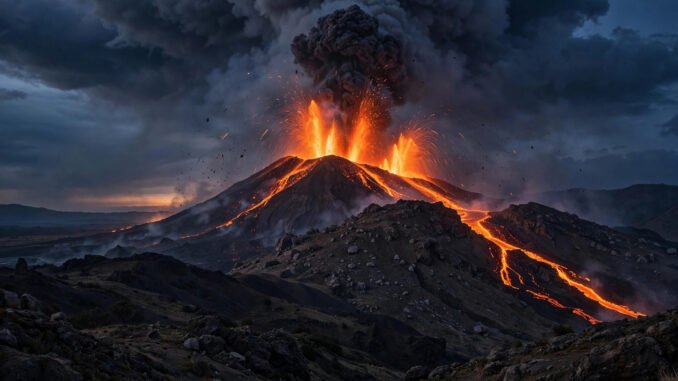
Can you really understand how volcanoes erupt on a tight budget while living in Denver, Colorado? Absolutely — and you picked a great home base for it. Volcano science is one of the most visually dramatic subjects in all of science, and nearly all of the learning is free: live eruption webcams, open USGS data, museum exhibits, and some of the best volcanic landscapes in America within driving distance. This guide explains how volcanoes actually erupt (the real physics, not the movie version), then lays out a Denver-specific plan to learn it all for next to nothing.
How Volcanoes Erupt: The Real Physics
Forget the Hollywood image of a mountain simply “blowing its top.” An eruption is a pressure story, and it starts dozens of miles underground. Here’s the sequence:
Step 1: Magma forms and rises
Rock in the mantle melts (usually where tectonic plates pull apart or one dives beneath another), forming magma — less dense than the surrounding rock, so it buoyantly rises, pooling in a magma chamber a few miles below the surface.
Step 2: Dissolved gases want out
Magma contains dissolved gases, mostly water vapor and carbon dioxide — like the fizz dissolved in a sealed soda bottle. As magma rises, pressure drops, and the gases begin bubbling out (exsolution). This is the entire engine of eruption: expanding gas bubbles provide the explosive force.
Step 3: Viscosity decides the style
Whether you get a gentle lava fountain or a civilization-altering explosion comes down to viscosity — how thick the magma is, controlled by its silica content. Runny basaltic magma (low silica, like Hawaii’s) lets gases escape easily: fire fountains, lava flows, spectacular but slow. Thick rhyolitic magma (high silica, like Yellowstone’s or Mount St. Helens’) traps the gas until pressure catastrophically wins: explosive eruption, ash columns miles high, pyroclastic flows. The soda-bottle analogy holds — shake it and open slowly (Hawaii) versus shake it and the cap fails all at once (St. Helens).
The three volcano shapes (viscosity made visible)
Viscosity doesn’t just decide eruption style — it sculpts the mountain. Runny basalt builds shield volcanoes: broad, gentle domes like Hawaii’s Mauna Loa, the largest mountain on Earth by volume. Sticky, gas-rich magma builds stratovolcanoes: steep, conical peaks like Mount Rainier, Fuji, and St. Helens — beautiful and dangerous. And the most violent eruptions leave calderas: vast collapsed craters like Yellowstone’s or Crater Lake’s, marking where a magma chamber emptied catastrophically. Learn to read the shape and you can guess the temperament — geology’s version of judging a book by its cover, except here it works.
The USGS Volcano Hazards Program documents every U.S. eruption with this physics, and its observatory pages are the most authoritative free resource in volcanology.
Why Eruptions Are Predictable (Sometimes) and Surprising (Often)
Volcanoes telegraph their punches — usually. Rising magma cracks rock (earthquake swarms), inflates the ground (measurable by GPS and satellites), and releases gases (sniffed by spectrometers). The USGS volcano observatories fuse these into alert levels, and evacuations before eruptions — like Mount Pinatubo in 1991, where forecasting saved tens of thousands of lives — are modern volcanology’s proudest achievement.
But “usually” isn’t “always.” Phreatic eruptions — groundwater flashing to steam with no fresh magma involved — can strike with minimal warning, as the 2019 Whakaari/White Island tragedy showed. Understanding volcanoes means respecting both the science’s power and its limits.
Learning Volcanoes on a Tight Budget in Denver
Here’s the good news: volcanology is overwhelmingly a free-knowledge science, and Denver is better positioned than most American cities.
Free digital resources ($0)
The USGS Volcano Hazards Program site offers eruption histories, real-time monitoring data, webcams (the Hawaiian Volcano Observatory cams are mesmerizing), and educator materials — all free. The Smithsonian’s Global Volcanism Program maintains the authoritative database of every known Holocene eruption on Earth: 1,300+ volcanoes, searchable, with photos. Between these two sites you have a graduate-level reference library for $0.
Denver-area experiences (free to cheap)
The Denver Museum of Nature & Science has strong earth-science exhibits covering volcanism, and its Gates Planetarium shows occasionally feature volcano-themed programming. Admission isn’t free, but the museum offers free days for Colorado residents several times a year — check the schedule and plan around them.
Then there’s the field trip advantage: Colorado is volcanic country. The Dotsero volcano (a 4,200-year-old cinder cone near the town of Dotsero, off I-70) is Colorado’s youngest volcano — a free roadside geology lesson. The San Juan Mountains are the eroded remains of one of Earth’s largest volcanic fields. Capulin Volcano National Monument in northern New Mexico is a very doable weekend trip: you can drive to the rim of a cinder cone and walk into the crater. Standing inside a volcano teaches more in an hour than a week of videos.
Budget learning plan
$0 tier: USGS + Smithsonian sites, volcano webcams, library books (Denver Public Library carries Simon Winchester’s Krakatoa and Clive Oppenheimer’s Eruptions That Shook the World). Total: a world-class education.
Under $50: Add a museum free-day visit (parking/transit), a used geology textbook, and gas money for the Dotsero drive. This is the sweet spot — most of the value, almost none of the cost.
Under $200: Add the Capulin weekend trip. Still less than one college textbook.
The budget-learning mindset transfers everywhere: the same resourcefulness that gets you international travel on a tight budget or a budget Chromebook for students works for science education. Free primary sources beat expensive secondary ones almost every time.
The Yellowstone Question Every Coloradan Asks
Living in Denver, you’ll eventually wonder about Yellowstone — the supervolcano about 500 miles northwest. Here’s the honest science: Yellowstone’s magma chamber is real, monitored intensely by the Yellowstone Volcano Observatory, and its alert level is Normal. The probability of a super-eruption in any given year is on the order of 1 in 700,000 — far below everyday risks. Smaller lava flows are the more likely (still unlikely) future activity. Understanding the actual monitoring data, freely published by USGS, replaces anxiety with proportion — which is precisely what learning the science buys you.
Conclusion: Free Knowledge, Million-Dollar Views
Volcanoes erupt when rising magma’s dissolved gases break free — viscosity writes the rest of the story, from Hawaii’s fountains to St. Helens’ blast. And learning all of it in Denver on a tight budget isn’t just possible, it’s ideal: the USGS and Smithsonian give away the knowledge, and Colorado’s volcanic landscapes give away the field trips. Start with the webcams tonight, visit Dotsero this month, and read the eruption database like the thriller it is. The most explosive science on Earth — free of charge.
Frequently Asked Questions
How do volcanoes erupt in simple terms?
Magma rises from underground; as pressure drops, dissolved gases bubble out like fizz escaping a shaken soda. If the magma is runny, gases escape gently (lava fountains). If it’s thick, pressure builds until it explodes catastrophically.
Can I learn volcanology for free in Denver?
Yes. USGS and Smithsonian websites provide professional-grade free resources, Denver Public Library stocks the key books, the Museum of Nature & Science runs free resident days, and volcanic sites like Dotsero crater are free to visit.
Is Yellowstone going to erupt soon?
According to USGS monitoring, no eruption is imminent — the alert level is Normal and a super-eruption’s annual probability is roughly 1 in 700,000. The volcano is among the most closely watched on Earth.
What’s the difference between magma and lava?
Same material, different location: magma is molten rock underground; once it erupts onto the surface, it’s called lava.
Are there volcanoes in Colorado?
Yes — extinct and dormant ones. Dotsero (near I-70) erupted about 4,200 years ago, and the San Juan Mountains are eroded remnants of a massive ancient volcanic field. None are currently active.
Leave a Reply