
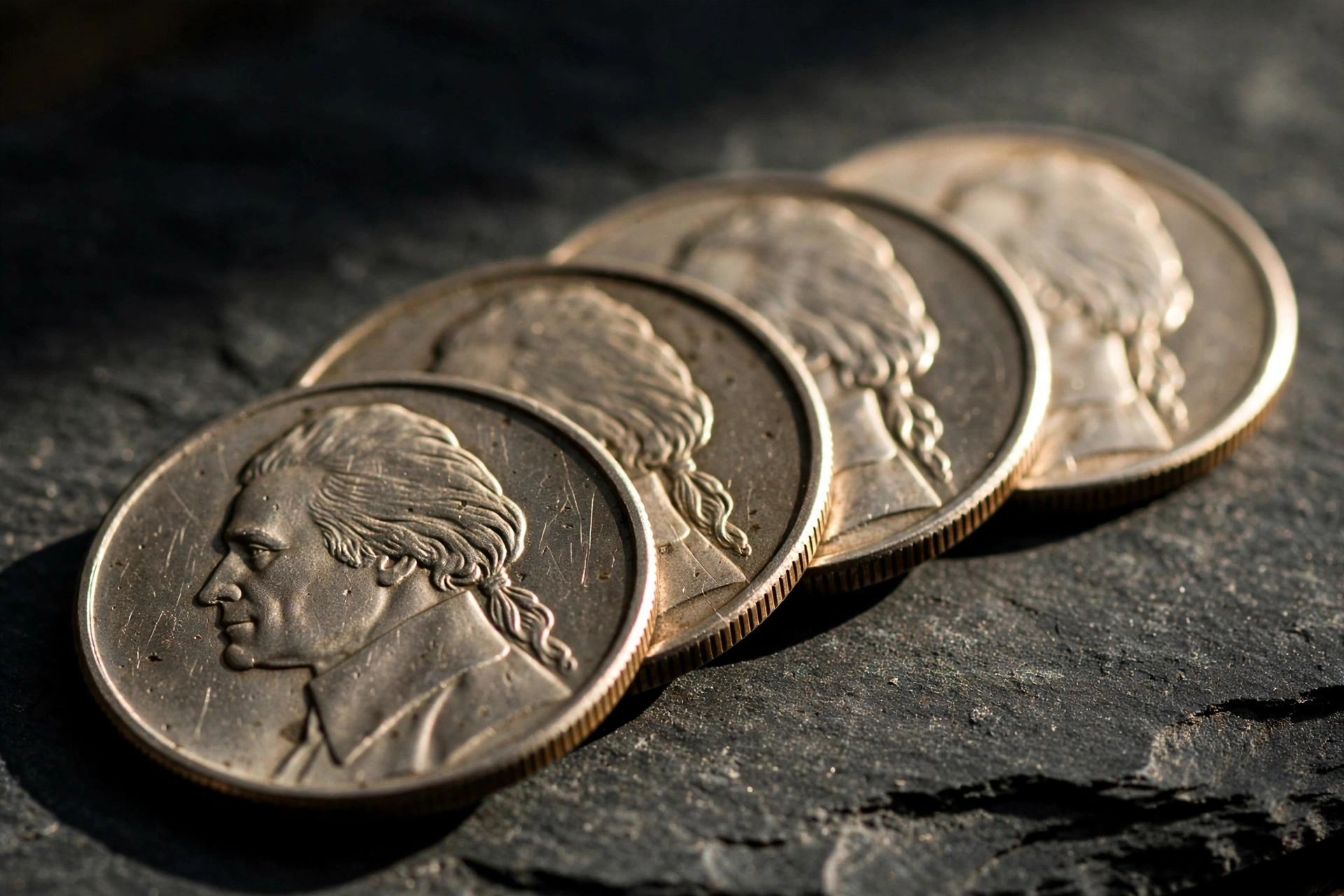
How much is a nickel worth? The quick answer: five cents. The interesting answer: it depends on the coin in your hand. Most nickels in circulation are worth exactly their face value, but the metal inside them has its own value, and certain rare dates and errors are worth hundreds or even millions of dollars to collectors.
This guide covers all three kinds of value, face value, metal (melt) value, and collector value, plus how to check the nickels in your own pocket or coin jar for the ones that matter.
Face Value: Five Cents
Every US nickel is legal tender worth $0.05. A standard roll of nickels contains 40 coins and is worth $2. If you pulled a nickel from your change today, odds are overwhelmingly good that it is worth five cents, no more, no less. Modern Jefferson nickels in worn, circulated condition have no premium over face value, and banks will always take them at face value.
That said, “face value” is only the floor. The other two kinds of value are where things get interesting.
Metal Value: What Is a Nickel Made Of?
Despite the name, a modern US nickel is not mostly nickel. Since 1866, the five-cent coin has been made of 75% copper and 25% nickel, weighs exactly 5 grams, and measures 21.2 mm across. The US nickel coin has kept this basic recipe for over 150 years, with one famous wartime exception covered below.
The melt value, what the metal alone is worth, moves with copper and nickel prices. For most of recent history, the metal in a nickel has been worth close to, and sometimes slightly more than, five cents. That creates an odd situation: the raw metal can be worth more than the coin’s spending power. However, it has been illegal since 2007 to melt US pennies and nickels for profit, with fines up to $10,000, precisely to stop people from cashing in on that gap. So the metal value is trivia, not a business plan.
A Short History of the Nickel
The five-cent coin was introduced in 1866 to replace the tiny silver “half dime,” which people kept losing. Its designs tell a story of American coinage:
- Shield nickel (1866-1883): the first five-cent nickel coin, with a shield design.
- Liberty Head or “V” nickel (1883-1912): named for the large Roman numeral V on the back. The 1913 Liberty Head is one of the most famous rarities in all of coin collecting.
- Buffalo nickel (1913-1938): James Earle Fraser’s iconic design with a Native American portrait and an American bison. The Buffalo nickel is beloved by collectors and still turns up in circulation occasionally.
- Jefferson nickel (1938-present): Thomas Jefferson on the front, his home Monticello on the back (with design variations in recent years).
- how many books make a library
Wartime Silver Nickels (1942-1945)
During World War II, nickel metal was needed for the war effort, so the Mint changed the recipe. Nickels dated 1942 to 1945 with a large mint mark above Monticello contain 35% silver, along with copper and manganese. These “war nickels” are the only US nickels ever made with silver, and they are worth more than face value for their silver content alone, typically a few dollars each depending on the silver price and condition.
How to spot one: look for a big P, D, or S mint mark stamped prominently above the Monticello dome on the reverse. Regular Jefferson nickels have small mint marks (or none) in other positions. If you find one in change, set it aside.
Collector Value: The Nickels Worth Real Money
Collector value depends on three things: rarity (date and mint mark), condition, and demand. A common-date nickel in worn condition is worth five cents. The same design in pristine condition, or a scarce date, can be worth far more. Here are the famous ones:
- 1913 Liberty Head nickel: only five are known to exist, struck under mysterious circumstances. One sold at auction for over $3 million. If you somehow owned one, you would know. Learn more about the Liberty Head nickel series and its legendary final year.
- 1918/7-D Buffalo nickel (overdate): a 1918 die was re-stamped over a 1917 die, leaving a visible doubled date. Even worn examples are worth hundreds; sharp ones reach five figures.
- 1937-D “three-legged” Buffalo nickel: a mint worker over-polished the die and accidentally removed one of the bison’s legs. A genuine example in decent shape is worth $500 to several thousand dollars.
- 1950-D Jefferson nickel: the lowest-mintage Jefferson nickel at about 2.6 million. Uncirculated examples carry a real premium, though worn ones are modest.
- 1942-1945 silver war nickels: worth their silver content at minimum, a few dollars each, more in high grades.
- Error coins: off-center strikes, doubled dies, and wrong-planchet errors can be worth $50 to thousands depending on how dramatic the error is.
Condition grading runs from “Good” (heavily worn) to “Mint State” (uncirculated). The jump in value between grades can be enormous: a coin worth $10 in worn condition might be worth $1,000 uncirculated. Never clean an old coin; cleaning destroys collector value instantly.
How to Check Your Own Nickels
Grab your coin jar and work through these steps:
- Check the date first. Anything before 1960 deserves a closer look. Pre-1938 designs (Buffalo, Liberty Head, Shield) are all collectible to some degree.
- Read the mint mark. On Buffalo nickels it is under the bison; on Jefferson nickels it is on the reverse near the rim (or above Monticello for war nickels). Coins from certain mints in certain years are the scarce ones.
- Judge the condition honestly. Sharp details, original luster, and minimal wear mean higher value. Compare against photo grading guides online.
- Look up the date in a price guide. The “Red Book” (A Guide Book of United States Coins) lists values by grade for every date. Free online price guides work too.
- Get valuable finds authenticated. If you think you have something worth hundreds or more, a professional grading service or a reputable local coin dealer can confirm it. For genuinely rare coins, third-party grading is worth the fee.
Frequently Asked Questions
Are old nickels without a readable date worth anything?
Buffalo nickels with worn-off dates are extremely common and worth only a small premium, usually under a dollar, unless the coin is otherwise exceptional. They are fun to find but not valuable.
Can I melt nickels for their metal value?
No, not legally. Since 2007, US law prohibits melting pennies and nickels for their metal content, with penalties up to $10,000. The rule exists because the metal value has at times exceeded face value.
Are war nickels magnetic?
No. Despite containing manganese, wartime silver nickels are not magnetic. Do not use a magnet test on them; check for the large mint mark above Monticello instead.
What is the most valuable nickel ever sold?
The 1913 Liberty Head nickel, one of only five known, has sold for over $3 million at auction, making it one of the most valuable American coins of any denomination.
You May Also Like
- How Many Trans People Are in the US? — the data behind a widely quoted demographic statistic.
- How Do I Get Started Playing Padel? — a beginner’s guide to the world’s fastest-growing racket sport.
- How to Free Dive Deeper for Beginners — safe techniques for building depth on a single breath.
Coin collecting rewards the same habit that makes trivia fun: paying attention to small details. If you enjoyed this, our explainers on how many transgender people live in the US and beginner guides to padel and freediving are worth a read next.
Leave a Reply