
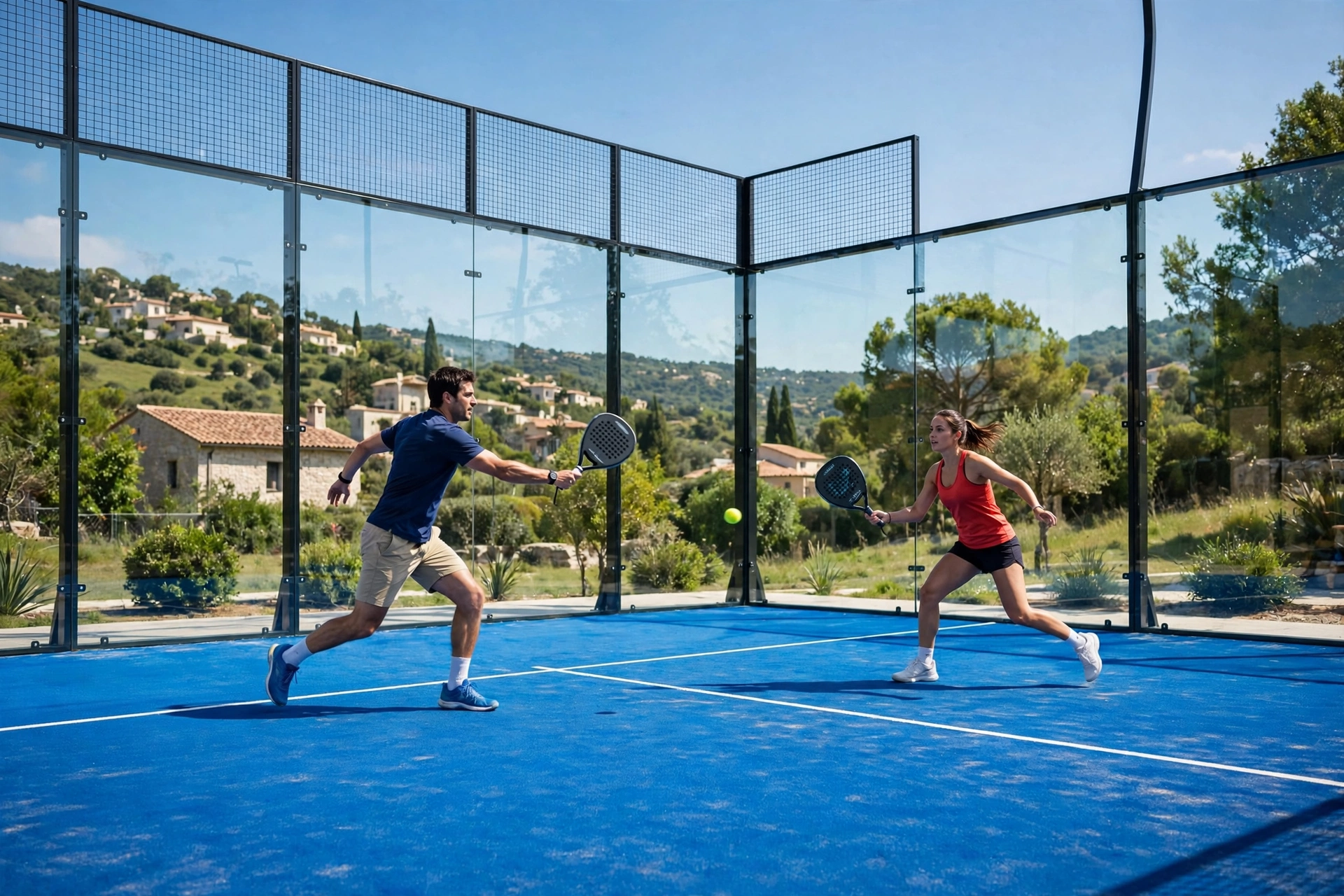
Padel is the fastest-growing racket sport in the world, and it is easy to see why. It blends the best parts of tennis and squash: you play on an enclosed court with glass walls, the ball stays in play longer, and the rallies are genuinely fun. The rules take about five minutes to learn, and most people enjoy their very first match.
If you are asking yourself, “how do I get started playing padel,” here is the short answer: you need a racket, a court, and a basic understanding of the rules. That is honestly enough to play your first game. This guide walks you through the gear, the rules, the costs, and the beginner skills that will make your first weeks on court far more enjoyable.
What Exactly Is Padel?
Padel is a racket sport played in doubles on an enclosed court that is roughly one-third the size of a tennis court. The court is surrounded by glass and mesh walls, and the ball is allowed to bounce off them, which keeps rallies alive much longer than in tennis. Serves are hit underhand, the scoring is the same as tennis, and the game rewards smart placement more than raw power.
The sport started in Mexico in the late 1960s, became a national obsession in Spain and Argentina, and has since exploded across Europe, the Middle East, and the United States. You can read more about the history of padel if you are curious how a backyard experiment turned into a global sport with professional tours.
Why Padel Is Perfect for Beginners
Plenty of sports claim to be beginner-friendly. Padel actually earns it:
- Easier to pick up than tennis. The underhand serve removes the hardest shot in tennis, the court is smaller, and the ball comes back to you more often thanks to the walls.
- Rallies last longer. Because you can play the ball off the walls, points do not end the moment you mis-hit. Longer rallies mean more fun per minute.
- It is social by design. Padel is almost always played as doubles, so there are four people on court. It is a great way to meet people.
- Less running than singles tennis. The smaller court means shorter sprints, which is kinder on knees and lungs.
- Year-round play. Many clubs have indoor courts, so weather rarely cancels your plans.
- how to play pool
The Gear You Actually Need
You do not need expensive equipment to start. Here is what matters and what does not.
A Padel Racket
A padel racket is short, solid (no strings), and full of holes. Beginners should look for a round-shaped racket weighing around 350 to 370 grams with a soft or medium foam core. That shape gives you a bigger sweet spot and more control, which matters far more than power when you are learning. Expect to pay roughly $50 to $120 for a decent beginner racket. Do not buy the most expensive model in the shop; you will not feel the difference yet, and you will upgrade with better judgment later.
Padel Balls
Padel balls look like tennis balls but are made with slightly lower internal pressure, so they bounce a little less. They also wear out faster because of the walls and the mesh. A tube of three or four balls is cheap, and most players just split the cost. Open a fresh tube for important matches and use the older ones for practice.
Court Shoes
Padel involves constant side-to-side movement, so shoes with good lateral support matter more than fancy cushioning. If you play on artificial grass courts, look for soles with small studs or a herringbone pattern. Running shoes work for your first few sessions, but proper court shoes will save your ankles as you play more.
Clothing
Any comfortable sportswear works. If you play outdoors, bring a cap, sunscreen, and water. Padel is more tiring than it looks from the sidelines, especially in the sun.
Money-saving tip: most padel clubs rent rackets for a few dollars. Rent for your first two or three sessions before buying anything.
How to Find a Court and Playing Partners
Finding a place to play is easier than ever. Search for padel clubs in your area, check apps like Playtomic that list courts and open matches, and look at local sports centers, many of which have added padel courts in recent years. If your city has a padel community on social media, join it; players are always looking for a fourth.
Your best move as a total beginner is to book an introductory clinic or a beginner group session. A coach will show you the grip, the basic shots, and the rules in one hour, and you will meet other beginners at your level. After two or three clinics, you will be ready to join casual open-play matches without feeling lost.
The Basic Rules You Need for Your First Game
You do not need to memorize the full rulebook. These are the rules that actually come up in a beginner match:
- Played in doubles. Four players, two per side. Singles padel exists but is rare.
- Court and walls. The court is 20 meters long and 10 meters wide, enclosed by glass and metal mesh. The ball may bounce off the walls on your side, and you can even let it pass you and play it off the back wall.
- Scoring. Padel uses the standard tennis-style scoring system: 15, 30, 40, deuce, advantage. Matches are usually best of three sets, with six games to win a set.
- The serve. Serves are underhand. You bounce the ball once, then hit it below waist height into the diagonally opposite service box. If the ball hits the glass before bouncing in the box, it is a fault. You get two serves, just like tennis.
- Wall rules. After the ball bounces once on your side, it can hit the wall and you can still play it. But if the ball hits the wall before bouncing on your side, or bounces twice on the ground, the point is over.
- The net. If your serve hits the net and lands in the box, it is a let and you serve again.
That is genuinely enough to play. The finer points, like what happens when the ball goes out through the court door, you will pick up naturally.
Beginner Skills to Practice First
Padel technique is simpler than tennis technique, but a few fundamentals make a huge difference:
- The flat forehand. Keep your swing short and compact. Long tennis-style swings cause errors in padel because the court is small and the ball comes back fast.
- The backhand. Many beginners use two hands for extra control. Either way, step into the ball rather than reaching for it.
- The lob. This is the most important shot in beginner padel. A high, deep lob pushes your opponents back and buys you time to move to the net. Practice hitting it with height, not power.
- Playing off the walls. Let the ball come to you off the back glass instead of panicking. Wait for the bounce off the wall, then play a controlled shot. This feels strange for the first hour and natural after the third.
- Net position. In doubles, the team that controls the net usually wins the point. After serving, try to move forward with your partner rather than hanging at the back.
A simple practice routine: spend ten minutes rallying forehands down the middle, ten minutes practicing lobs from the back, and ten minutes letting balls hit the back wall and playing them calmly. Do that a few times and you will be ahead of most first-month players.
What to Expect in Your First Few Games
Your first match will be messy, and that is normal. Everyone shanks balls into the glass and forgets the score. A casual game takes about 60 to 90 minutes. Basic etiquette will carry you far: call out the score before each serve, return balls promptly to the server, and do not walk across another court to fetch a ball while a point is being played.
Play with people near your level when you can. Games are most fun when rallies last, and that happens when all four players are roughly matched. Do not be shy about telling better players you are new; most padel players love introducing beginners to the sport.
How Much Does It Cost to Start Playing Padel?
Padel is one of the more affordable racket sports. A beginner racket costs $50 to $120, a tube of balls is under $10, and court rental typically runs $20 to $60 per hour, split four ways, which works out to $5 to $15 per person. Beginner clinics usually cost $15 to $30 per session. All in, you can start playing regularly for well under $200 in your first month, including the racket. If you are weighing up active hobbies, our guide on how to free dive deeper for beginners covers another low-equipment sport with a very different kind of thrill.
Frequently Asked Questions
Is padel harder than tennis?
For a beginner, padel is easier. The underhand serve, smaller court, and walls remove the steepest parts of the tennis learning curve. Skilled tennis players still need time to adjust to wall play, though.
Do I need to be fit to start?
No. Padel works at whatever pace you bring. The court is small, points are short, and you can rest between points. Many people pick it up in their 40s, 50s, and beyond, and it is a genuinely good workout once you start moving well.
Can I play padel as singles?
Technically yes, but almost nobody does. The court is designed for doubles, and singles padel is exhausting because the walls keep everything in play. Find three friends or join an open match instead.
How long does a padel match take?
A best-of-three-sets match usually takes 60 to 90 minutes. Most court bookings are sold in 90-minute slots, which fits one full match comfortably.
How is padel different from other racket sports?
The walls are the big difference. No other mainstream racket sport lets you play the ball off the enclosure, which creates longer rallies and a totally different strategy around lobs and net control. If you enjoy racket games generally, you will also find our overview of popular racket sports interesting for context.
You May Also Like
- How to Free Dive Deeper for Beginners — another beginner-friendly sport with a focus on technique over strength.
- How Many Trans People Are in the US? — a factual look at the numbers behind a widely discussed statistic.
- How Much Is a Nickel Worth? — face value, metal value, and the rare dates collectors pay for.
Between matches, plenty of our readers also enjoy quick factual reads like the one on how many transgender people live in the United States or the surprisingly interesting story of what a nickel is actually worth. Now grab a rented racket, book a beginner clinic, and get on court. Your first rally is closer than you think.
Leave a Reply