
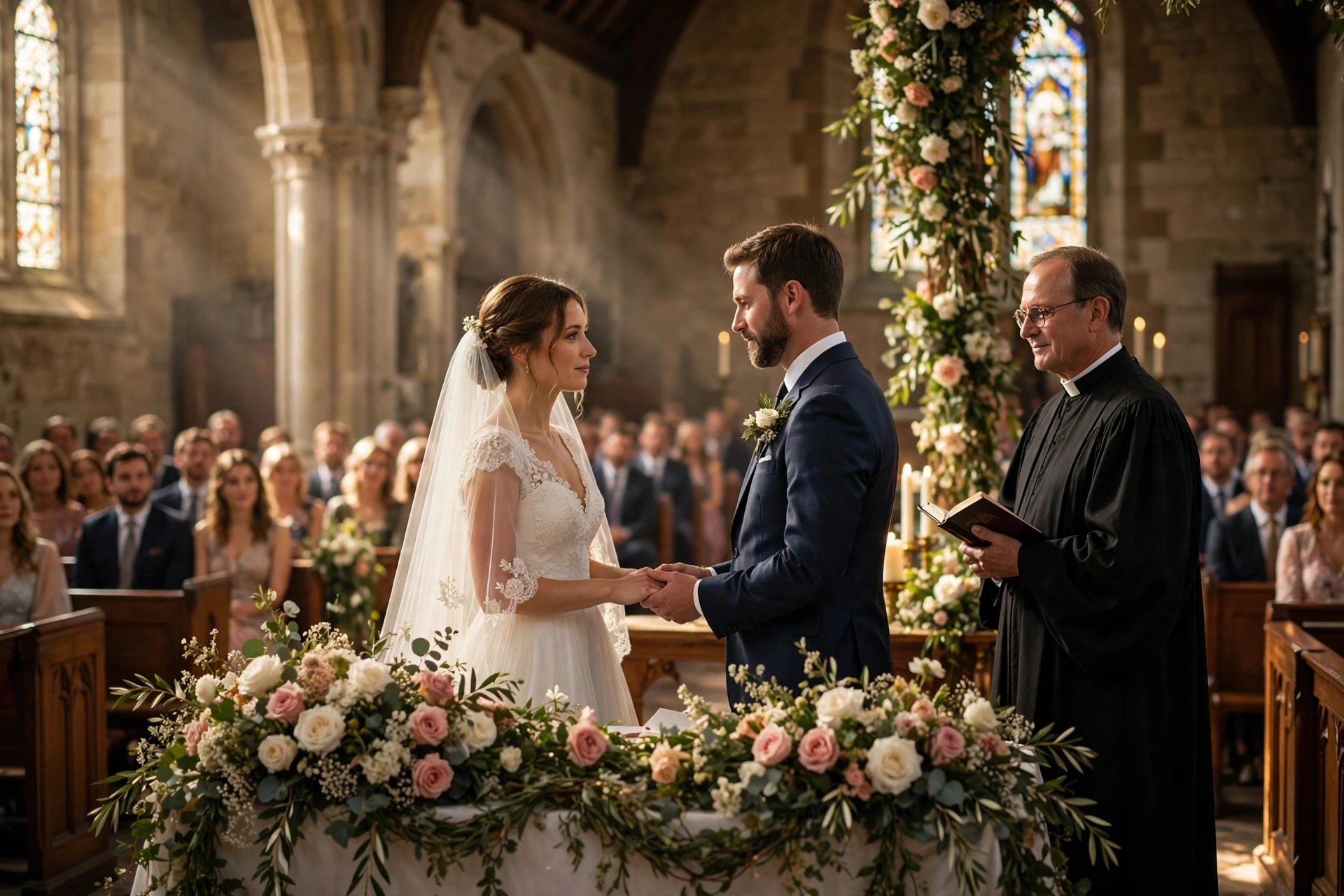
When you’re building your wedding day timeline — or sitting in the pews as a guest wondering when cocktail hour starts — the key question is simple: how long does a wedding ceremony last? Most wedding ceremonies run 20 to 30 minutes. But the real answer ranges from under 10 minutes to over two hours depending on the type of ceremony.
Here’s what to expect for every major ceremony style, what makes ceremonies run long, and how to plan the rest of your day around it.
Average Ceremony Lengths by Type
- Civil / courthouse ceremony: 10–15 minutes. Quick, legal, done.
- Non-religious officiant-led ceremony: 20–30 minutes. This is the most common American wedding and the figure most timelines are built around.
- Catholic wedding (full Mass): 45–60 minutes. A Catholic ceremony without Mass runs 25–30 minutes.
- Protestant Christian ceremony: 20–40 minutes depending on denomination and elements included.
- Jewish ceremony: 30–45 minutes, including the ketubah signing, circling, and glass breaking.
- Hindu ceremony: 1–3 hours. Traditional Hindu weddings are elaborate multi-ritual events; some last an entire day.
- Muslim nikah ceremony: 20–40 minutes for the contract and blessings, often part of a longer celebration.
- Eastern Orthodox ceremony: 45–60 minutes, rich with ritual and chanting.
- Elopement / self-solemnizing: 5–15 minutes. Just the essentials.
What Actually Fills the Time?
A typical 25-minute non-religious ceremony breaks down roughly like this:
- Processional: 3–5 minutes (wedding party and couple walking in)
- Welcome and opening remarks: 2–3 minutes
- Readings or rituals: 3–8 minutes (unity candle, handfasting, readings by friends)
- Vows: 3–5 minutes
- Ring exchange: 2–3 minutes
- Pronouncement and kiss: 1–2 minutes
- Recessional: 2–3 minutes
Every element you add — a reading, a song, a ritual — adds 2 to 5 minutes. Three readings and two songs can easily stretch a 20-minute ceremony to 40.
What Makes Ceremonies Run Long
- Large wedding parties: A 12-person processional takes noticeably longer than 4 people. (If you’re still deciding, see how many bridesmaids to have.)
- Multiple readings or performances: Each one adds time and transitions.
- Religious requirements: Full Mass, multiple blessings, or ritual sequences are the biggest factor.
- Translations: Bilingual ceremonies essentially double the spoken content.
- Late starts: The ceremony itself doesn’t get longer, but everything shifts — which is why timelines need buffer.
How to Keep Your Ceremony on Track
Write a ceremony script with timings
Ask your officiant to draft the full script with estimated minutes per section. You’ll spot the bloat immediately.
Limit readings to one or two
One meaningful reading beats three forgettable ones. Your guests’ attention peaks in the first 15 minutes.
Rehearse the logistics
The rehearsal isn’t just tradition — it’s where you discover the processional takes twice as long as expected or the readers can’t be heard.
Choose your rituals deliberately
Unity candle, sand ceremony, handfasting, wine box — each is lovely, but pick one, not four. Every ritual needs setup, explanation, and execution time.
Planning the Day Around the Ceremony
The ceremony length anchors your entire timeline. Here’s how a typical day flows with a 30-minute ceremony starting at 4:00 PM:
- 4:00–4:30: Ceremony
- 4:30–5:30: Cocktail hour (photos happen here — this is why photographers need to know your ceremony length; see tipping your photographer for coverage planning)
- 5:30–6:00: Guests seated, grand entrance
- 6:00–7:30: Dinner and toasts
- 7:30–10:00: Dancing and celebration
- 10:00: Send-off
Add a 15-minute buffer after the ceremony in your timeline. Guests take time to move, congratulate you, and find the cocktail area. The day always runs a little behind — plan for it.
For Guests: How Long Will You Be Sitting?
If you’re attending a wedding and wondering about the time commitment: plan on the ceremony plus 30 minutes of buffer (seating, processional delays, recessional). For a standard American wedding, block out one hour. For a Catholic Mass or Hindu ceremony, block out two. When in doubt, check the invitation — some couples note the expected length for longer ceremonies.
Can a Ceremony Be Too Short?
Honestly? Rarely. Guests consistently say their favorite ceremonies were short and personal. A 15-minute ceremony with heartfelt vows beats a 45-minute one padded with generic readings. The ceremony is the emotional core of the day — keep it focused and it will feel exactly right, however long it runs.
The one exception: if key family members traveled far for religious traditions they expected to see, cutting a traditional hour-long ceremony to 15 minutes can disappoint. Know your audience.
The Bottom Line
Plan on 20–30 minutes for a standard ceremony, 45–60 for most religious services, and longer for Hindu or Orthodox traditions. Time your script, limit the extras, build buffer into the timeline — and remember that the best ceremonies feel shorter than they are because every minute earns its place. If you’re mapping out the full day, our guide to planning a wedding in six months includes timeline templates, and how getting married works covers the legal side.
The Building Blocks of Ceremony Traditions
Every wedding ceremony — from a five-minute courthouse signing to a three-hour Hindu celebration — is assembled from the same basic parts: a gathering, an opening, vows or promises, an exchange of symbols, and a closing. The overview of wedding ceremony traditions across cultures shows how universally these elements appear, even as their expression varies wildly. Understanding the underlying structure helps you design a ceremony that feels complete at any length: as long as you have the core beats, even fifteen minutes can feel profound.
Inside a Catholic Wedding Mass
Since Catholic ceremonies are among the longest most guests will attend, it’s worth understanding where the time goes. The Catholic wedding Mass structure follows the standard Mass — Introductory Rites, Liturgy of the Word, the Rite of Marriage itself, Liturgy of the Eucharist, and Concluding Rites. The marriage rite sits in the middle; everything around it is the full Sunday Mass with nuptial blessings added. If you’re attending as a non-Catholic guest, expect about an hour, and know that communion is typically reserved for practicing Catholics — you can remain seated or approach with arms crossed for a blessing, depending on the parish’s custom.
Interfaith and Blended Ceremonies
Blending two traditions is increasingly common and adds meaningful time. Practical advice:
- Explain rituals briefly. A one-sentence explanation before each tradition’s ritual keeps all guests engaged instead of confused.
- Balance, don’t stack. Pick the most meaningful element from each tradition rather than performing both ceremonies in full — a two-hour double ceremony exhausts everyone.
- Consult both officiants early. Some clergy have firm requirements about what can be combined. Discover conflicts months out, not weeks.
- Print a program. For blended ceremonies, programs aren’t optional — they’re how guests follow along.
Outdoor Ceremony Timing Considerations
Outdoor ceremonies have hidden time factors indoor ones don’t:
- Guest seating takes longer — ushers navigate lawns and uneven ground more slowly than aisles.
- Sound dissipates. Without walls, readers and vows need microphones, and mic checks add setup time.
- Weather buffers are essential. Build 15–30 minutes of flex into the timeline; outdoor delays are the norm, not the exception.
- Golden hour matters. Many couples time the ceremony to end as golden hour begins for photos — which means the ceremony length directly determines your photo window. Work backward from sunset.
How Long Should Your Ceremony Be?
Here’s a decision framework: start with your non-negotiable elements (the legal bits plus any religious requirements), then add personal elements one at a time, asking of each: “Will our guests care about this in five years?” Most couples land on 20–30 minutes because that’s where meaning peaks and attention holds. If your draft script runs over 40 minutes, cut a reading before you cut a ritual — rituals are visual and memorable, readings are where attention wanders.
One final tip: time your rehearsal. Actually run the ceremony start to finish with a stopwatch. Couples are consistently surprised — usually by how much longer the processional takes and how much shorter the vows feel. Adjust the timeline with real data, not guesses.
Leave a Reply