
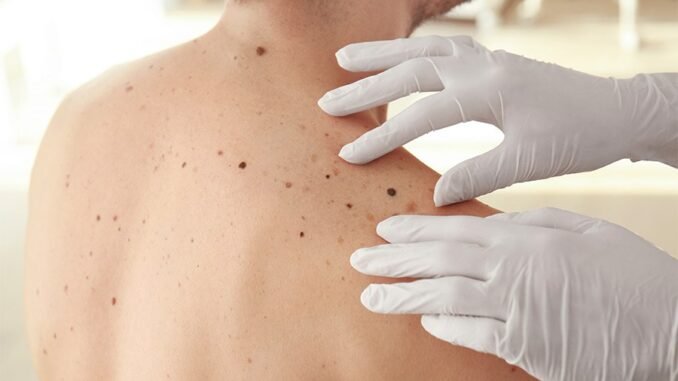
You’re getting dressed and notice it — a mole on your shoulder that you’re pretty sure looks different than last summer. Darker? Bigger? Or is it just your imagination? How do I know if I need to see a dermatologist about a mole? This is one of those questions where getting it right genuinely matters: melanoma, the deadliest skin cancer, is highly curable when caught early (5-year survival over 99% for localized cases) and dangerous when caught late. The difference between those outcomes is often just someone noticing a change and getting it checked promptly.
Here’s exactly what to look for, how to monitor your skin, and when to stop wondering and book the appointment.
How Do I Know If I Need to See a Dermatologist About a Mole? The ABCDE Rule
Dermatologists worldwide teach the ABCDE criteria for identifying suspicious moles. Memorize these — they take 30 seconds to run through:
- A — Asymmetry: one half of the mole doesn’t match the other half. Benign moles are usually symmetrical.
- B — Border: edges are irregular, blurred, jagged, or notched instead of smooth and well-defined.
- C — Color: varied colors within one mole — tan, brown, black, red, white, blue — instead of a single even shade. Especially watch for very dark or black areas.
- D — Diameter: larger than about 6mm (roughly a pencil eraser). Important caveat: melanomas can be smaller, so don’t ignore a small mole that has other warning signs.
- E — Evolving: any change over time — in size, shape, color, elevation, or new symptoms like itching, crusting, or bleeding. This is the most important one. A mole that’s changing deserves evaluation regardless of the other letters.
There’s also the “ugly duckling” rule: if one mole looks distinctly different from all your other moles, get it checked even if you can’t articulate why. Your pattern-recognition is often right.
What About New Moles as an Adult?
Most moles appear in childhood and young adulthood. A brand-new mole appearing after age 30–40 deserves a closer look — it’s not automatically dangerous (many are benign), but new growth in adulthood is worth a dermatologist’s eyes. The same goes for any spot that won’t heal, a sore that bleeds easily and reopens, or a dark streak under a fingernail or toenail that you can’t attribute to injury.
How to Monitor Your Skin (The 10-Minute Monthly Check)
Once a month, after a shower, examine your skin head to toe in good light with a hand mirror for hard-to-see areas (back, scalp — use a blow dryer to part hair — behind ears, buttocks, soles of feet, between toes). Melanoma can appear anywhere, including places that never see sun.
Take baseline photos of any moles you’re watching — your phone camera is perfect for this. Include a coin or ruler for scale. Photos turn vague “I think it changed” into objective comparison, and dermatologists love when patients bring them. There are also mole-mapping apps, but a simple dated photo album works just as well.
Know your personal risk factors, which lower your threshold for getting checked:
- Fair skin, light hair/eyes, tendency to burn
- History of blistering sunburns (especially in childhood)
- Many moles (50+) or atypical moles
- Family or personal history of skin cancer
- Heavy tanning bed use
- Weakened immune system
If you’re in a high-risk group, ask your dermatologist about the right surveillance schedule — often a full-body skin exam yearly. And if you’re working on choosing the right sunscreen, that’s the prevention half of this equation.
What Happens at the Dermatologist
Knowing what to expect removes the intimidation factor. A skin check is quick and painless:
- Visual exam: the dermatologist examines your skin, often with a dermatoscope (a handheld magnifier with light that reveals subsurface structures invisible to the naked eye).
- Documentation: suspicious spots get photographed and measured.
- Biopsy (if needed): if a mole looks concerning, the doctor removes part or all of it under local anesthetic — you feel a small pinch from the numbing shot, then nothing. It takes about 10 minutes, needs a stitch or two at most, and the sample goes to a lab.
- Results: pathology results typically come back in 1–2 weeks. Most biopsied moles turn out benign — dermatologists biopsy liberally precisely because it’s the only way to be sure.
Don’t let fear of the biopsy stop you from going. The procedure is trivial; the disease it rules out is not. And don’t try to remove or “treat” a suspicious mole yourself — no apple cider vinegar, no essential oils, no cutting. Partial home removal can mask a melanoma’s appearance and delay real diagnosis.
Beyond Moles: Other Spots Worth Checking
Moles get the attention, but basal cell and squamous cell carcinomas (far more common, rarely deadly but locally destructive) look different: pearly or waxy bumps, flat scaly red patches, sores that don’t heal, or rough scaly growths. Any persistent new spot — not just moles — earns a look from a professional if it doesn’t resolve in a few weeks. If you’re unsure whether something qualifies, most dermatology offices will triage by photo through their patient portal.
The American Academy of Dermatology’s skin cancer resources include excellent photo guides showing what concerning spots look like, and the Skin Cancer Foundation’s melanoma pages cover the ABCDEs with visual examples.
Full-Body Skin Exams: What to Expect
If you have risk factors — many moles, fair skin, family history, heavy sun exposure — your dermatologist may recommend periodic full-body skin exams. Here’s what happens: you change into a gown, and the doctor systematically examines your skin head to toe, including scalp, behind ears, between toes, and other spots you’d never check yourself. It takes 10–15 minutes, it’s clinical and professional, and it catches things you’d never find on your own — dermatologists routinely spot concerning lesions patients had no idea existed. Frequency depends on risk: annually for high-risk patients, every few years for others. Between visits, your monthly self-checks (with those dated phone photos) are the surveillance system. Think of it like dental cleanings for your skin — routine maintenance that catches small problems before they become big ones. And pair surveillance with prevention: daily proper sunscreen use remains the single highest-impact thing you can do.
The practical takeaway: learn the ABCDEs, do a monthly 10-minute skin check with phone photos for comparison, and book a dermatologist promptly for anything asymmetric, irregular, multi-colored, changing, bleeding, or simply new in adulthood. When in doubt, get it checked — the appointment takes 15 minutes, and early-detected melanoma is one of the most curable cancers there is.
Leave a Reply