
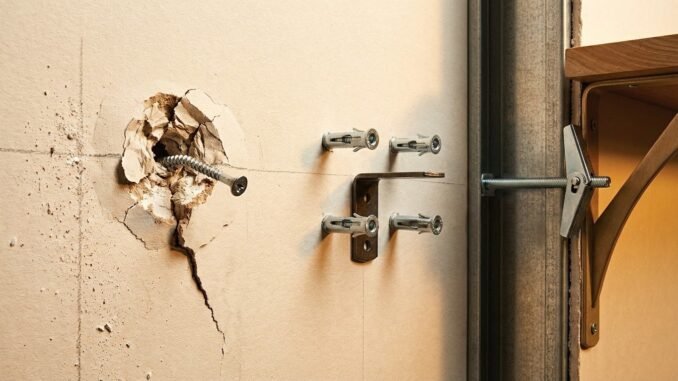
There’s a special kind of heartbreak in hearing a shelf crash at 2 a.m. Learning how to hang shelves on drywall without them falling down comes down to one thing most tutorials gloss over: drywall itself holds almost nothing — it’s the anchor (or the stud behind it) doing all the work. I’ve hung dozens of shelves, from floating bookshelves to a 40-pound reclaimed-wood mantel shelf, and the method below has never failed me. Let’s make sure your shelves stay up.
Step 1: Find the Studs (Always Try This First)
A screw driven into a wooden stud holds 50–100+ pounds. A screw in bare drywall holds about 5. So finding studs is always plan A.
- Electronic stud finder ($20–$40 — Zircon or Franklin Sensors): slide slowly, mark both edges of each stud, the center is between your marks. The best $25 you’ll spend on DIY.
- The knock test: rap the wall — solid thunk = stud, hollow echo = cavity. Imprecise but useful as a backup.
- Magnet trick: a strong neodymium magnet dragged along the wall sticks to the drywall screws marking stud locations. Weirdly effective.
- Studs are typically 16 inches apart (center to center) in US homes — measure from a corner or an outlet (outlets are usually mounted to a stud side).
If your shelf bracket holes land on studs, use #8 or #10 wood screws, 2–2.5 inches long, driven into the stud center. Done — that shelf isn’t going anywhere.
Step 2: When There’s No Stud — Choose the Right Anchor
This is where shelves fail. Not all anchors are equal — match the anchor to the weight:
- Plastic expansion anchors (the ones that come free in the box): rated ~15–25 lbs in perfect conditions. Fine for a small spice shelf. Do not trust these with books.
- Self-drilling threaded anchors (E-Z Ancor style): ~25–50 lbs each in 1/2″ drywall. Good for medium shelves. Easy to install — they screw right in with a drill.
- Toggle bolts / snap toggles (Toggler Snaptoggle): 80–265 lbs each depending on size. The metal wings spread behind the drywall, distributing weight. This is the answer for heavy shelves. A pair of 1/4″ snap toggles holds a bookshelf of hardcovers without breaking a sweat.
- Molly bolts: solid 25–50 lb rating, but toggles have largely replaced them for DIY.
Rule of thumb: estimate your loaded shelf weight, then double it for the anchor rating. Books are shockingly heavy — a 3-foot shelf of hardcovers weighs 40–60 lbs.
How to Hang Shelves on Drywall Without Them Falling Down: The Installation
- Mark your line with a level — not by eye. A 48″ level ($15–$25) is worth owning; phone level apps are okay in a pinch.
- Mark bracket holes on the wall through the bracket itself. For floating shelves, mark the mounting rail.
- Drill pilot holes slightly smaller than your anchors. For snap toggles, you’ll need a 1/2″ drill bit — yes, the hole looks alarmingly big. That’s normal.
- Set the anchors per their instructions. For toggles: push the metal channel through, pull the straps tight, snap them off flush.
- Mount the bracket/shelf, tightening screws firmly but not gorilla-tight — over-tightening strips the anchor.
- Load gradually and check level again. Then give it the honest test: press down firmly with both hands. Any flex or creaking means rethink the anchors.
Floating Shelves: Special Rules
Floating shelves hide their hardware inside the shelf, which means all the weight hangs on the mounting rail. Cheap floating shelves with thin metal rails and plastic anchors are the #1 crash culprit. For floating shelves:
- Hit at least one stud with the rail, toggles for the rest.
- Don’t exceed the manufacturer’s weight rating — and assume it’s optimistic by 30%.
- For heavy floating shelves (mantels, thick wood), consider a French cleat — two interlocking beveled boards that distribute weight across a wide area. Rock solid and invisible.
The Family Handyman anchor test data backs this up: in real drywall, toggle-style anchors outperform plastic expansion anchors by 3–5x. Spend the extra $6 on good anchors. Your books, your dishes, and your 2 a.m. peace of mind are worth it.
Shelf-Hanging Mistakes to Avoid
- Trusting the free plastic anchors with real weight: those included anchors are rated for ideal conditions — real drywall, real books, real life are not ideal. For anything heavier than a spice rack, upgrade to self-drilling or toggle anchors.
- Eyeballing level: a shelf that’s off by even half a bubble looks wrong and items slide. A $15 48-inch level (or a careful phone app) is non-negotiable.
- Drilling without checking for pipes and wires: studs aren’t the only thing in walls. A $30 stud finder with AC detection (Zircon, Franklin) warns you before you drill into a wire. Bathrooms and kitchens are the highest-risk walls.
- Over-tightening anchors: cranking screws gorilla-tight strips the anchor and destroys its holding power. Firm, then a quarter-turn — that’s it.
Hanging Shelves FAQs
How much weight can drywall actually hold?
Bare drywall: almost nothing (~5 lbs per screw). With self-drilling anchors: 25–50 lbs each. With snap toggles: 80–265 lbs each. Into a wooden stud: 50–100+ lbs per screw. The anchor (or stud) does the work — the drywall is just the surface.
How do I find studs without a stud finder?
Knock test (solid thunk vs. hollow echo), neodymium magnet (sticks to drywall screws marking studs), measure 16 inches from a corner or outlet (outlets mount to stud sides), or look for nail pops in the baseboard. A $25 stud finder is still the best answer.
Why did my shelf fall down?
99% of the time: inadequate anchors for the weight. Books are shockingly heavy (40–60 lbs per 3-foot shelf). Plastic expansion anchors + books = eventual crash. Rehang with snap toggles or into studs and it stays up permanently.
Can I hang shelves on plaster walls?
Yes, with care: plaster is harder and more brittle than drywall — drill pilot holes (don’t hammer), use masonry-style anchors or toggles, and expect some cracking around the hole (hidden by the bracket). Toggle bolts work excellently in plaster’s hollow lath cavities.
Leave a Reply