
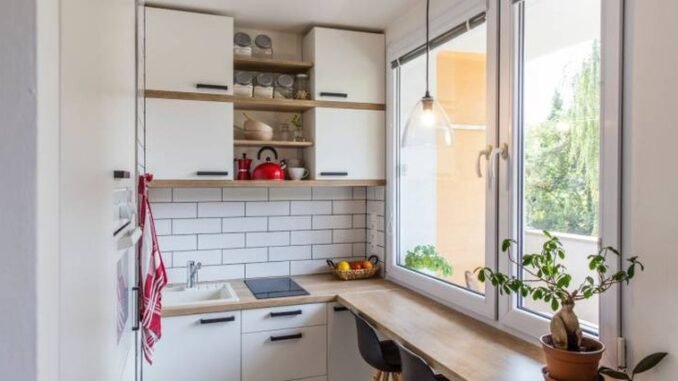
A small kitchen doesn’t have to feel small. Learning how to make a small kitchen look bigger on a budget is about manipulating light, sight lines, and visual clutter — and almost every trick costs under $50. I’ve helped two friends transform galley kitchens that felt like hallways into spaces people actually compliment, without moving a single wall. Here’s what works, ranked by impact per dollar.
1. Paint: The $60 Transformation
Nothing changes a kitchen’s perceived size faster than paint. Go light and warm on walls — soft white, pale greige, or whisper-light sage. Then do the thing most people skip: paint the upper cabinets the same color as the walls. When cabinets blend into the wall, the eye reads one continuous surface instead of a chopped-up wall of boxes. A gallon of quality cabinet paint (Behr Alkyd Semi-Gloss or Benjamin Moore Advance, ~$50–$60/gallon) plus a weekend is the highest-ROI move on this list.
2. Lighting: Banish the Single Sad Fixture
Small kitchens usually have one overhead light creating harsh shadows — shadows that visually shrink space. Fix it cheap:
- Under-cabinet LED strips ($20–$35 for a set on Amazon): stick-on or plug-in, they wash the counters in light and make the whole kitchen glow. This single addition changes the feel more than anything except paint.
- Swap the overhead for a brighter, modern flush-mount ($40–$80). Aim for 3000K–4000K bulbs — warm enough to feel homey, bright enough to feel spacious.
- Open the window: take down heavy valances or dark blinds. A $15 sheer curtain lets in light while keeping privacy.
3. Declutter the Counters (Free)
Visual clutter is the #1 space-killer, and fixing it costs nothing. The rule: if you don’t use it daily, it doesn’t live on the counter. The stand mixer, the knife block, the paper towel holder, the decorative canisters — relocate them. Keep out only: coffee maker (if daily), one cutting board, soap dispenser. Everything else goes in cabinets. A clear counter reads as more counter, which reads as more kitchen. Mount a $15 magnetic knife strip on the wall to free the knife block’s footprint.
How to Make a Small Kitchen Look Bigger on a Budget: Hardware and Surfaces
Swap the hardware ($30–$60 total)
Replacing dated knobs with sleek bar pulls ($2–$4 each on Amazon) modernizes cabinets instantly and draws the eye horizontally — horizontal lines make walls feel wider. It’s a 2-hour job with a screwdriver.
Reflective backsplash ($50–$120)
Peel-and-stick subway tile or mirrored backsplash panels bounce light around the room. A 10-square-foot area runs $50–$120 and installs in an afternoon with no special tools. Glossy finishes reflect more light than matte — that’s the whole point here.
Open up one cabinet ($0–$20)
Remove the doors from one upper cabinet (or one section) to create open shelving. Styled with matching dishes and glasses, it adds depth and airiness. Keep it to one cabinet — a whole kitchen of open shelves just looks messy.
Layout Tricks That Cost Nothing
- Clear the sight line: make sure you can see from the entrance straight to the farthest point (usually the window). Anything blocking that path — a trash can, a drying rack — chops the room in half visually.
- Small-scale furniture: if you have a kitchen table, two backless stools tuck completely under; bulky chairs eat visual space.
- Continuous flooring: if you’re replacing flooring, run the same material into the adjoining room with no threshold strip. Unbroken flooring makes two small rooms read as one larger space.
- Glass-front or no upper cabinets on one wall opens things dramatically — but only if what’s inside looks intentional.
The $200 Total Makeover Budget
Paint ($60) + LED strips ($25) + hardware ($40) + peel-and-stick backsplash ($60) + sheer curtain ($15) = $200. That’s a kitchen that photographs twice its size and feels genuinely pleasant to cook in. The Houzz small-kitchen galleries are full of proof that square footage is overrated — light, color, and clear counters do the heavy lifting. Start with the paint this weekend; you’ll wonder why you waited.
Small Kitchen Mistakes to Avoid
- Dark colors on all surfaces: dark walls + dark cabinets + dark counters in a small kitchen creates a cave. If you love dark, commit to one dark element (lower cabinets, say) and keep everything else light and reflective.
- Cluttered counters: every appliance on the counter eats visual space. If you don’t use it daily, it lives in a cabinet. A clear counter reads as more counter.
- Heavy window treatments: dark valances and thick blinds block the light that makes small kitchens feel open. Sheers or nothing — let the window work.
- Oversized hardware and fixtures: chunky knobs and a massive faucet scale wrong in a compact kitchen. Sleek, appropriately-sized choices keep proportions feeling right.
Small Kitchen FAQs
What’s the single biggest visual change I can make?
Paint the upper cabinets the wall color. When cabinets blend into the wall, the eye reads one continuous surface instead of chopped-up boxes — $60 in cabinet paint visually doubles the space. Second place: under-cabinet LED strips ($25).
Should I remove upper cabinets for open shelving?
Selectively. Removing one cabinet section for open shelves adds airiness; removing all of them destroys storage and looks messy unless you’re ruthlessly minimal. Small kitchens need their storage — don’t sacrifice function for the look.
What flooring makes a small kitchen look bigger?
Large-format tiles or planks (fewer grout lines = less visual chopping) in a light color, run continuously into the adjoining room with no threshold. Diagonal or straight lay both work — the continuity matters more than the pattern.
How much should I budget for a cosmetic small-kitchen refresh?
$200–$500 covers paint, hardware, LED strips, a peel-and-stick backsplash, and new curtains — the full visual transformation. $2,000–$5,000 adds new counters or refaced cabinets. Full remodels start around $15,000 — rarely necessary for the “feels bigger” goal.
Leave a Reply