
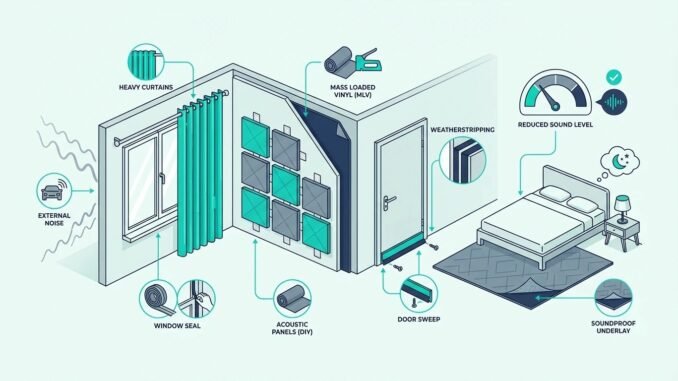
Let’s set expectations honestly: you can’t make a bedroom silent without construction. But you can absolutely soundproof a bedroom without major construction enough to cut perceived noise by 30–50% — the difference between hearing every word of the TV downstairs and sleeping through the night. I’ve done this in two apartments and one house, and the layered approach below is what actually works. No tearing open walls, no contractors, everything reversible.
The Biggest Leak: The Door
Interior doors are the #1 sound leak in most bedrooms — a hollow-core door with a half-inch gap underneath is acoustically basically an open window. Fix it:
- Door sweep or draft stopper ($10–$20): seal the bottom gap. The under-door gap alone leaks more sound than the entire door panel. An adhesive silicone sweep takes 5 minutes.
- Weatherstripping ($10–$15): self-adhesive foam or silicone strips around the door frame seal the perimeter. Close the door on a dollar bill — if it slides out easily, air (and sound) is leaking there.
- Door upgrade (optional): swapping a hollow-core door for a solid-core door ($80–$150 + 1–2 hours) blocks dramatically more sound. It’s the single biggest upgrade, still no “construction.”
- Mass-loaded vinyl (MLV) curtain: hanging a heavy moving blanket or MLV sheet ($40–$80) over the door adds mass — the core principle of sound blocking.
Walls and Windows: Add Mass and Seal Gaps
Walls (shared walls especially)
- Heavy furniture against the noisy wall: a full bookshelf ($0 if you own one) adds mass and breaks up sound reflection. Free and effective.
- Acoustic panels ($30–$60 for a 12-pack): these absorb echo within the room (great for making the room feel quieter) but block limited sound from neighbors. Manage expectations — they’re for reflection, not transmission.
- Thick tapestries or moving blankets ($20–$40) on shared walls: add mass cheaply and look intentional if chosen well.
Windows (street noise)
- Seal gaps with removable rope caulk ($6) — press it into drafty window seams in winter, remove in spring.
- Heavy blackout curtains ($40–$80/panel — look for “triple-weave”): the mass helps noticeably with mid/high-frequency noise (traffic, voices).
- Window inserts ($250–$400/window — Indow or similar): acrylic panels that press into the frame, creating an air gap. The closest thing to double-glazing without replacing windows. Worth it for street-facing bedrooms.
Floors and the Nuclear Option: White Noise
- Thick rug + dense pad ($100–$250): essential if noise comes from below (or you want to stop sending it down). A 1/2-inch felt rug pad ($60–$100) does more than the rug itself.
- White noise machine ($30–$50 — LectroFan or Yogasleep Dohm): doesn’t block sound, masks it — and masking is often more effective for sleep than blocking. Place it between you and the noise source. The Dohm’s mechanical fan sound is less fatiguing than digital loops for all-night use.
- Seal outlets and vents on shared walls with acoustic putty pads ($15 for a pack) — sound pours through electrical boxes.
How Can I Soundproof a Bedroom Without Major Construction? Realistic Results
Set targets by noise type: voices and TV (mid-frequency) respond best — expect 40–50% reduction with door sealing + curtains + soft furnishings. Traffic rumble and bass (low-frequency) are physics — mass and air gaps help, but true isolation needs construction. Footsteps from above need the upstairs neighbor’s cooperation (rugs) more than anything you can do.
The $200 starter kit: door sweep + weatherstripping ($25), blackout curtains ($60), thick rug pad ($70), white noise machine ($40). Do the door first — it’s always the door. Then sleep through the night and wonder why you waited so long.
Soundproofing Mistakes to Avoid
- Buying acoustic foam expecting sound blocking: foam panels absorb echo within a room — they barely block sound transmission through walls. For neighbor noise, you need mass and sealed gaps, not foam.
- Ignoring the door: the under-door gap leaks more sound than the entire door panel. A $15 door sweep + weatherstripping outperforms $200 of wall panels. Always start with the door.
- Egg cartons and mattresses: internet folklore — egg cartons do essentially nothing (they’re too thin to absorb meaningful sound). Skip the dorm-room myths; use mass-loaded vinyl, heavy curtains, and sealed gaps.
- Expecting silence: without construction, 30–50% noise reduction is the realistic ceiling — enough to sleep through normal household noise, not enough to block a home theater subwoofer. Set expectations by noise type.
Bedroom Soundproofing FAQs
What’s the single most effective non-construction fix?
Sealing the door — sweep + weatherstripping ($25 total, 30 minutes). Second: heavy blackout curtains ($60–$80/panel) for window noise. Third: a white noise machine ($30–$50) — masking is often more effective for sleep than blocking.
Do acoustic panels block neighbor noise?
Barely. Panels treat reflections inside your room (less echo, calmer feel) but add little mass — and mass is what blocks transmission. For neighbors: bookshelves full of books against the shared wall (free mass), MLV sheets, and sealed gaps.
How do I block bass/low-frequency noise?
Honestly: with great difficulty. Low frequencies pass through mass easily — true isolation needs decoupled construction (double walls, resilient channels). Non-construction options (white noise with low-frequency masking, earplugs, addressing it with the neighbor) are more practical than physics-defying products.
Are white noise machines safe for all-night use?
Yes, at reasonable volumes — keep it at the level of a quiet conversation or lower, placed across the room rather than by your head. Mechanical-fan models (Yogasleep Dohm) produce less fatiguing sound than digital loops for all-night use.
Renters: Soundproofing Without Losing Your Deposit
Everything above is renter-safe (no construction, no permanent changes), but renters get bonus options: removable rope caulk ($6) seals drafty window seams and peels off cleanly; tension-rod blackout curtains need no drilling; large bookshelves (freestanding) add mass to shared walls; and thick area rugs with dense pads protect both your sleep and your downstairs neighbor relationship. The Acoustical Society of America publishes accessible explainers on how sound actually travels through buildings — useful background when deciding where your limited budget does the most good (spoiler: it’s still the door). Document everything with move-in photos so the rope caulk and curtain rods don’t become deposit disputes later.
Leave a Reply