
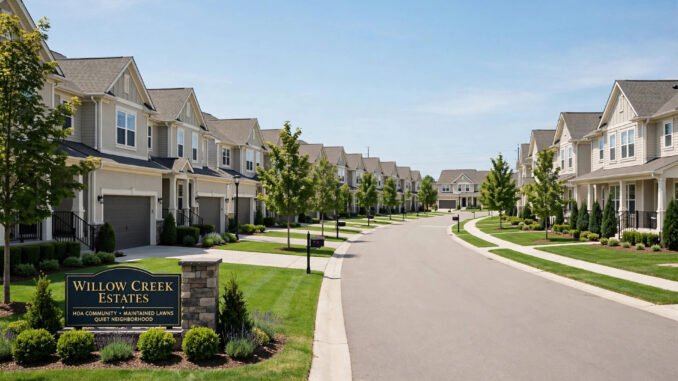
You found two perfect houses. One sits in a manicured HOA community with a pool, guarded gates, and $350/month dues. The other is a free-standing home with no HOA — total freedom, total responsibility. The price difference is small, but the lifestyle and financial difference will compound for as long as you live there. Understanding HOA versus non-HOA homes is one of the highest-leverage decisions in homebuying, and most buyers make it on vibes instead of analysis.
This guide breaks down the real trade-offs: what HOAs cost and provide, what freedom really costs on the other side, and how to decide based on your finances, temperament, and timeline.
What an HOA Actually Is (and Is Not)
A homeowners association is a private governing body for a community — condos, townhomes, and many single-family subdivisions. You pay monthly or quarterly dues ($200–$700+ for typical communities; luxury high-rises can exceed $2,000), and in exchange the HOA maintains common areas, enforces community rules (CC&Rs), and manages shared insurance and reserves. It is not a government, though it can feel like one: HOAs can fine you, place liens on your home for unpaid dues, and in extreme cases foreclose.
What HOAs are not: optional (dues are mandatory and attached to the deed), profit-driven (they are nonprofits, though mismanagement happens), or uniform — a well-run HOA is invisible and valuable; a badly run one is a slow-motion financial disaster. The HUD homeowner resources explain HOA disclosure requirements, and the Consumer Financial Protection Bureau covers how HOA dues factor into mortgage qualification — lenders count them in your debt-to-income ratio, which directly reduces your buying power.
The Case for HOA Communities
Predictable maintenance and amenities
The HOA handles roofing (in condos), landscaping, exterior maintenance, pools, gyms, security, and common-area insurance. For busy professionals, frequent travelers, or first-time buyers intimidated by maintenance, outsourcing the exterior of your life has genuine value. Amenities you could never afford solo — a pool, tennis courts, a staffed gym — come bundled.
Property value protection
HOA rules prevent the neighbor with six junk cars and a collapsing fence from torpedoing your property value. In well-managed communities, this uniformity supports resale values — appraisers and buyers pay for predictability.
Built-in community
Shared spaces and organized events create neighbor connections that non-HOA streets often lack. For newcomers to a city, this social infrastructure matters.
The costs behind the benefits: dues rise over time (budget 3–5% annual increases), special assessments ($5,000–$30,000 levied for major repairs when reserves fall short) can arrive without warning, and the rules constrain your freedom — paint colors, fences, pets, rentals, even flags are all regulatable. Before buying any HOA property, our advice on home inspections applies doubly to HOA documents: review the budget, reserve study, meeting minutes, and litigation history during escrow like a forensic accountant.
The Case for Non-HOA Homes
Total control
Paint your house purple, build the workshop, keep the chickens (check city ordinances), rent out rooms freely. Your property, your rules — subject only to municipal law. For DIY enthusiasts, this freedom is the whole point of homeownership, and it pairs perfectly with projects from our guide to DIY projects that increase home value — improvements you choose, on your timeline.
No dues, no assessments, no politics
The $350/month HOA fee invested at 7% over 30 years is roughly $425,000. That is the true lifetime cost of dues — not the monthly number. Non-HOA owners keep that money (minus what they spend on their own maintenance) and never attend a single contentious board meeting.
The honest downsides
You own 100% of maintenance: roof ($10,000–$20,000 every 20–30 years), exterior paint, landscaping, driveway, sewer lateral — budget 1–2% of home value annually and mean it. Your neighbor’s choices affect your value with no recourse beyond city code enforcement. And you get no amenities unless you build or buy them yourself.
How to Decide: Five Questions
1. What is your maintenance temperament? Love weekend projects → non-HOA. Dread them → HOA. 2. How long will you stay? Under 5 years: HOA uniformity aids resale; run the dues math against the convenience. 10+ years: non-HOA freedom and the invested-dues compounding favor independence. 3. Can you afford the dues growth? Do not underwrite based on today’s dues — model 4% annual increases plus one special assessment per decade. 4. Do you want to rent it out someday? Many HOAs restrict rentals (caps, minimum lease terms, or outright bans) — a dealbreaker for future investors. 5. Have you read the documents? For any HOA purchase: reserve study funding level (under 70% funded is a yellow flag), pending litigation, rental restrictions, pet policies, and the last two years of meeting minutes. A healthy HOA answers these proudly; a troubled one obfuscates.
HOA Horror Stories: What Goes Wrong (and How to Spot It Early)
The nightmare scenarios are real but detectable: Underfunded reserves — the HOA kept dues artificially low for years, then levies a $25,000 special assessment per unit for a new roof. Detection: reserve study funding below 70%, dues that have not risen in five years (suspicious, not generous). Developer control — in new communities, the developer controls the HOA board until enough units sell, sometimes approving sweetheart maintenance contracts with their own companies. Detection: ask when control transfers and review contracts signed during developer control. Litigation — the HOA is suing the builder (or being sued), freezing reserves and spiking insurance. Detection: meeting minutes and the resale disclosure package mention it; always ask directly. Rule overreach — fines for grass height measured in fractions of an inch, rental bans enacted after you bought intending to rent. Detection: read the CC&Rs fully (yes, all 80 pages) and the last year of violation/fine logs. None of these are reasons to fear all HOAs — they are reasons to investigate the specific one, because HOA quality varies more than almost any other factor in homebuying.
Conclusion
HOA versus non-HOA is a lifestyle purchase disguised as a housing choice. HOAs trade money and freedom for convenience, amenities, and value protection — worth it for the maintenance-averse and the community-seeking, punishing for the independent and the investor-minded. Non-HOA homes trade convenience for control and long-term savings — worth it for DIYers and long-term holders who will actually maintain their property. Price both honestly (dues compounded, maintenance budgeted), read every HOA document before committing, and choose the constraints you will resent least. The wrong choice is not HOA or non-HOA — it is choosing without doing this math.
Frequently Asked Questions
What are typical HOA fees?
$200–$700/month for typical condo and subdivision communities; luxury buildings can exceed $2,000. Fees generally rise 3–5% annually, plus occasional special assessments of $5,000–$30,000 for major repairs.
Can an HOA foreclose on my home?
Yes, in most states HOAs can place liens for unpaid dues and, in extreme cases, foreclose. Unpaid HOA debt is serious — treat dues with the same priority as your mortgage payment.
Do HOAs affect my mortgage qualification?
Yes. Lenders include HOA dues in your debt-to-income ratio, which reduces the mortgage amount you qualify for. High dues can meaningfully shrink your buying power.
Can I rent out my HOA property?
Depends on the community — many HOAs cap rentals, require minimum lease terms, or ban them entirely. Check the CC&Rs before buying if future rental is part of your plan.
Are non-HOA homes harder to resell?
Not inherently. Well-maintained non-HOA homes in desirable areas sell strongly. The risk is neighborhood variability — one neglected neighboring property can affect values without HOA enforcement to correct it.
Leave a Reply