
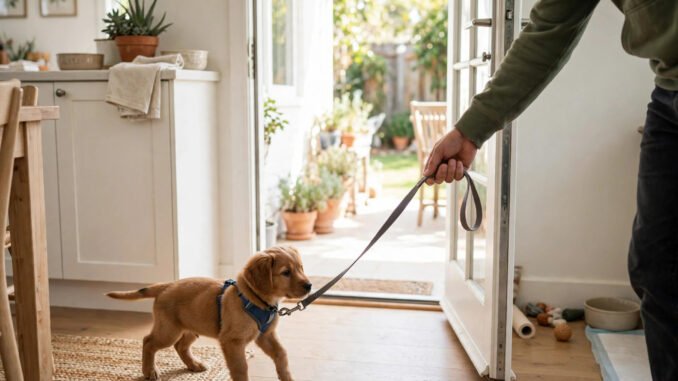
Nothing humbles a new puppy owner quite like the third accident of the day. House-training — teaching your puppy to eliminate outside, on cue, reliably — is the first real project of dog ownership, and as a complete beginner it’s easy to feel like you’re failing at it. You’re not. House-training is a biological process as much as a training one: young puppies physically cannot hold it for long, and success comes from management and timing, not from any special talent. Here’s the complete beginner’s method that actually works.
Understanding the Biology (Why Your Puppy “Can’t Help It”)
The single most useful fact for beginners: a puppy can generally hold their bladder about one hour per month of age, up to roughly 8–9 months. An 8-week-old puppy: about 2 hours max. A 4-month-old: about 4 hours. This isn’t a training failure — it’s anatomy. Bladder muscles and the neurological control to “hold it” develop with age, and no amount of scolding accelerates biology.
Puppies also eliminate after predictable triggers: waking up (from any nap, any length), eating or drinking (within 5–30 minutes), playing (excitement loosens everything), and — the one beginners miss — after coming back inside from an unsuccessful outdoor trip. If your puppy plays hard for 20 minutes then squats, that’s not defiance. That’s physiology.
Most puppies are reliably house-trained between 4 and 6 months old, with smaller breeds sometimes taking a bit longer (smaller bladders, faster metabolisms). “Reliably” means accidents are rare, not zero — the occasional regression during exciting or stressful events is normal well into the first year.
The Core Method: Schedule, Supervise, Reward
Forget everything complicated. House-training has three pillars:
1. A ruthless schedule. Take the puppy out: first thing in the morning, after every meal, after every nap, after every play session, after drinking water, and every 1–2 hours in between (adjusted for age). Same door, same spot outside, same boring routine. Puppies learn location habits fast — “this is the potty spot” forms within days if you’re consistent.
2. Constant supervision indoors. A puppy you can’t see is a puppy having an accident you’ll discover later. When you can’t actively supervise, the puppy is in a crate or pen (more on crate sizing below). The goal is to prevent accidents, not punish them — every accident indoors rehearses the wrong habit; every success outdoors rehearses the right one.
3. Immediate, over-the-top rewards. The instant the puppy finishes eliminating outside — mid-squat is fine — deliver a high-value treat and genuine praise. Timing is everything: reward within 2–3 seconds. The puppy must connect “peeing here” with “amazing things happen.” Treats beat praise alone for most puppies; use both.
Add a cue word (“go potty,” “do your business” — pick one and stick with it), said calmly as the puppy starts. Within a couple of weeks, most puppies begin associating the cue with the act, which eventually gives you on-demand elimination — genuinely useful before car rides and bedtime.
The Crate: Your Best Management Tool
Proper crate use is the beginner’s secret weapon, and it’s not cruel — dogs are den animals, and most take to a properly introduced crate readily. The crate works because dogs naturally avoid soiling their sleeping area, which leverages their instincts while their bladder control develops.
The critical detail: the crate must be just big enough to stand, turn, and lie down. Too big, and the puppy will designate one corner as the bathroom. Use a divider panel in a larger crate, or buy size-appropriate. Introduce it positively over several days — meals in the crate, treats tossed in, never as punishment. A puppy should never be crated longer than they can physically hold it.
Nighttime: most young puppies need one overnight trip out. Set an alarm rather than waiting for crying — if the puppy learns that crying gets them out, you’ve accidentally trained 3 AM wake-ups as a permanent feature. Take them out silently, boringly, on leash, straight back to the crate. No play, no party.
Accidents: What to Do (and What Never to Do)
Accidents will happen. When one does:
Interrupt calmly if you catch them mid-act — a gentle “oops” and immediate trip outside. If they finish outside, reward.
If you find it after the fact, just clean it. The puppy cannot connect your anger now with something they did ten minutes ago. Scolding after the fact teaches only that you’re scary and unpredictable.
Never rub their nose in it, never yell, never punish. This is the most important paragraph in this article. Punishment for accidents creates dogs that hide to eliminate (behind the couch, in the spare bedroom) and damages your relationship. It has never house-trained a dog faster. Not once.
Clean with enzymatic cleaner. Regular cleaners leave behind proteins the puppy can still smell, which says “bathroom here.” Enzymatic pet cleaners (Nature’s Miracle and similar) actually break down the odor compounds. This step matters more than most beginners realize — repeat accidents in the same spot are often a cleaning failure, not a training failure.
For broader home setup with a new puppy, the best flooring options for homes with pets covers which surfaces survive the house-training phase with the least stress — useful context if you’re choosing rugs or planning renovations around a new dog.
Troubleshooting the Common Stalls
“He goes outside, then pees again inside ten minutes later.” He didn’t fully empty outside — puppies get distracted. Stay out longer, keep it boring (no play until after business), and try walking a bit; movement stimulates elimination.
“She won’t go when it’s raining/cold.” Totally normal. Accompany her (your presence helps), use the same spot, consider a covered area or a large umbrella. Some puppies need a raincoat — dignity is optional, dryness is not.
“He was doing great for two weeks, then regressed.” Regression around 4–5 months often coincides with teething, growth spurts, or schedule changes. Go back to basics (more frequent trips, closer supervision) for a week; it usually resolves. Also rule out urinary tract infections — sudden regression in a previously reliable puppy warrants a vet check.
“She only goes on the patio/deck, not the grass.” Surface preference forms fast. If you want grass elimination, start taking her to grass from day one — don’t let the convenient surface become the only surface.
The AKC’s house-training guide and the ASPCA’s behavior resources both reinforce this schedule-supervise-reward method — it’s the professional consensus, not just one opinion.
Sample Schedule for an 8–12 Week Old Puppy
6:30 AM: outside immediately on waking. 7:00: breakfast, then outside within 15 minutes. 9:00: outside after morning nap. 11:00: outside; play session, then outside again after. 12:30: lunch, then outside. 2:00, 4:00: outside after naps. 5:30: dinner, then outside. 7:00: outside after evening play. 9:00: last water pickup (about 2 hours before bed). 10:30: final outside trip, then crate for the night. 2:30 AM: one overnight trip (alarm, not crying).
Yes, it’s a lot of trips. It lasts a few months. Every accident prevented is a deposit in the “reliable adult dog” account — and if you’re considering the bigger commitment, low-maintenance pets for apartment living is worth reading before the puppy phase convinces you otherwise.
Conclusion
House-training a puppy as a complete beginner comes down to three things: a schedule built around the one-hour-per-month-of-age rule, supervision that prevents accidents instead of punishing them, and instant rewards that make the right spot the best spot. Expect 4–6 months to reliability, clean accidents with enzymatic cleaner, never punish, and size the crate correctly. It’s repetitive, it’s occasionally exhausting, and it works — every single time it’s done consistently. The puppy isn’t giving you a hard time; the puppy is having a hard time with a bladder the size of a walnut. Meet them where their biology is, and the trained dog on the other side is worth every 2 AM trip to the yard.
Frequently Asked Questions
How long does it take to house-train a puppy?
Most puppies are reliably house-trained between 4 and 6 months old with consistent training. Smaller breeds may take slightly longer. Occasional accidents during exciting or stressful events can continue into the first year and are normal.
Should I punish my puppy for accidents inside?
No — never. Puppies can’t connect delayed punishment with the accident, so it only teaches fear and hiding. Interrupt calmly if caught mid-act, clean thoroughly with enzymatic cleaner, and focus on preventing the next one through scheduling and supervision.
How often should I take my puppy outside?
After waking, after eating/drinking, after playing, and every 1–2 hours otherwise — guided by the one-hour-per-month-of-age bladder rule. An 8-week-old puppy needs trips roughly every 2 hours during the day plus one overnight.
Is crate training cruel?
No, when done correctly. Dogs are den animals and most accept crates readily with positive introduction. The crate must be properly sized, never used as punishment, and the puppy should never be confined longer than they can physically hold it.
Leave a Reply