
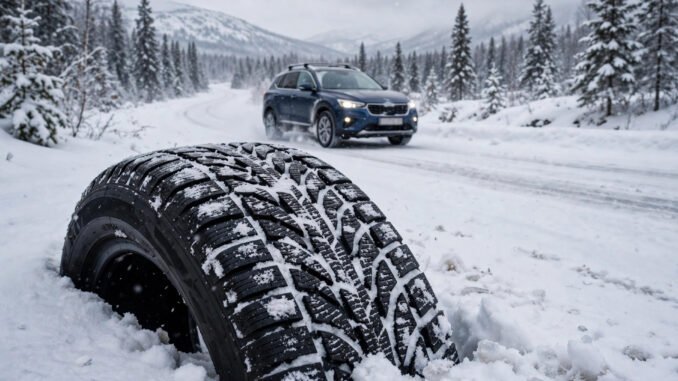
Winter is coming to the mountains, the forecast shows snow next week, and you are wondering whether your all-season tires are “good enough.” They are not — not for real winter conditions. Choosing winter tires is one of the highest-impact safety decisions a driver in snow country makes: the difference in stopping distance on ice between all-seasons and true winter tires can exceed 30 feet from just 30 mph. That is the difference between stopping and colliding.
This guide explains how winter tires actually work, when you need them, how to choose the right set, and what they really cost.
How Winter Tires Actually Work (It’s the Rubber, Not the Tread)
The common misconception: winter tires are about aggressive tread patterns. Tread matters, but the real magic is the rubber compound. All-season and summer tires harden as temperatures drop — below about 45°F (7°C), their rubber becomes stiff and loses grip, like a hockey puck versus a tennis ball. Winter tires use softer compounds with more natural rubber and silica that stay pliable in cold, maintaining grip on cold dry pavement, not just snow.
This is why the temperature rule matters more than the snowfall rule: if temperatures regularly drop below 45°F, winter tires outperform all-seasons even on dry roads. The tread features — deeper grooves, thousands of tiny slits called sipes that bite into ice, wider channels that evacuate slush — handle the snow and ice on top of the compound advantage.
The three-peak mountain snowflake symbol (3PMSF) on the sidewall certifies the tire passed standardized snow-traction testing. All-seasons with M+S (mud and snow) marking have not passed this test — M+S is a tread-pattern designation, not a performance certification. This distinction matters enormously when shopping.
Do You Actually Need Them? (the Honest Assessment)
Yes, if: you live where temperatures stay below 45°F for months (Upper Midwest, Northeast, mountain states), you drive in snow/ice regularly, or your area gets freeze-thaw cycles creating black ice. For these drivers, winter tires are not optional equipment — they are the single biggest safety upgrade available, bigger than AWD (which helps you go, not stop).
Probably not, if: you live in the Sun Belt or Pacific Northwest lowlands where winter means rain, not snow and sustained cold. Quality all-seasons suffice — though dedicated rain performance matters more than snow ratings there.
The gray zone: Mid-Atlantic, lower Midwest — a few snow events yearly, temperatures hovering around freezing. Here, premium all-weather tires (a distinct category carrying the 3PMSF symbol but usable year-round — e.g., Michelin CrossClimate, Nokian WR series) split the difference well. They are ~80% of a winter tire’s snow performance with none of the seasonal changeover hassle.
How to Choose: The Buying Guide
Studded vs. studless
Studless (friction) winter tires are the default choice for 95% of drivers — excellent on snow, very good on ice, quiet, and legal everywhere. Modern studless compounds (Bridgestone Blizzak, Michelin X-Ice, Nokian Hakkapeliitta R series) achieve remarkable ice grip through advanced rubber chemistry.
Studded tires add metal studs for maximum ice traction — superior on sheer ice, but noisy, damaging to dry pavement (restricted or banned in many states — check local laws), and worse than studless on wet/dry cold pavement. Justified only for rural drivers facing regular ice with minimal plowing.
Sizing: narrower is better
For winter, narrower tires cut through snow to reach pavement rather than floating on top — the opposite of summer performance logic. Many drivers “minus-size” for winter: if you run 225-width summers, 205-width winters on smaller-diameter wheels. This also makes winter tires cheaper (smaller = less expensive) — a rare win-win. Check your owner’s manual for approved alternate sizes.
Second set of wheels: the smart money
Mounting winter tires on a dedicated set of steel or inexpensive alloy wheels ($60–$120/wheel) saves $80–$150 in twice-yearly mount/balance fees and prevents bead damage from repeated remounting. The wheels pay for themselves in 2–3 seasons and make DIY changeovers feasible (a $50 jack and 30 minutes).
Top-tier options by reputation
The consistently top-rated studless winter tires: Bridgestone Blizzak WS90, Michelin X-Ice Snow, Nokian Hakkapeliitta R5, Continental VikingContact 7. Any of these is excellent — buy based on price and availability in your size rather than agonizing between them. The Tire Rack’s test data provides objective comparisons if you want depth.
What They Really Cost
Tires alone: $100–$250 per tire depending on size — $400–$1,000 for a set of four. Never buy just two; mismatched grip front-to-rear causes dangerous handling imbalances (the rear losing grip while the front holds = spin).
Plus wheels: add $240–$480 for steel wheels. Total first-year investment: $640–$1,480.
Ongoing: seasonal changeover $80–$150/year at a shop (free DIY), plus storage (garage corner, or $50–$100/season tire hotel services).
The hidden savings: your summer/all-season set lasts roughly twice as long since it sits out winters — the winter set does not purely “cost extra,” it splits wear across two sets. Amortized over 4–6 seasons, winter tires cost ~$150–$300/year net. That is cheap for the safety gain.
Budget for the changeover alongside winterizing your home — seasonal preparation is a package deal. And the NHTSA’s winter driving guidance reinforces what the data shows: tires matter more than drivetrain for winter safety.
Timing: When to Switch
Mount winters when temperatures consistently drop below 45°F (typically late October–November in snow country); remove them when spring temperatures consistently exceed 45°F (March–April). Running winter tires in warm weather wears them rapidly — the soft compound that grips in cold degrades quickly in heat. Set calendar reminders; the transition weeks are when most drivers procrastinate dangerously.
Storage: clean them, store in a cool dark place (basements beat hot garages), stacked flat or hung — not standing on tread for months. Proper storage extends life to 5–6 seasons; replace when tread depth hits 5/32″ (winter tires lose snow effectiveness well before the legal 2/32″ minimum).
Winter Driving Technique (Tires Are Half the Equation)
The best tires cannot repeal physics. Winter technique: everything gentler — accelerate, brake, and steer as if there is an egg under each pedal. Increase following distance to 6+ seconds. Brake before turns, not in them. If you skid, look where you want to go and steer there (target fixation is real — look at the ditch and you will visit it). And remember what winter tires do not do: they do not help you see, they do not shorten the laws of physics, and they do not make black ice safe — just safer.
Pair tire prep with proper winter gear for yourself — the driver matters as much as the tires.
Conclusion
Choosing winter tires comes down to: if your winters mean sustained sub-45°F temperatures, get them — studless 3PMSF tires, ideally minus-sized on dedicated wheels, all four (never two). Budget $640–$1,480 upfront, ~$150–$300/year amortized, and switch on the temperature rule, not the calendar. It is the single biggest winter safety upgrade you can buy — bigger than AWD, bigger than any electronic aid. Your stopping distance will thank you.
Frequently Asked Questions
Can I just use all-season tires in winter?
In mild-winter regions (rarely below 40°F, little snow), yes. Where temperatures regularly drop below 45°F or snow/ice is common, all-seasons’ hardened rubber loses grip dramatically — winter tires stop significantly shorter and corner more securely. All-seasons are a compromise; winter is when the compromise shows.
Are all-weather tires a good compromise?
Yes, for the gray zone — all-weather tires (3PMSF-rated, usable year-round) deliver ~80% of winter-tire snow performance with no changeovers. They are the right answer for regions with occasional snow but not sustained deep winter. In serious snow country, dedicated winters still win.
Do I need winter tires if I have all-wheel drive?
Yes — AWD helps you accelerate, not stop or turn. Every car has all-wheel braking and all-wheel steering; winter tires improve both. An AWD car on all-seasons will out-accelerate a 2WD car on winters, then slide further when braking. Tires matter more than drivetrain for safety.
How long do winter tires last?
4–6 seasons with proper seasonal use and storage. Replace at 5/32″ tread depth (not the 2/32″ legal minimum) — winter tires lose meaningful snow traction below that. Heat is the enemy: remove them promptly in spring.
Are studded tires worth it?
Only for drivers facing regular sheer ice with minimal plowing (rural northern areas). For everyone else, modern studless tires match or beat studded performance on snow and wet/dry cold pavement, without the noise, road damage, and legal restrictions. Check your state’s studded-tire laws before considering them.
Leave a Reply