
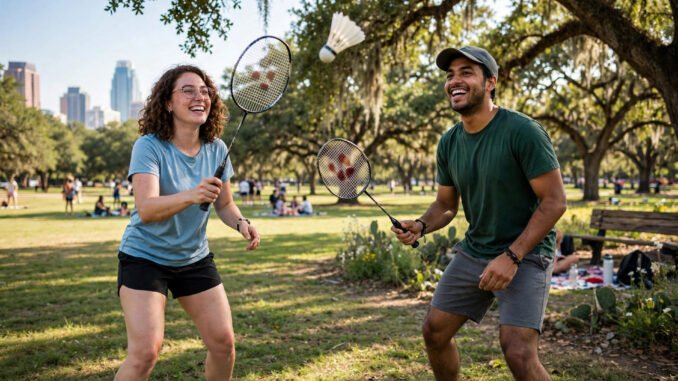
Ask most people to name a cardio workout and you will hear running, cycling, swimming — almost never badminton. That is a shame, because badminton is secretly one of the best cardio workouts available: it burns 400–500 calories an hour, torches your agility and reflexes, and feels like a game instead of exercise. In Austin, where year-round weather and a strong recreational sports scene make it easy to play, it might be the most fun-per-dollar cardio in the city.
This guide breaks down what playing badminton for cardio really costs in Austin, Texas in 2026 — gear, court access, and lessons — plus how to turn casual rallies into a genuine workout.
Why Badminton Is Elite Cardio (Seriously)
The numbers surprise people. Competitive badminton rallies demand explosive lunges, rapid direction changes, and overhead smashes — sports scientists have measured heart rates in competitive play rivaling soccer and tennis, with the shuttlecock reaching speeds over 200 mph in elite smashes (faster than any other racket sport projectile). For recreational players, an hour of active doubles play burns roughly 350–450 calories; fast singles play pushes 450–550 — comparable to jogging at a 9-minute-mile pace, but with far less joint pounding and far more fun.
It also trains things running never touches: lateral agility, hand-eye coordination, reaction time, and core rotation. The CDC’s activity guidelines count racket sports toward both aerobic and muscle-strengthening recommendations. If you are comparing cardio options generally, our breakdown of walking versus running for weight loss covers the calorie math across modalities.
The Real Cost Breakdown in Austin (2026)
Gear: $40–$100 to start
A beginner racket runs $25–$50 (Yonex and Victor entry models are excellent; avoid the $15 toy-store rackets that warp in a month). A tube of feather or nylon shuttlecocks costs $12–$25 — nylon lasts far longer for beginners and is the economical choice. Court shoes with non-marking soles: $40–$70 if you do not already own them (running shoes work initially but lack lateral support). Total honest starter kit: under $100, and the racket lasts years.
Court access: $0–$15/session
This is where Austin shines. Many Austin parks have outdoor courts usable free year-round thanks to the climate — Zilker Park and neighborhood parks are popular pickup spots. Indoor options: Austin recreation centers offer drop-in badminton for roughly $5–$10 per session, and dedicated clubs like the Austin Badminton Center run memberships in the $50–$80/month range with unlimited open play. Compare that to boutique fitness classes at $25–$35 a pop, and badminton is a steal.
Lessons: optional, $30–$60/hour
You do not need lessons to get cardio value — rallying with a friend burns calories from day one. But 2–3 beginner group clinics ($15–$25 each) dramatically improve your clear, drop, and smash technique, which makes rallies longer and workouts better. Private coaching ($40–$60/hour in Austin) is worthwhile only if you catch the competitive bug.
Realistic first-year cost: ~$75 gear + $10/week drop-in × 40 weeks = roughly $475/year for weekly play. A gym membership you actually use costs more; boutique fitness costs triple.
Turning Rallies Into a Real Workout
Casual backyard badminton barely elevates the heart rate — the cardio magic requires sustained rallies. Three upgrades: Play singles when possible. Covering the whole court alone roughly doubles the intensity of doubles. Use the “21-point sprint” format: Play games to 21 with minimal breaks between rallies; the scoring structure naturally creates interval-style intensity. Drill for 15 minutes before games: Alternating clears (deep shots) and drops with a partner is essentially HIIT disguised as practice — 30 seconds on, 30 seconds off, ten rounds.
Warm up properly: 5 minutes of light movement plus dynamic leg swings and arm circles. Badminton’s explosive lunges punish cold muscles — Achilles and calf strains are the classic injuries, and they are almost entirely preventable with warm-ups and gradual intensity. Cool down with calf and hip-flexor stretches. For general guidance on structuring weekly activity, see how much exercise you need each week.
Finding Games in Austin
Austin’s badminton community is welcoming and easy to join. Check Meetup.com for beginner-friendly open play groups, the City of Austin Parks and Recreation schedule for drop-in sessions, and local clubs’ open-gym nights (most allow non-member drop-ins). Facebook groups for Austin badminton regularly organize weekend games at parks. Show up with a racket, introduce yourself as a beginner, and you will be rallying within minutes — racket-sport people love converting newcomers.
Outdoor play note: Austin wind turns shuttlecocks into chaos agents. Mornings are calmest; nylon shuttles handle breeze better than feathers. And in summer, play before 10 a.m. or after 6 p.m. — Texas heat plus sprint intervals is a combination to respect, with water and shade breaks non-negotiable.
Badminton vs. Other Austin Cardio (Cost Comparison)
Running: $150 shoes, free thereafter — cheapest, but high joint impact and (for many) boring. Cycling: $500+ bike, great cardio, Austin’s trails are superb. Boutique fitness: $25–$35/class, $200+/month unlimited — 4–5x badminton’s cost. Tennis: similar racket-sport benefits but court time in Austin runs $15–$30/hour and the learning curve is steeper. Badminton wins on the fun-to-cost ratio for anyone who likes games more than grind — which, honestly, is most people. The American Heart Association notes that the best exercise is the one you will actually do consistently, and enjoyment is the strongest predictor of consistency.
A Sample Week: Badminton as Your Cardio Base
Here is how two sessions a week cover your cardio needs: Tuesday (60 min): 10-minute warm-up and drills, then three 21-point singles games — this is your high-intensity day. Saturday (90 min): Open play doubles at the park, social and steady-state — your endurance day. That is roughly 150 minutes of moderate-to-vigorous activity, hitting the CDC guideline with a racket in your hand. Add a 20-minute bodyweight strength session once a week (squats, lunges, planks) and you have a complete fitness program for about $40 a month in court fees. No treadmill required, no monthly app subscription, no motivation crisis — because you will actually look forward to it.
Conclusion
Playing badminton for cardio in Austin really costs under $100 to start and roughly $400–$500 a year for weekly play — a fraction of boutique fitness, with calorie burn rivaling running and a fun factor running cannot touch. Get a decent beginner racket, find free park courts or cheap rec-center drop-ins, warm up properly, and play singles-style rallies for real intensity. The shuttlecock is the fastest projectile in sports; chasing it is one of the cheapest great workouts in Austin.
Frequently Asked Questions
How much does it cost to start playing badminton in Austin?
Under $100: a beginner racket ($25–$50), shuttlecocks ($12–$25), and court shoes if needed ($40–$70). Court access runs $0 (parks) to $5–$15 per drop-in session at rec centers and clubs.
Is badminton good cardio exercise?
Excellent — an hour of active play burns 350–550 calories with heart rates comparable to soccer and tennis, plus agility, coordination, and core benefits that running does not provide.
Where can I play badminton in Austin?
Free outdoor courts at parks like Zilker, drop-in sessions at Austin recreation centers ($5–$10), dedicated clubs with monthly memberships ($50–$80), and Meetup groups for beginner-friendly open play.
Do I need lessons to play badminton for fitness?
No — rallying with a friend burns calories from day one. Two or three beginner group clinics ($15–$25 each) improve technique and make rallies longer, which improves the workout.
What is the main injury risk in badminton?
Calf and Achilles strains from explosive lunges on cold muscles. Warm up with 5 minutes of movement plus dynamic stretches, increase intensity gradually, and wear court shoes with lateral support.
Leave a Reply