
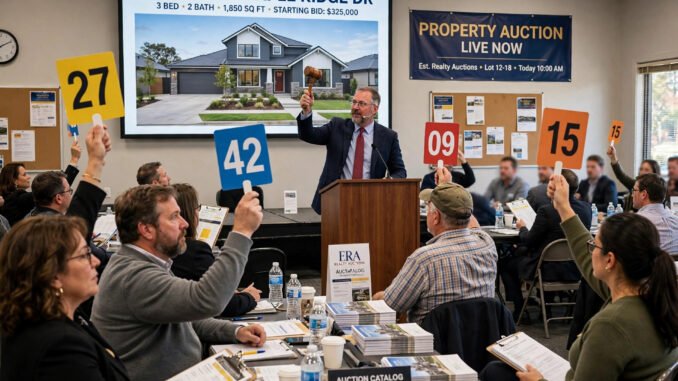
Television makes property auctions look thrilling — the gavel, the bidding war, the steal of a lifetime. The reality is less cinematic but potentially more profitable: buying a property at auction can deliver genuine below-market deals, but it can also deliver expensive disasters to unprepared buyers. Auctions reward the prepared and punish the impulsive with unusual efficiency.
This guide explains how property auctions actually work in the US, the real costs and risks, how to prepare like a professional, and whether auction buying suits a beginner.
How Property Auctions Actually Work
US property auctions come in several distinct types — confusing them is the first beginner mistake:
Foreclosure auctions (sheriff/trustee sales). Properties sold to satisfy defaulted mortgages, conducted by county sheriffs or trustees — often literally on courthouse steps. These offer the deepest discounts but the highest risk: you usually cannot inspect the interior, title issues are common, and occupants may still be living there (eviction becomes your problem).
Tax lien/deed auctions. Properties sold for unpaid property taxes. Prices can be shockingly low — but so can the property’s condition, and redemption periods in some states let the original owner reclaim the property after your purchase.
Bank/REO auctions. Bank-owned properties sold via auction platforms (Auction.com, Hubzu). More transparent than foreclosure auctions — often with inspections allowed — but discounts are smaller because the bank knows the market value.
Estate and voluntary auctions. Sellers choosing auction for speed — estates, divorces, relocations. These resemble normal transactions with auction mechanics: inspectable, financeable, with genuine motivation on the seller’s side. The beginner-friendliest category.
Online auctions. Increasingly dominant — platforms run timed online bidding with property details, and sometimes inspection windows. More accessible for beginners, but the convenience attracts more bidders, compressing discounts.
The Real Costs (Beyond the Bid)
The winning bid is the beginning of the spending, not the end:
Buyer’s premium: 5–10%. Most auctions add a premium to the hammer price — a $200,000 winning bid with a 10% premium costs $220,000. Factor this into every bid calculation; beginners routinely forget it.
Earnest money: due immediately. Typically 5–10% of the bid, due within 24–48 hours — often non-refundable. You need liquid funds ready before bidding, not after winning.
Closing timeline: 30 days or less. Auction purchases close fast. Financing must be arranged in advance — and many auction properties do not qualify for conventional mortgages (condition issues), pushing buyers toward cash or hard-money loans.
Repairs: budget generously. Auction properties are sold as-is. Distressed properties need $20,000–$100,000+ in work; even “clean” auction properties surprise buyers. Professional investors budget repair costs at 150% of initial estimates for auction purchases.
Title and liens: foreclosure and tax auctions can carry junior liens, IRS liens (which survive foreclosure with redemption rights), HOA super-priority liens, and code violations with fines attached. A pre-auction title search ($200–$400) is the cheapest insurance in the process.
How Professionals Prepare (the Checklist)
1. Research the property deeply. Comparable sales, tax assessed value, permit history, code violations, HOA status, flood zone. All public record, all free or cheap to access. If you cannot verify value confidently, do not bid.
2. Inspect what you can. Drive by. Walk the exterior. For auctions allowing interior access, bring a contractor for a 30-minute walkthrough ($100–$200 that saves tens of thousands). For no-access auctions, assume the worst interior condition in your math.
3. Set your maximum bid in advance — and honor it. Maximum = (after-repair value × 0.70) − repair costs − all fees and premiums. The 70% rule (the “MAO” — maximum allowable offer) leaves room for profit, surprises, and the costs of money. Auction fever is real; the investors who survive set the number at home and do not exceed it in the heat of bidding.
4. Secure funding before bidding. Proof of funds for cash purchases; hard-money pre-approval for financed deals. Have the earnest money liquid and accessible — a winning bid you cannot fund becomes a forfeited deposit and potential legal liability.
5. Understand the auction terms completely. Read the terms and conditions document fully: premium rates, deposit requirements, closing timeline, what conveys with the property, eviction responsibilities, redemption rights. Terms vary enormously between auction types and houses.
Is Auction Buying Right for a Beginner?
Honest assessment: foreclosure and tax auctions are not beginner-friendly. The no-inspection risk, title complexity, occupant issues, and cash requirements punish inexperience severely. Beginners lose money in these arenas at high rates.
Estate/voluntary and online auctions with inspection rights are viable for careful beginners — especially with an experienced buyer’s agent guiding the process. The discounts are smaller (5–15% below market rather than 30–50%), but so are the risks.
The beginner on-ramp: attend 3–5 auctions as an observer before bidding on anything. HUD’s listings of repossessed homes show how government foreclosure sales work, and the Consumer Financial Protection Bureau explains the borrower protections shaping every auction. Watch what properties sell for, who bids, how the process works. Then start with the friendliest auction type, the simplest property, and conservative numbers. How AI is changing agents’ work provides context on the agent’s role in this process — and for financing the purchase, getting loans with no credit history illustrates the funding creativity auction buying sometimes demands. Always get a professional inspection whenever the auction type permits it.
Conclusion
Buying property at auction works when you match the auction type to your experience level, research deeply, set a maximum bid from cold math (70% of after-repair value minus costs), secure funding in advance, and never bid sight-unseen on high-risk auction types as a beginner. The gavel rewards preparation, not courage. Observe first, bid conservatively, and let the impulsive bidders fund your education by watching their mistakes.
Financing Auction Purchases (Plan This First)
Auction financing differs sharply from conventional homebuying, and misunderstanding it sinks beginners:
Cash is king. Foreclosure and tax auctions effectively require cash — full payment within 24 hours to 30 days, no mortgage contingencies. This is why deep discounts exist: the buyer pool is limited to those with liquid capital.
Hard-money loans fill the gap. Short-term investor loans (typically 9–12% interest, 1–3 points, 6–12 month terms) fund auction purchases for flippers and landlords. Expensive but fast — the business model only works if you renovate and refinance or sell quickly. Never use hard money without a clear, timed exit strategy.
Conventional mortgages work for friendly auctions. Estate, voluntary, and some online auctions allow standard financing with normal contingencies and timelines. Get fully underwritten pre-approval (not just pre-qualification) before bidding — in competitive auctions, the strength of your financing is part of your bid’s attractiveness.
Proof of funds is mandatory. Every serious auction requires proof you can close — bank statements or pre-approval letters submitted with registration. Arrange this days before the auction, not the morning of.
Frequently Asked Questions
Can you get a mortgage on an auction property?
Sometimes — estate and online auctions with inspection rights often qualify for conventional financing if the property meets habitability standards. Foreclosure and tax auction properties usually do not, requiring cash or hard-money loans. Arrange financing before bidding, always.
What is a buyer’s premium?
A fee added to the winning bid, typically 5–10%, paid by the buyer to the auction house. A $200,000 hammer price with 10% premium costs $220,000. Always calculate bids net of the premium.
Can I inspect a property before a foreclosure auction?
Usually not the interior — foreclosure auctions typically sell sight-unseen inside. You can research exteriors, public records, and comparables. This no-inspection risk is why foreclosure auctions offer the steepest discounts and demand the most experience.
What happens if I win but cannot close?
You forfeit the earnest money deposit (typically 5–10%, non-refundable) and may face legal action for breach of contract. Never bid without certain funding — the consequences are immediate and expensive.
Are online property auctions legitimate?
Yes — major platforms (Auction.com, Hubzu, Xome) run legitimate auctions for banks, estates, and sellers. Standard precautions apply: verify the platform, read all terms, research the property independently, and be wary of any auction demanding wire transfers to unusual accounts.
Leave a Reply