
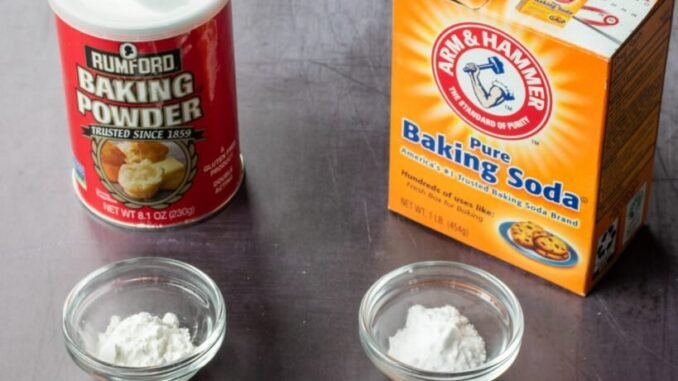
They sit side by side in the pantry, they both make things rise, and mixing them up can ruin a recipe — but baking soda and baking powder are not the same thing. Understanding the difference between baking soda and baking powder is one of those small knowledge upgrades that quietly fixes a whole category of baking failures: the flat cookies, the soapy-tasting cake, the muffins that rose and then collapsed. Here’s the chemistry, translated into practical rules.
What Each One Actually Is
- Baking soda = pure sodium bicarbonate. It’s a base — it does nothing until it meets an acid (buttermilk, vinegar, lemon juice, brown sugar, cocoa, yogurt, honey), at which point it produces carbon dioxide bubbles immediately. Single-acting, fast, powerful.
- Baking powder = baking soda plus powdered acid(s) and a starch filler. It’s complete in itself — just add liquid. Modern “double-acting” baking powder releases some gas when wet and more when heated, giving two waves of lift.
In short: baking soda needs an acid partner; baking powder brings its own. That’s the entire difference, and every rule below flows from it.
When Recipes Use Each
- Baking soda: recipes with acidic ingredients — buttermilk pancakes, chocolate cake with natural cocoa, banana bread, gingerbread (molasses is acidic). The soda neutralizes the acid (improving flavor and browning) while producing lift.
- Baking powder: recipes without significant acid — vanilla cakes with regular milk, biscuits, scones, most muffins. The built-in acid does the job.
- Both together: very common — the soda handles the acid present (and boosts browning), while the powder provides reliable extra lift. Chocolate cakes, many cookies, and pancakes often use both.
Can You Substitute One for the Other?
- Baking powder for baking soda: use 3x the amount (1 tsp soda → 3 tsp powder). Works in a pinch, but the extra acid in the powder can add a slightly tangy/metallic taste in large quantities.
- Baking soda for baking powder: use 1/3 the amount (1 tbsp powder → 1 tsp soda) PLUS add acid — for every teaspoon of soda, the recipe needs roughly 1 cup of acidic ingredient (buttermilk instead of milk, or 1 tsp lemon juice/vinegar added). Without added acid, you’ll get soapy, metallic-tasting baked goods with yellowish color. This substitution requires adjusting the recipe — it’s not a straight swap.
- The real answer: they’re $3–$4 each and last 6–12 months. Just own both. The substitution math exists for emergencies, not as a lifestyle.
What Is the Difference Between Baking Soda and Baking Powder? Freshness Matters
Both lose potency — dead leavening is the #1 cause of flat baked goods:
- Test baking soda: drop 1/2 teaspoon in vinegar — vigorous fizzing = alive.
- Test baking powder: drop 1/2 teaspoon in hot water — vigorous bubbling = alive.
- Shelf life: 6 months once opened (manufacturers say 6–12; 6 is the honest number for reliable lift). Write the open date on the box with a marker.
- Storage: cool, dry place — not above the stove (heat + humidity kill it). The fridge is fine for baking soda (it also absorbs odors — the open-box-in-fridge trick is real, just don’t bake with that box).
Common Failures, Diagnosed
- Soapy/metallic taste: too much baking soda, or soda without enough acid. Measure carefully — level teaspoons, not heaping.
- Rose then collapsed: too much leavening overall — the structure couldn’t support the rise. Or the oven door was opened early (the temperature drop deflates).
- Dense and flat: dead leavening (test it), or acid + soda reacted before baking — get batters with baking soda into the oven promptly after mixing.
- Yellow spots / uneven color: baking soda not fully whisked into the flour — always sift or whisk dry ingredients thoroughly.
King Arthur Baking‘s ingredient guides confirm: the acid rule is the whole game. If your recipe has buttermilk, cocoa, or brown sugar, it probably needs soda; if it doesn’t, it probably needs powder; if it has both, now you know why. Two $4 boxes, tested twice a year, and an entire category of baking mysteries solved.
Baking Soda vs. Powder Mistakes to Avoid
- Using them interchangeably 1:1: they’re not equivalent — 1 tsp soda ≠ 1 tsp powder. Powder for soda: 3x the amount. Soda for powder: 1/3 the amount PLUS added acid. Straight 1:1 swaps ruin recipes.
- Using dead leavening: both lose potency — test every 6 months (soda in vinegar, powder in hot water — vigorous fizz/bubbles = alive). Dead leavening is the #1 cause of flat baked goods.
- Heaping instead of leveling: too much soda = soapy, metallic taste and yellow color. Level teaspoons — the difference between measured and heaped is the difference between delicious and chemical.
- Letting batters sit: baking soda reacts immediately with acid — batters with soda should hit the oven promptly. A 30-minute-rested pancake batter has spent its lift sitting on the counter.
Baking Soda vs. Powder FAQs
What’s the actual difference?
Baking soda = pure sodium bicarbonate (a base) — needs an acid partner (buttermilk, vinegar, brown sugar) to produce lift. Baking powder = soda plus built-in acids — just add liquid. Soda needs acid; powder brings its own. That’s the entire difference.
Can I use both in one recipe?
Yes — very common. The soda neutralizes the recipe’s acid (improving flavor and browning) while the powder provides reliable extra lift. Chocolate cakes, many cookies, and pancakes routinely use both — they’re complementary, not redundant.
How long do they last?
6 months once opened (the honest number for reliable lift; manufacturers claim 6–12). Write the open date on the box. Store cool and dry — not above the stove (heat + humidity kill potency). Test before important bakes.
Why did my cake taste soapy?
Too much baking soda — or soda without enough acid to neutralize it. Unreacted soda tastes soapy and metallic. Fix: measure level teaspoons, ensure the recipe has adequate acid for the soda quantity, and whisk dry ingredients thoroughly (pockets of pure soda = soapy spots).
Leave a Reply