
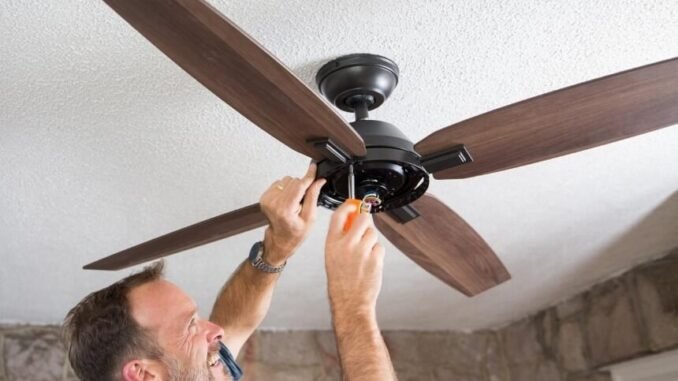
How much does it cost to install a ceiling fan? A professional installation runs $150–$500 in most US markets, with the national average hovering around $250–$350 for a straightforward replacement. DIY costs just the fan itself ($50–$300). But the real answer depends on what’s already in your ceiling — replacing an existing light fixture is a completely different job (and price) than installing a fan where no electrical box exists. Let’s sort it out.
Cost by Scenario
- Replacing an existing light fixture with a fan: $100–$250 labor. The wiring and box are there; the electrician swaps the box for a fan-rated one and hangs the fan. 1–2 hours of work.
- New installation where no fixture exists: $200–$500+. Requires running new wiring from the panel or an existing circuit, cutting drywall, and installing a fan-rated box. 2–4 hours, sometimes more.
- Replacing an existing fan with a new fan: $75–$150 — the easiest job, often DIY-able in under an hour.
- High or vaulted ceilings: add $100–$200 for the extra labor, scaffolding, and downrod extension.
The fan itself: budget fans $50–$100 (Hunter, Harbor Breeze at Home Depot — perfectly fine), mid-range $120–$250 (better motors, quieter, nicer finishes), premium $250–$500+ (Minka-Aire, Big Ass Fans Haiku — whisper-quiet DC motors, designer looks).
The Critical Safety Detail: Fan-Rated Boxes
This is the thing that matters most and that DIYers most often skip. A ceiling fan must mount to a fan-rated electrical box — marked “acceptable for fan support,” rated for 70+ lbs of dynamic load. A standard light-fixture box is rated for ~35 lbs of static load. A wobbling 30-pound fan on a light box can literally tear out of the ceiling.
Fan-rated boxes cost $10–$20 (retrofit brace boxes that expand between joists are brilliant — no attic access needed). If your installer doesn’t mention the box, ask. If they say the existing box is “probably fine,” get a different installer.
DIY: When It’s Safe and When It Isn’t
DIY-friendly: replacing an existing fan or light with a new fan, where a fan-rated box already exists. Turn off the breaker (not just the switch — verify with a $15 non-contact voltage tester), match wire colors (black to black, white to white, green/copper to ground), follow the manual. Under an hour.
Call an electrician:
- No existing electrical box in the ceiling
- You need a new switch leg or want separate fan/light switches
- Aluminum wiring (common in 1965–1975 homes — needs special handling)
- Anything involving the breaker panel
- You’re not 100% comfortable — $200 for an electrician beats a house fire
How Much Does It Cost to Install a Ceiling Fan? Getting It Right the First Time
- Sizing: up to 75 sq. ft. → 29–36″ fan; 76–144 sq. ft. → 36–44″; 144–225 sq. ft. → 44–50″; 225–400 sq. ft. → 50–60″+. Bigger rooms need bigger (or multiple) fans.
- Height: blades should hang 7–9 feet above the floor, at least 10 inches below the ceiling. Use downrods for high ceilings.
- Direction: counterclockwise in summer (downdraft cooling), clockwise on low in winter (pushes warm air down). The switch is on the motor housing.
- Energy math: a fan uses ~60 watts vs. ~3,500 for central AC. Running fans lets you set the thermostat 4°F higher with the same comfort, cutting cooling costs 15–30% per the Department of Energy.
Get 2–3 quotes from licensed electricians (check reviews, verify the fan-rated box is in the quote), and don’t let anyone talk you into the cheapest fan on the shelf — a wobbly $50 fan will annoy you daily for a decade, while a $150 Hunter hums quietly in the background of your life.
Ceiling Fan Mistakes to Avoid
- Mounting to a standard light box: a fan needs a fan-rated box (marked “acceptable for fan support,” 70+ lb dynamic rating). A wobbling fan on a light box can tear out of the ceiling — the most dangerous shortcut in this project.
- Wrong size for the room: a 36-inch fan in a 300 sq. ft. great room just stirs the air decoratively. Size up: 50–60″+ for rooms over 225 sq. ft. — or install two fans.
- Blades too close to the ceiling: hugger mounts in rooms with 9+ foot ceilings waste the fan’s potential — blades should hang 7–9 feet above the floor. Use a downrod ($15–$30) on high ceilings.
- Running the wrong direction: counterclockwise in summer (cooling downdraft), clockwise on low in winter (redistributes warm air). Half of all ceiling fans run the wrong direction year-round.
Ceiling Fan Installation FAQs
Can I install a ceiling fan myself?
Replacing an existing fixture: yes — turn off the breaker, verify with a voltage tester, match wire colors, mount to a fan-rated box. New wiring, no existing box, or aluminum wiring: hire an electrician ($150–$300). The box rating is the safety-critical detail.
How much does it cost to run a ceiling fan?
About $5–$15 per year in electricity (60 watts × typical use). Compare: central AC costs $300–$600 per cooling season. Fans let you set the thermostat 4°F higher with equal comfort — that’s the real savings.
Why does my fan wobble?
Unbalanced blades (use the included balancing kit — clip weights until it smooths out), loose mounting screws, or a bent blade bracket. Fix promptly — wobbling stresses the electrical box over time.
Do ceiling fans actually cool a room?
They cool people, not rooms — the breeze accelerates sweat evaporation (wind-chill effect). An empty room with a fan running wastes electricity (the motor actually adds slight heat). Turn fans off when you leave the room.
Smart Fans: Worth It?
Smart ceiling fans ($150–$350 — Hunter, Minka-Aire smart lines) add app/voice control, scheduling, and breeze modes that vary speed naturally. Worth it if: you want bedroom scheduling (fan ramps down as you fall asleep), voice control from bed, or integration with a smart thermostat (fan + AC coordination). Not worth it if you just need air movement — a $50 pull-chain fan moves the same air. The middle path: a $25–$40 smart wall switch or canopy module (Lutron, Hunter) that makes a dumb fan smart — all the convenience, none of the premium. Either way, the fan-rated box and correct sizing matter 10x more than connectivity.
Leave a Reply