
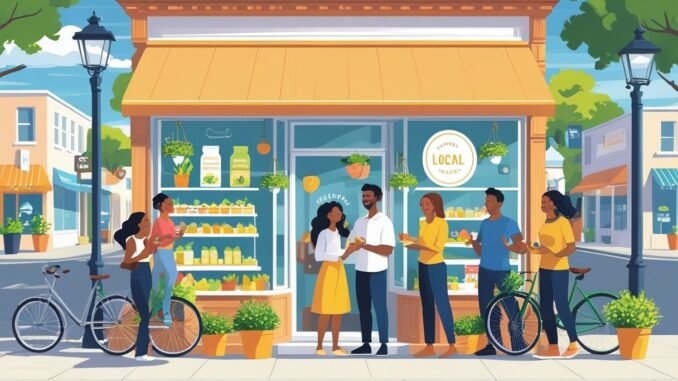
Learning how do I build a customer base for a new local business is the challenge that keeps new owners up at night. You have the skills, the location, the signage, and then… crickets. I have watched local businesses go from empty to booked-solid, and the pattern is consistent: the first 100 customers come from hustle and community, not advertising. Here is the playbook.
How Do I Build a Customer Base for a New Local Business? Phase 1: Foundation (Week 1-2)
- Claim your Google Business Profile and complete every field: hours, services, photos, description. This is your most important digital asset. Most local searches never go past Google’s map pack.
- Get listed everywhere free: Yelp, Bing Places, Apple Maps, Nextdoor, and industry directories. Consistent name/address/phone everywhere boosts search rankings.
- Build a simple website with your services, prices, location, hours, and an easy contact/booking method. One page done well beats five pages of fluff.
- Set up review collection before your first customer: a QR code linking to your Google review page, printed and ready. Reviews from day one compound fast.
- Define your irresistible opening offer: Not a desperate discount, but a genuine reason to try you first: “Free consultation,” “First visit 20% off,” “Founding member pricing.” Make the first yes easy.
Phase 2: First 100 Customers (Month 1-3) — The Hustle Phase
- Tell everyone you know. Personally. Not a mass post, individual messages: “I just opened X, would love your support.” Your network’s first visits and referrals are your launch fuel.
- Grand opening event. Even a modest one: refreshments, demonstrations, special pricing, a reason for foot traffic. Invite local micro-influencers and community Facebook group admins.
- Partner with neighboring businesses. Cross-promote with non-competing locals: flyers in their shops, joint offers, shared social posts. The coffee shop sends people to the bookstore and vice versa.
- Join community groups (online and off): neighborhood Facebook groups, Nextdoor, chamber of commerce, BNI chapters. Be helpful first, promotional second. Answer questions, show expertise, become known.
- Door-to-door introductions for hyperlocal services: introduce yourself to nearby homes/businesses with a flyer and a smile. Old-fashioned, remarkably effective.
- Ask every customer for reviews and referrals from customer number one. “Would you mind leaving us a Google review?” asked warmly at the right moment works astonishingly well.
Phase 3: Momentum (Month 3-12) — Systems That Scale
- Referral program: Formalize it. “Give $20, get $20” cards, digital referral links, or simple tracking. Referred customers are your cheapest and most loyal.
- Email/SMS list: Collect contact info at every transaction (with permission). Monthly updates with offers and news keep you top-of-mind. A list of 500 locals beats 5,000 followers.
- Consistent social content: Before-and-afters, customer stories, behind-the-scenes, staff spotlights. Post 3-4x weekly. Local content gets shared locally, which is exactly the audience you want.
- Community presence: Sponsor a youth team, participate in street fairs, host small events. Visibility builds familiarity; familiarity builds trust; trust builds customers.
- Loyalty program: Simple punch cards or digital equivalents. Rewarding repeat visits increases lifetime value dramatically.
- Targeted local ads: Once organic engines run, add $10-$20/day in hyperlocal Facebook/Google ads to accelerate. Never lead with ads; amplify what already works.
The Math of Customer Acquisition
- Know your numbers: Customer acquisition cost (CAC) and customer lifetime value (LTV). If a customer is worth $500 over two years, spending $50 to acquire them is excellent business.
- Retention beats acquisition: Increasing retention 5% can boost profits 25-95% (Bain research). A follow-up text, a birthday discount, remembering names, small touches create regulars.
- The 80/20 rule: Your best 20% of customers drive 80% of revenue. Identify them, thank them, reward them, and ask who they know.
Mistakes That Stall Growth
- Inconsistent hours or quality. Nothing kills a new business faster than a customer showing up to a closed door or a bad experience. Reliability is marketing.
- Ignoring reviews. Respond to every review, especially negative ones, professionally and promptly. Your responses are marketing to future readers.
- Trying to appeal to everyone. “We serve everyone” means no one feels it is for them. Be specific about who you serve best.
- No follow-up system. Most sales happen in the follow-up. One quote request ignored is money left on the table.
- Competing on price alone. There is always someone cheaper. Compete on experience, reliability, and relationship.
The Bottom Line
Build a local customer base in phases: foundation (Google profile, listings, website, review system, opening offer), hustle (network, grand opening, partnerships, community presence, relentless review/referral asks) for the first 100, then systems (referral program, email list, consistent content, loyalty, targeted ads) for scale. Know your acquisition cost and lifetime value, obsess over retention, respond to every review, and never compete on price alone. The first 100 customers take hustle; the next 1,000 take systems.
Frequently Asked Questions
How long does it take to build a customer base from zero?
Realistic timeline: first 10 customers in month one through personal network, 50-100 by month three with consistent hustle, and self-sustaining momentum around month 6-12 as referrals and reviews compound. Businesses expecting hundreds of customers in week one are set up for disappointment. The curve is slow then sudden; most quit during the slow part.
What is the cheapest way to get my first customers?
Your personal network (free), Google Business Profile with review requests (free), community groups and partnerships (free), and a grand opening event (under $200). Paid advertising before you have social proof and a refined offer wastes money; the first 100 customers should cost almost nothing but effort. Spend time, not money, until the offer is proven. Free planning help is available through the SBA’s local marketing resources.
How important are online reviews for a local business?
Decisive. The vast majority of consumers read reviews before visiting a local business, and review count and rating directly affect Google Maps rankings. A business with 100+ reviews at 4.5+ stars has a structural advantage competitors cannot quickly replicate. Systematic review collection from day one is the highest-ROI marketing activity for local businesses, period.
Should I offer discounts to attract first customers?
Strategic opening offers yes, permanent discounting no. A founding-member rate or first-visit special lowers the trial barrier without training customers to expect deals. Avoid deep ongoing discounts; they attract price-sensitive customers who leave when prices normalize and erode the perceived value of your full-price offering. Discount the first visit, deliver excellence, earn the second at full price.
Leave a Reply