
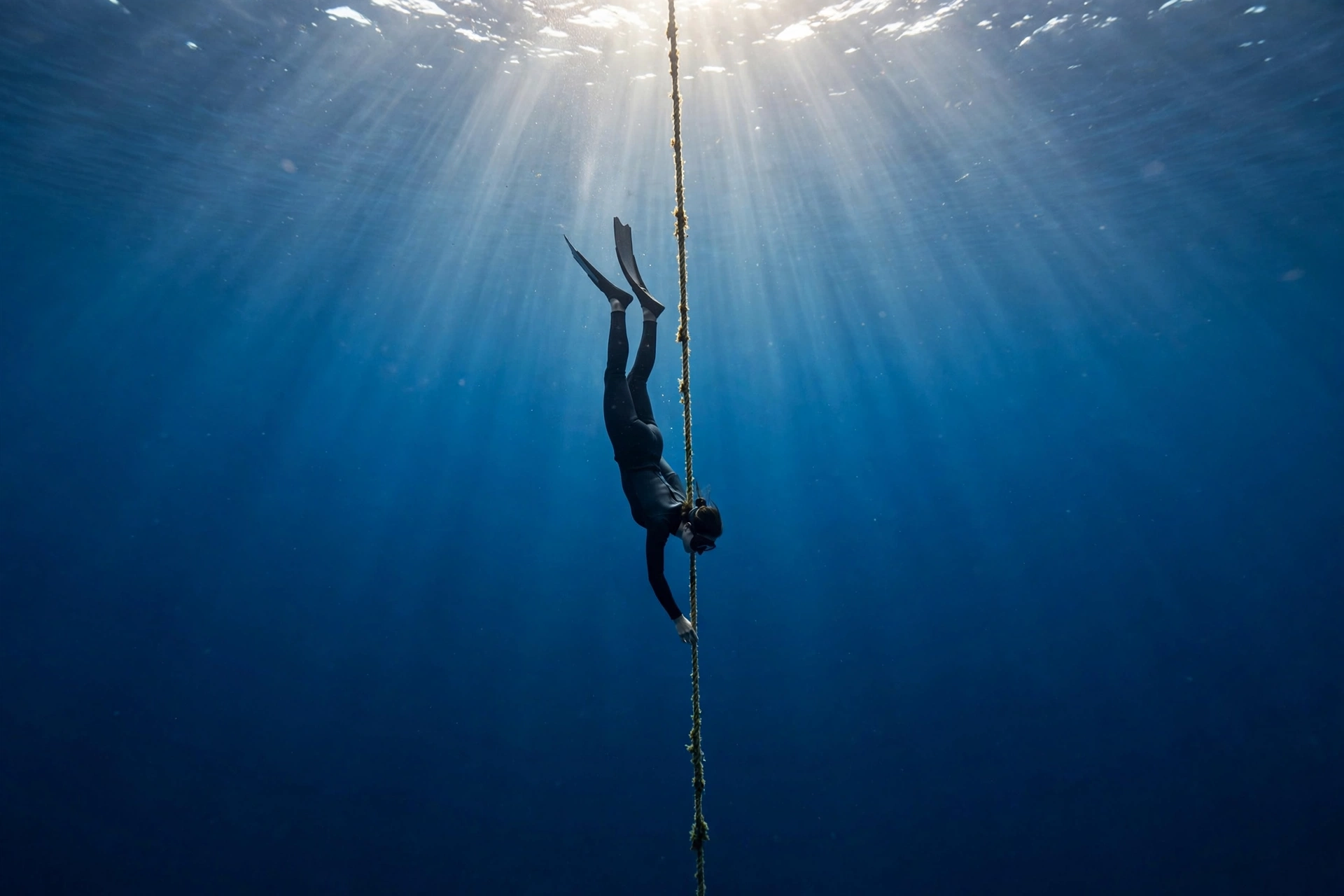
Freediving, diving underwater on a single breath, is one of the most peaceful sports you can try. There is no noisy scuba gear, no bubbles, just you, your breath, and the blue. The question every new freediver asks is the same: how to free dive deeper for beginners without pushing too far or getting hurt.
The honest answer is that depth comes from technique and relaxation, not from forcing it. This guide covers the safety rules, the equalization methods, the breathing habits, and the training routine that take beginners from a few meters down to comfortable dives of 10 to 20 meters. Read the safety section first. Everything else builds on it.
Safety First: The Rules That Keep You Alive
Freediving has real risks, and the main one is shallow water blackout: fainting underwater from low oxygen, usually near the surface at the end of a dive. It is silent and gives no warning. That is why the number one rule of the sport of freediving is simple:
- Never dive alone. Always dive with a trained buddy who watches you from the surface and can reach you within seconds.
- Take a beginner course. Agencies like AIDA, SSI, and PADI Freediver teach rescue skills, proper breathing, and equalization in a single weekend. This is the single best investment a new freediver can make.
- Never hyperventilate. Taking lots of fast, deep breaths before a dive feels like it helps, but it lowers your carbon dioxide without adding much oxygen. CO2 is what triggers your urge to breathe, so suppressing it removes your warning signal while your oxygen still drops. The result can be blackout with no urge to breathe first.
- Dive a line or with a float. A weighted line with depth markings gives you something to follow down and pull yourself back up on, and a surface float makes you visible to boats.
- Know your limits and respect them. If equalization hurts, stop the descent. If you feel the urge to breathe strongly, start your ascent. Depth records are for later; coming home is the goal.
- how to snorkel with glasses or contacts
How Depth Actually Works
Water pressure increases by about one atmosphere for every 10 meters you descend. That pressure squeezes the air spaces in your body, mainly your lungs, sinuses, and middle ears. Your lungs shrink, which is fine within recreational limits, but your ears need active equalization: adding air to the middle ear to match the outside pressure.
Most beginners can comfortably reach 5 to 8 meters once they learn to equalize. Getting to 10 to 20 meters is mostly about doing the same things more smoothly. Beyond that, technique refinements and training matter more. Depth is a byproduct of good habits, not a goal to chase directly.
Equalization: The Skill That Unlocks Depth
Equalization is the number one barrier for beginners. If your ears will not clear, you cannot go deeper, full stop. There are two main techniques:
Valsalva (Beginner Method)
Pinch your nose and gently blow against it. You have probably done this on an airplane. It works down to about 10 meters for most people, but it uses chest and abdominal pressure, which tenses your body and wastes oxygen. It is fine for starting out, but it becomes a ceiling.
Frenzel (The Technique to Learn)
The Frenzel equalization technique uses your tongue as a piston to push air into the middle ears. Pinch your nose, close the back of your throat, and make a “K” or “guh” movement with your tongue. It is gentler, faster, and works at any depth because it does not depend on lung pressure. Every serious freediver uses Frenzel or a variant of it.
Practice Frenzel on dry land first: pinch your nose and try to make your ears click using only your tongue and throat. Do it while sitting at your desk, in the car, anywhere. Once you can click your ears on command without straining your belly, take it to the pool. Equalize early and often during descent, before you feel pressure, not after it hurts.
Breathing and Relaxation: Your Real Engine
Beginners obsess over lung capacity. Experienced freedivers obsess over relaxation. A calm body uses far less oxygen than a tense one, and calm comes from your breathing routine before the dive, called the breathe-up.
- Breathe slowly for two to three minutes before diving: inhale for about 4 seconds, exhale for about 8. Long exhales activate your parasympathetic nervous system and slow your heart rate.
- Take one final full breath, filling from belly to chest, but do not pack your lungs to bursting. About 80 to 90 percent of a maximum inhale is plenty.
- Relax your face, jaw, and shoulders as you start the descent. Tension anywhere burns oxygen.
- Move slowly. Fast finning feels productive but floods your muscles with CO2. Smooth, unhurried kicks use a fraction of the oxygen.
As CO2 builds during the dive, your diaphragm will start to contract involuntarily. These contractions are uncomfortable but normal and not dangerous by themselves; they are your body asking for air. With training, you learn to stay calm through them instead of panicking.
Body Position and Finning Technique
Good form saves enormous amounts of energy. The basics:
- The duck dive. Bend at the waist, lift your legs so your body weight pushes you down, and let your fins follow. A clean duck dive gets you to 3 to 5 meters with almost no kicking.
- Streamline. Keep your arms at your sides or one hand on the line. Every limb sticking out creates drag.
- Kick from the hips, not the knees. Long, slow fin strokes with relatively straight legs are efficient. Bicycle-kicking from the knees wastes energy and goes nowhere.
- Learn the freefall. Around 10 to 15 meters, your wetsuit compresses and you become negatively buoyant. Stop kicking and let yourself sink. Freefalling is the most relaxing part of a dive and a major milestone for beginners.
A Beginner Training Plan for Building Depth
Train two to three times a week, mixing water and dry sessions. Progress in small steps, adding no more than a couple of meters at a time.
Pool Sessions (Technique)
In the pool, practice dynamic swims: horizontal underwater swims on one breath to build comfort and CO2 tolerance. Practice Frenzel equalization hanging vertically in the deep end. Work on your duck dive and streamlining where a coach or buddy can watch your form.
Open Water Sessions (Depth)
Dive a marked line with a buddy. Warm up with easy dives to half your target depth. Then do a few dives to your target, focusing on one thing at a time: early equalization, slow finning, or a clean freefall. End the session while you still feel good, not when you are exhausted.
Dry Training
You can train breath-hold at home with CO2 tables: repeated breath-holds with shrinking rest periods, done lying down and never in water or while driving. Static apnea practice builds mental comfort with the urge to breathe, which transfers directly to deeper dives. Stop immediately if you feel dizzy or unwell.
Flexibility Work
Chest and diaphragm stretching helps your lungs expand fully on the final breath and makes equalization easier. Simple daily stretching of the ribcage and diaphragm pays off within weeks.
Common Beginner Mistakes That Stall Your Depth
- Equalizing too late. Waiting until your ears hurt means the pressure difference is already large. Equalize on the surface before you duck dive, then every meter or so on the way down.
- Kicking too hard. New divers sprint downward and arrive at depth already out of breath. Slow down; the bottom is not going anywhere.
- Looking around. Lifting your head to look breaks your streamline and tenses your neck. Tuck your chin and look slightly down.
- Diving cold or tired. Fatigue and cold water spike your heart rate and oxygen use. Warm up, rest between dives, and wear enough wetsuit.
- Chasing numbers. Announcing a target depth creates pressure to reach it even when your body says no. Dive to how you feel, not to a number.
Basic Gear for Deeper Beginner Dives
You do not need much, but the right gear helps:
- Low-volume mask. Less air space means less air wasted equalizing the mask.
- Long-blade fins. Freediving fins are longer and softer than snorkeling fins, giving more thrust per kick.
- Wetsuit. Even warm water cools you over a long session. A 3mm suit suits most tropical and summer diving.
- Weight belt. A couple of kilos to offset wetsuit buoyancy, worn so you are positively buoyant at the surface. Never overweight yourself.
- Snorkel. Useful on the surface between dives, but remove it from your mouth before duck diving so water does not flood in.
How Deep Can a Beginner Realistically Go?
With a weekend beginner course and a few weeks of practice, most people comfortably dive to 10 meters. Within a few months of regular training, 15 to 20 meters is realistic for a relaxed diver with solid Frenzel technique. Competitive freedivers go far deeper, but that requires years of structured training and is a different sport from recreational freediving.
The milestone that matters is not a number. It is the dive where you descend slowly, equalize without thinking, freefall for a few meters, and surface feeling calm. When you can do that repeatedly, depth takes care of itself.
You May Also Like
- How Do I Get Started Playing Padel? — if you want a social racket sport to balance your solo water time, padel is easy to pick up.
- How Much Is a Nickel Worth? — a fun piece of money trivia for surface intervals.
- How Many Trans People Are in the US? — the factual story behind a widely quoted statistic.
Like freediving, many great hobbies reward patience over force. If dry-land sports are more your speed, check out our beginner guide on getting started with padel. And if you enjoy learning how everyday things work, you might like our look at how much a nickel is actually worth or the data behind how many transgender people live in the US. Dive safe, dive with a buddy, and enjoy the quiet down there.
Leave a Reply