
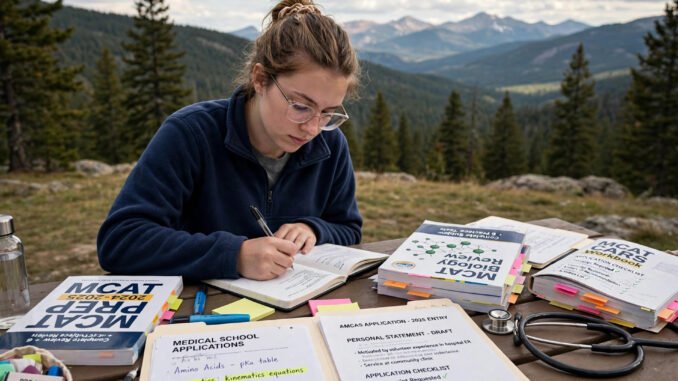
Medical school admissions punishes late starters in a way few other paths do. The application opens in late spring for entry the following fall, so the work stretches across a 15-month runway before a student even steps onto campus. When to start is not a small detail. It is the whole game. Start with enough time and each piece can be done well. Start late and strong students end up rushing the test, begging for letters, and sending a thin file that does not show what they can do.
The phases below run in order, from foundation work nearly two years out to submission day and the wait that follows. Costs are laid out with current fees, stated with their source, so you can budget with real numbers. Everything here is general information about a competitive process, never a promise of admission. Use the timeline to judge honestly whether this cycle is yours, or whether a stronger file next cycle serves you better.
Phase 1: 18 to 24 Months Before Matriculation — Build the Foundation
The foundation phase feels quiet, and that is why students underrate it. Two years before entry, your job is to plan prerequisite courses and earn strong grades in them, in a sequence that leaves no last-term scramble. Map the required science courses with your adviser, spread the hardest loads across terms you can handle, and protect your grades by refusing a schedule built to impress rather than to pass well.
Start clinical exposure in this phase too. Shadowing doctors and volunteering in care settings shows you what medicine actually is on an ordinary Tuesday: long hours, hard conversations, paperwork, teamwork, and patients whose lives do not pause for your plans. Committees can tell the difference between a student who has stood in those rooms and one who loves the idea of medicine from a distance. Begin early so your exposure is steady and real, not a frantic burst before you apply.
Use these months to build honest relationships with the teachers who will one day write your letters. Go to office hours. Ask good questions. Do careful work in class and in labs. A strong letter grows out of months of contact, not a polite email from a stranger in May. Keep notes on projects, cases, and moments that shaped your thinking. You will thank yourself when you draft your personal statement.
Before you go further, ground yourself in how medical school in the United States is structured, from pre-clinical study through clinical rotations and residency matching. Knowing the full path helps you speak about your goals with sense and keeps surprises down the road from rattling you now.
Phase 2: 12 to 15 Months Before — Face the MCAT With Time to Spare
Take the MCAT by April or May of the application year at the latest. That date leaves one retake buffer if the first score falls short, and it lets your score sit ready when applications open. A summer test date with no room to recover turns one bad day into a lost cycle.
Serious preparation runs about 3 to 6 months for most students. The 300 to 500 study hours range is the commonly cited range for that work, so plan backward from your test date and guard study blocks the way you guard class time. Short daily study over months usually holds up better than heroic weekends followed by burnout. Practice tests under timed conditions matter as much as content review, because pacing and stamina are part of the test.
Before you set your study plan, review what the MCAT covers and how it is scored so you know the sections, the skills each one tests, and how schools will read your result. That clarity helps you split your hours with care instead of studying only the topics you already like.
Budget for this phase with current numbers. The AAMC’s current standard fee puts MCAT registration at $355. Prep materials and courses run anywhere from about $200 to $2,500 depending on route, from used books and free practice to a full course. A high price does not guarantee a high score. Steady hours, honest practice scores, and review of every missed question matter more than the brand on the box.
Phase 3: 9 to 12 Months Before — Build the Application Itself
With the test underway or done, shift to the file schools will actually read. Draft your personal statement early and redraft it more than once. The first version will try to say everything. Later versions should say one true thing well: why medicine, shown through experience, with reflection that proves you have thought hard about the work and its costs. Give drafts to readers who will be blunt, and leave days between rounds so you can see weak lines with fresh eyes.
Request letters while there is still time to be gracious about it. Ask each writer whether they can write a strong letter, give them your resume and draft statement, and state the deadline plainly. Then track confirmations. A missing letter can hold an otherwise complete file hostage, and polite early requests prevent that quiet disaster.
Phase 4: June — Submit Early, Then Wait With a Plan
AMCAS opens in May, with submission following a few weeks later. Treat the earliest submission window as your true deadline. Under rolling admissions, early, complete applications are read first, while seats are still plentiful. A file sent late competes for what is left, no matter how strong it is.
Secondaries arrive after the primary, often in waves, and they carry their own essays and fees. Return each secondary within about two weeks as the working target. Faster is better when the writing stays careful. Pre-draft answers to common prompts — a challenge you faced, your ties to a region, why that school — so the wave does not bury you. Keep a tracker for logins, deadlines, and fees paid.
The Real Cost of Applying in the 2026-27 Cycle
Start with the test costs already noted. MCAT registration is $355, as set by the AAMC for the current cycle, plus prep at about $200 to $2,500 by route. Next comes the primary application. AMCAS charges $180 for the first school and $48 for each additional school in the current cycle. Run the math on common list sizes. Fifteen schools comes to $852. Twenty schools comes to $1,092. Across the usual range of 15 to 25 schools, the primary alone runs about $850 to $1,330.
Secondaries add the next layer. Schools charge about $50 to $150 per school for secondary applications. At 20 schools, that adds roughly $1,000 to $3,000. The spread is wide because fees differ by school, which is one more reason to build a list you can afford to complete, not just to start.
Interviews add travel where they are held in person, at about $200 to $500 a trip for transport, lodging, and food. Virtual options are now common and can cut that cost sharply, so take them when a school offers them without penalty. Add small costs too: transcript fees, a suit that fits, and time off work. Put together, a total realistic budget for one cycle is about $3,000 to $8,000. Save toward that figure during the foundation phase, not the month before you submit.
Apply Now or Wait a Year: The Reapplicant Warning
Every spring, students with shaky files ask whether to push ahead anyway. Hear this warning without softening it. A rushed, weak application that fails does not just waste the fees. It makes you a reapplicant, and reapplicants must show what changed. Schools can see that you applied before. A second file that looks much like the first, with no clear growth in grades, scores, experience, or reflection, reads worse than a strong first file sent a year later.
A gap year that genuinely strengthens the file is usually cheaper than a failed cycle. Use the year to retake a weak test with full preparation, repair grades where a program allows it, gain deeper clinical experience, and return with a story of change you can prove. Waiting is not losing. Waiting with a plan is often the move that gets a student admitted.
Apply this cycle if your record is ready: grades and score in a competitive range for your list, real clinical exposure, strong letters lined up, and a statement you would defend line by line. Wait if two or more of those legs wobble. Honesty here protects both your money and your future chances.
What Committees Actually Want to See
Committees want evidence of genuine engagement with the realities of medicine, over box-checking volume. As an example pattern of the failure mode, picture a file padded with 500 hours of box-checking volunteering and no reflection on any of it. That figure is an illustration of a pattern, not a measure of any real applicant. The pattern fails because hours alone prove only attendance. Schools want to know what you saw, what it taught you, and how it changed the way you think about caring for patients.
Reflection is the difference. A student with fewer hours who can speak with care about a patient encounter, a hard shift, or a moment of doubt reads as more ready than a student with a long list and nothing to say. Service, shadowing, research, and work all count more when you can connect them to the doctor you hope to become.
Genuine engagement also means knowing where the profession is heading. Medicine is changing fast in tools and teamwork, and students who follow those changes speak about their future with more sense. Reading about how AI is changing the way doctors diagnose patients is one way to think past the exam room of the past and toward the practice you will actually join. You do not need expert views. You need curiosity backed by reading and thought.
School List Strategy: Start With Your State
Build your list around fit and odds, not fame. In-state public schools are usually a resident’s best odds, since they reserve seats for residents and know the communities their graduates will serve. They also cost far less. As typical recent ranges that vary by school, in-state public tuition runs roughly $30,000 to $45,000 a year, against $60,000 to $70,000 or more for private tuition. Across four years, that gap shapes debt for a decade.
Keep the list affordable to complete. A list of 15 to 25 schools, fully finished with secondaries sent on time, beats a longer list abandoned halfway for lack of funds or hours. Your goal is not the most applications. It is the strongest set of complete files, sent early, to schools you would gladly attend.
Leave a Reply